


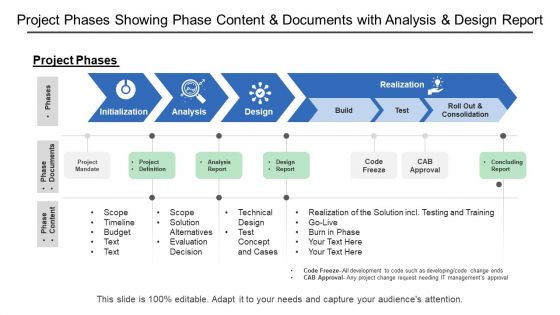
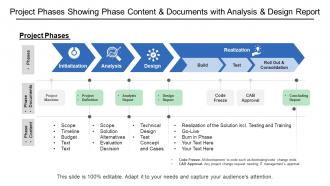
Project phases showing phase content and documents with analysis and design report





Try Before you Buy Download Free Sample Product
 Impress Your
 Audience
 100%
100% Editable
 Save Hours
 of Time


Chart out their development with our Project Phases Showing Phase Content And Documents With Analysis And Design Report. Communicate the great benefits that are bound to accrue.
People who downloaded this PowerPoint presentation also viewed the following :
Project phases showing phase content and documents with analysis and design report with all 5 slides:
Give your brilliant ideas the appropriate backdrop with our Project Phases Showing Phase Content And Documents With Analysis And Design Report. You will acquire the ideal balance.

FAQs for Project phases showing phase content and documents with analysis
Okay so each phase has different stuff you need to deliver. Start with initiation - that's your project charter and stakeholder register. Planning gets crazy busy with scope statements, WBS, schedules, budgets, risk registers, the whole nine yards. During execution you're cranking out actual deliverables plus those weekly status reports nobody reads but everyone wants. Monitoring happens alongside everything else - performance reports and change requests mostly. Closing wraps up with lessons learned docs and final reports. Honestly, just figure out what people expect upfront and map it all out. Trust me, you don't want to be that person frantically asking "wait, what docs do I actually need?" two weeks before deadline.
Honestly, just pick your communication tools and actually stick with them from the start. Weekly check-ins are clutch - don't skip these even when you're swamped. Make sure everyone knows who handles what because that confusion thing gets messy fast. I'm a big fan of Slack for quick stuff, but document the big decisions somewhere permanent. Oh, and push updates out before people start asking - like, when stuff goes wrong, tell them immediately. Nobody likes surprises. Write up a basic communication plan early on and follow it religiously.
Dude, you HAVE to do stakeholder analysis right at the start. Map out who's got power and who gives a damn about your project. Figure out the politics early - like who could torpedo everything versus who'll have your back. I've watched projects completely blow up because someone ignored a key person who felt left out. Super avoidable mistake. List everyone who might be affected or could mess with your timeline. Then rank them by how much influence they actually have. This way you won't get blindsided later when some random director suddenly cares about your project.
Start by breaking everything down into tiny tasks - that's honestly the only way to get decent estimates. When I try to guess big chunks, I always miss something obvious like testing time or code reviews. Ask whoever's actually doing the work what they think too, because they'll catch stuff you won't. Historical data helps a lot if you have it from similar projects. Always add buffer time though - dependencies are sneaky and something random will definitely go wrong. Oh, and write down what you're assuming! When things change (they will), you'll need those notes to adjust. Better to be conservative upfront than scrambling later.
Gantt charts are your best friend for seeing timelines and what depends on what. Kanban boards show work moving through stages - super helpful. I'd go with Asana, Monday, or Trello (honestly all three work fine, just pick whatever clicks with your team). Don't forget regular check-ins and progress reports too - sometimes stuff falls through the cracks otherwise. Oh and here's the thing - start with just ONE main tool. I've seen people try to track everything in five different places and it becomes a nightmare.
Honestly, scope creep is gonna be your biggest headache - along with going over budget and missing deadlines. Set up change control processes that actually have teeth, otherwise people will keep adding "just one more thing." Weekly schedule checks and regular budget reviews are non-negotiable. Communication falling apart kills projects faster than anything else, so send consistent updates even when you feel like you're being annoying. Catch problems early with monitoring instead of scrambling later. Oh, and set up alerts for budget limits and milestone delays - way better than manually checking everything constantly.
Honestly, project closure stuff is like investing in your future self - sounds boring but it's actually clutch. Document what went wrong and what didn't, save your materials somewhere you can find them later. I know teams are usually burned out by this point (been there), but those reports become lifesavers for the next project. You'll dodge the same dumb mistakes and steal the good ideas that worked. Even a basic one-page template helps capture the important bits. Trust me, future you will thank present you when you're not reinventing the wheel every single time.
Honestly, I'd start with stakeholder interviews - you'll get the real scoop from people who actually matter. Surveys are solid for bigger groups, and workshops can be amazing if you can somehow get everyone's calendars to align (which, let's be real, is its own nightmare). Document analysis is clutch when you're working with existing stuff. Focus groups sometimes reveal things people didn't even realize they needed. Oh, and don't try doing everything at once - interview your key stakeholders first, then use the other methods to double-check and fill holes.
Honestly, dig into your old project docs and retrospectives before you start planning anything new. Those patterns you'll find are gold - like how your team always runs over on testing or that one supplier who's chronically late (ugh, vendors). Short-term pain, long-term gain though. Build those insights right into your timeline from day one instead of just writing them down at the end and shoving them in a drawer. I've seen too many teams make the same mistakes over and over because they don't actually use what they learned. Make it part of your actual process.
Honestly, I'd focus on just 3-5 metrics that actually matter to your stakeholders - don't overwhelm yourself. SPI and CPI are your go-to numbers for tracking if you're on schedule and budget. Earned Value Management sounds scary but it's actually pretty helpful once you get the hang of it. Keep an eye on scope creep too, that stuff sneaks up on you fast. Quality defects matter obviously, and if you're doing agile work then team velocity is key. Oh, and don't forget to update your risk register - I know it's boring but it'll save your butt later. Build a simple dashboard around whatever metrics you pick.
So during initiation, collaboration is pretty loose - you're just getting everyone on the same page about goals and scope. Planning is where things get interesting though, that's when your team really dives deep together, figuring out who does what and how everything flows. Execution gets more structured with regular check-ins and problem solving sessions. Monitoring keeps everyone coordinated through dashboards and meetings. Here's the thing - closure is where most teams completely blow it. You'll want to actually schedule that retrospective instead of just letting the project fade away. That's where you capture all the good stuff you learned.
Ugh, scope creep is the worst! First thing - create a formal change process and actually use it. Every request needs approval with clear impact on timeline/budget. I learned this the hard way when "small tweaks" turned into a total nightmare. Track everything in a shared log so you can show people the real patterns. Sprint reviews are clutch for catching drift early. Honestly, you've got to get comfortable saying no to non-essential stuff. Document boundaries upfront and don't feel bad about pushing back - your sanity depends on it!
Look, you can't just have one kickoff meeting and call it good. Map out who needs what info and when, then set up regular touchpoints - weekly updates, milestone check-ins, whatever works. I've watched so many projects crash because people felt totally out of the loop. Make it two-way though - ask for feedback and actually listen to it. Your exec sponsor needs different details than your tech team, so don't blast everyone the same updates. Honestly, if you make it easy for people to stay plugged in, they'll do it. Otherwise they'll just tune out.
Okay so the project charter is basically your project's birth certificate - it officially gives you permission to exist and start using resources. Without one, you're just some person with ideas but zero authority to actually do anything (trust me on this one). It spells out your project's purpose, rough scope, who matters, and what success looks like. Really helps keep everyone on the same page about what you're building. Get your key people to sign off before you dive in - seriously saves you from all that scope creep nonsense later when people suddenly want to add seventeen new features.
So when change requests come up during monitoring - and they will - you gotta follow your formal change control process. Document everything first. Then assess how it'll impact scope, timeline, and budget before getting approval from your change control board or stakeholders. You literally can't say yes to everything (learned that one the hard way!). Track each request in your change log and communicate decisions clearly to everyone affected. Oh, and update your project docs accordingly. Capture lessons learned too - honestly helps you spot patterns and gets better at managing changes next time around.
-
It saves your time and decrease your efforts in half.
-
Unique research projects to present in meeting.