


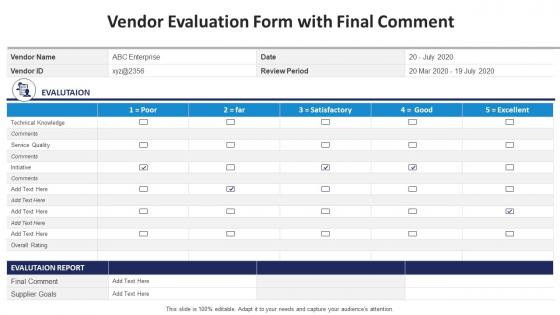
Vendor Evaluation Form With Final Comment Procurement Templates Bundle




Try Before you Buy Download Free Sample Product
 Impress Your
 Audience
 100%
100% Editable
 Save Hours
 of Time


Our Vendor Evaluation Form With Final Comment Procurement Templates Bundle are topically designed to provide an attractive backdrop to any subject. Use them to look like a presentation pro.
People who downloaded this PowerPoint presentation also viewed the following :
Vendor Evaluation Form With Final Comment Procurement Templates Bundle with all 6 slides:
Use our Vendor Evaluation Form With Final Comment Procurement Templates Bundle to effectively help you save your valuable time. They are readymade to fit into any presentation structure.





FAQs for Vendor Evaluation Form With Final Comment
A comprehensive vendor evaluation form should include financial stability, technical capabilities, service quality metrics, compliance certifications, pricing structure, and implementation timelines. These criteria enable organizations to assess vendors across critical dimensions like cost-effectiveness, reliability, and scalability, with many companies finding that structured evaluation processes ultimately deliver better partnerships and reduced procurement risks.
Scoring systems can be effectively implemented by establishing weighted criteria based on business priorities, using standardized numerical scales across all vendors, and incorporating multiple evaluator perspectives to minimize bias. Through automated scoring platforms, organizations streamline assessments, enhance transparency in vendor comparisons, and accelerate decision-making processes, ultimately delivering more objective vendor selections and stronger strategic partnerships.
Vendor history and reputation serve as critical predictors of future performance, reliability, and partnership quality, helping organizations assess risk levels, delivery consistency, and long-term viability. These factors enable businesses to evaluate past client relationships, project success rates, and market standing, with many companies finding that established vendors with strong reputations deliver enhanced stability and reduced operational disruptions.
Organizations can evaluate vendor compliance through comprehensive audits, regulatory certifications review, third-party assessments, ongoing monitoring systems, and detailed compliance documentation requests. Financial services firms and healthcare organizations increasingly use automated compliance tracking tools, regular site inspections, and contractual compliance clauses, ultimately ensuring regulatory adherence while minimizing risk exposure and maintaining operational integrity.
Factors influencing vendor financial stability include cash flow consistency, debt-to-equity ratios, profit margins, revenue growth trends, and credit ratings. Financial institutions and procurement teams assess these metrics through audited statements, market performance data, and third-party financial assessments, ultimately ensuring vendor reliability and minimizing supply chain disruptions across partnerships.
A vendor's customer service reputation is critically important in overall assessment, often determining long-term partnership success beyond initial cost considerations. Strong customer service directly impacts operational continuity, issue resolution speed, and relationship sustainability, with many organizations finding that responsive support significantly reduces downtime, enhances project outcomes, and ultimately delivers greater value than lower-cost alternatives with poor service records.
Key metrics for evaluating vendor quality include product reliability rates, service level agreement compliance, defect rates, customer satisfaction scores, and response times for support issues. These measurements enable organizations to assess performance consistency, with many companies in manufacturing, healthcare, and financial services finding that tracking delivery accuracy, quality certifications, and resolution times ultimately delivers better vendor partnerships and operational efficiency.
Organizations ensure unbiased vendor evaluation forms by standardizing criteria, using quantifiable metrics, implementing blind evaluation processes, and incorporating multiple evaluator perspectives. These approaches minimize personal preferences and subjective judgments through structured scoring systems, diverse evaluation teams, and clear performance benchmarks, with many procurement departments finding that anonymous feedback mechanisms and rotating evaluators ultimately deliver more objective vendor assessments.
Questions to assess vendor innovation and adaptability include asking about their R&D investments, recent product developments, technology roadmap updates, change management processes, and response times to market shifts. These inquiries help evaluate how vendors embrace emerging technologies, adapt to evolving business needs, and maintain competitive positioning, with many organizations finding that innovative vendors ultimately deliver enhanced scalability and long-term strategic value.
A vendor evaluation form can address sustainability practices by incorporating criteria for environmental certifications, waste reduction programs, energy efficiency measures, sustainable sourcing policies, and carbon footprint assessments. Through comprehensive sustainability scoring, organizations streamline vendor selection while meeting corporate responsibility goals, with many companies finding that sustainable vendors ultimately deliver cost savings, enhanced brand reputation, and stronger stakeholder relationships.
Methodologies for collecting qualitative vendor performance feedback include structured interviews, focus groups, case study analysis, observational assessments, and stakeholder surveys with open-ended questions. These approaches enable organizations to gather nuanced insights beyond metrics, with many procurement teams finding that combining multiple methodologies delivers comprehensive vendor evaluations and stronger strategic partnerships.
Organizations can tailor vendor evaluation forms by adjusting criteria weights, compliance requirements, communication protocols, and risk assessment parameters based on vendor scope and scale. Local vendors might emphasize community impact, responsiveness, and flexibility, while global vendors require extensive regulatory compliance, scalability metrics, and multi-region coordination capabilities, with many organizations finding that customized evaluation frameworks ultimately deliver more strategic partnerships and better operational alignment.
Cultural differences significantly impact vendor evaluation through varying communication styles, business practices, negotiation approaches, decision-making processes, and quality standards expectations. Organizations increasingly recognize that successful partnerships require cultural alignment assessment alongside technical capabilities, with many companies finding that vendors sharing similar values and work methodologies deliver enhanced collaboration, smoother project execution, and ultimately stronger long-term business relationships.
Organizations should prioritize evaluation criteria by first identifying their core business objectives, risk tolerance, budget constraints, and operational requirements, then weighting factors accordingly. Companies in highly regulated industries like healthcare prioritize compliance and security, while fast-growing startups emphasize scalability and cost-effectiveness, ultimately ensuring vendor selection aligns with strategic goals and delivers competitive advantage.
Vendor evaluation software includes procurement platforms like SAP Ariba, Oracle Procurement Cloud, vendor management systems, automated scoring tools, and collaborative assessment dashboards. These technologies streamline processes by centralizing vendor data, automating compliance checks, and enabling real-time collaboration across procurement teams, ultimately delivering faster decision-making and more accurate vendor selections.
-
Colors used are bright and distinctive.
-
Use of icon with content is very relateable, informative and appealing.