


Multi Phase Project Monitoring Plan And Roadmap




Try Before you Buy Download Free Sample Product
 Impress Your
 Audience
 100%
100% Editable
 Save Hours
 of Time


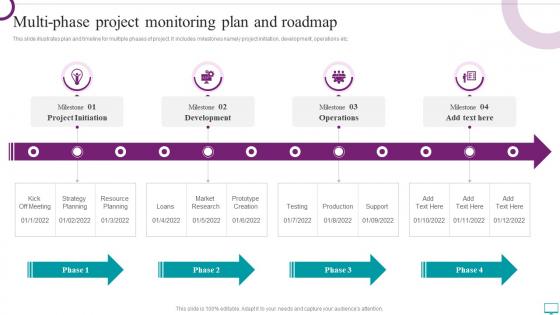
This slide illustrates plan and timeline for multiple phases of project. It includes milestones namely project initiation, development, operations etc.
People who downloaded this PowerPoint presentation also viewed the following :
Multi Phase Project Monitoring Plan And Roadmap with all 6 slides:
Use our Multi Phase Project Monitoring Plan And Roadmap to effectively help you save your valuable time. They are readymade to fit into any presentation structure.





FAQs for Multi Phase Project Monitoring
So there's five main phases: initiation, planning, execution, monitoring & control, and closing. Honestly the monitoring part is where things usually fall apart if you're not on top of it. Set up checkpoints between each phase to check progress and see if you're burning through your budget too fast. During execution you're basically just tracking everything against your original plan. Closing is when you document what went wrong (there's always something lol) and hand everything off. But seriously - don't skip those checkpoint reviews. That's where projects go completely off the rails and nobody realizes until it's a disaster.
Set up KPIs for each phase that feed into your bigger project picture. Baseline everything at phase transitions - trust me, learned this one the hard way! Monday or Asana work well for dashboards showing both current performance and overall trends. Track leading stuff like scope creeps and resource issues, not just the obvious lagging metrics like budget burn. Oh, and don't get too attached to your initial metrics - they'll need tweaking as you move through phases. Keep a few consistent ones though so you can actually see the full story. The phase-specific approach is honestly game-changing once you get it dialed in.
Honestly? Just pick one main platform and stick with it - Asana or Monday.com work well for linking project phases together. Slack's great for quick chats but gets messy fast without some structure. What's saved me is scheduling those phase review meetings ahead of time with actual agendas, not just "let's check in." Everyone needs to see the same dashboard showing where things stand. I learned the hard way that people won't update you unless the system basically forces them to. Oh, and don't try to use five different tools - you'll spend more time switching between apps than actually working.
Look, people won't stay engaged unless you're constantly pulling them back in. Regular check-ins are crucial, but match them to what each group actually cares about - execs want quick dashboards monthly, while end users need to see the thing working. Map out who needs what info and when, then stick to that plan no matter what. Show early wins whenever possible because honestly, that's what keeps people bought in. Oh and always tie your updates back to their specific problems or goals. I've seen too many projects fail just because the PM assumed stakeholders would magically stay interested on their own.
Scope creep is your biggest enemy - stakeholders will change their minds constantly. Resource handoffs get messy when teams overlap, and timeline dependencies are brutal. One delayed phase kills everything downstream. Communication gaps between phase teams cause most problems, honestly. You're also tracking different KPIs for each phase which makes seeing the big picture nearly impossible. My advice? Set up regular cross-phase meetings (even if people complain they're unnecessary). Document everything too. I know it's tedious but you'll be grateful later when someone asks "wait, why did we decide this again?"
Don't treat risk management like some separate thing you do once. Build it right into your phase reviews instead. At the start of each phase, identify what could go wrong specifically for that stage - then update your risk register every week. Honestly, the risks that matter most change completely between phases, and that's where most people get blindsided. Track your risk indicators alongside your normal project metrics. Before jumping to the next phase, do a quick risk check. The whole trick is making this stuff routine. If you're only thinking about risks when things are already falling apart, you're too late.
Start with a solid resource forecast mapping out what you need for each phase, plus some buffer room because scope always changes. Create a priority matrix ranking phases by business value - seriously, this saves your butt when stakeholders start fighting over resources. Rolling wave planning is your friend here since you'll learn tons as you go. Regular check-ins between phase managers help catch bottlenecks before they become disasters. Honestly, the whole thing's about staying flexible while keeping everyone focused on the end goal and timeline. Oh, and don't forget those resource sharing opportunities between phases.
Set your quality standards before you even start - seriously, this saves so much headache later. Build checkpoints after each phase where you actually sit down and review everything against those standards. I learned this the hard way on a project last year. Don't just assume things look good because that's when everything falls apart. Make sure everyone knows what "finished" actually means before they dive in. Keep your review process consistent and write it all down so you can catch patterns if quality starts dropping. Honestly, map out your checkpoint schedule right now while you're motivated.
Honestly, analytics are a game-changer for tracking multi-phase projects. Instead of just looking backward at what went wrong, you'll actually see bottlenecks coming before they hit. Track which phases always blow the budget or timeline - there's usually a pattern. The predictive stuff is where it gets interesting though. You can forecast resource needs for upcoming phases based on how things are going now. I'd benchmark against similar projects too, gives you realistic expectations instead of just hoping for the best. Start small - maybe 3-4 key metrics per phase and build from there.
Think of documentation as your project's memory bank. Capture decisions, lessons learned, and handoff details so nothing gets lost between phases. What worked? What bombed? Any scope changes or key feedback - write it down. I can't tell you how many projects I've watched crash because teams assumed the next group would magically know the backstory. Include deliverable status, risks still lurking, and clear next steps. Honestly, pretend you're explaining everything to yourself six months from now when you've forgotten why you made half these choices. Future you will thank present you.
So basically you need to switch up how you collaborate depending on what phase you're in. Planning phase? Get everyone together for kickoffs and make sure you've got shared docs. Once you're actually executing stuff, daily standups are your friend - and honestly, I've learned the hard way that you can't communicate too much during this part. When you're monitoring progress, regular check-ins plus some kind of visual dashboard really help. Oh and mapping out which methods work for each phase ahead of time is clutch. The intensity should match whatever pace your project's moving at.
Look, you need different updates for different people - executives just want the big picture stuff monthly (budget, timeline, major issues). Your actual project team? They'll need weekly check-ins with way more detail. I learned this the hard way by sending everyone the same reports and getting zero engagement. Set up dashboards that update automatically if you can, because manually creating reports every week will drive you insane. Be consistent with timing though - people hate surprises with this stuff. Oh, and don't sugarcoat problems. Better to flag risks early than pretend everything's perfect. Bi-weekly updates work well for sponsors who fall somewhere in the middle.
Honestly, you've got to schedule actual handoff meetings between phases - like 30-60 minutes where people talk through what worked and what was a disaster. Document it in a shared doc or whatever. I see this all the time where the good stuff just stays trapped in someone's brain, then they leave or forget. Start your next phase by reviewing those notes with the team first thing. Here's the key though - pick 2-3 changes and actually implement them right away. Otherwise it feels like pointless busy work. Make it real, you know? Focus on stuff that'll genuinely make the next phase less painful.
So instead of those rigid phase gates, you're basically doing continuous check-ins. Daily standups and sprint reviews give you real-time feedback - way better than waiting till the end to find out something's broken. You can actually catch problems early and pivot without screwing up your whole timeline. The phases start overlapping instead of that strict "finish A, then start B" thing. Honestly, retrospectives are probably my favorite part - you're constantly learning what works. Treat your milestones as flexible targets and do pulse checks every week or two. Much less stressful than the old waterfall approach.
Look, you want to get really specific with what "done" means for each phase. Skip the vague stuff like "complete design phase" - instead go for something like "wireframes approved by stakeholders, tech requirements documented, budget confirmed within 5% variance." I usually focus on three buckets: what got delivered, did it meet quality standards, and are we actually ready for what's next. Honestly, the trick is making criteria so clear there's zero debate about whether you hit them. Just list out what absolutely has to be true before moving forward, then turn those into checkpoints you can measure.
-
Use of different colors is good. It's simple and attractive.
-
Loved the collection. Editing the presentation was seamless with their templates.