


Monthly Multiphase Project Milestone Tracker Project Management Bundle




Try Before you Buy Download Free Sample Product
 Impress Your
 Audience
 100%
100% Editable
 Save Hours
 of Time


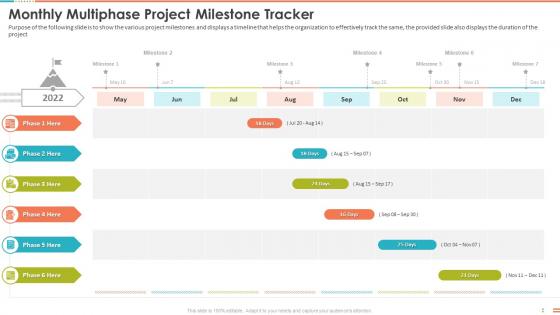
Purpose of the following slide is to show the various project milestones and displays a timeline that helps the organization to effectively track the same, the provided slide also displays the duration of the project.
People who downloaded this PowerPoint presentation also viewed the following :
Monthly Multiphase Project Milestone Tracker Project Management Bundle with all 6 slides:
Use our Monthly Multiphase Project Milestone Tracker Project Management Bundle to effectively help you save your valuable time. They are readymade to fit into any presentation structure.





FAQs for Monthly Multiphase Project Milestone Tracker
So there are five main phases: initiation, planning, execution, monitoring, and closure. First you define what you're actually trying to accomplish and set your scope. Planning comes next - timelines, resources, all that stuff. Here's where it gets interesting though: execution and monitoring happen at the same time, not separately like most people think. You're doing the work while constantly checking if you're on track. Honestly, monitoring might be the most crucial part because projects go sideways fast. Closure wraps up deliverables and captures what you learned. But don't think these are strict steps - you'll bounce back to planning constantly as things change.
Honestly, communication can totally make or break a project. You want everyone on the same page about goals and deadlines - otherwise people end up working on completely different stuff. Clear communication helps you spot problems early before they get expensive to fix. It also keeps your stakeholders happy and team morale decent when things get crazy (and trust me, they will). My advice? Do regular check-ins, write down decisions, and don't assume people know what's going on. Better to overcommunicate than leave people guessing.
Start with a risk register - basically just a fancy spreadsheet to track what could go wrong. Get your team together for brainstorming sessions and look at old projects to see what bit people before. Risk matrices are gold for this stuff - plot how likely something is vs how bad it'd be. Honestly, trying to plan for every possible thing will drive you nuts, so focus on the big ones. Do both quick gut-check assessments and proper number-crunching when it matters. Oh, and schedule regular check-ins during milestones. New risks pop up constantly, so you'll need to stay on top of it.
So basically, Waterfall is super straightforward - you do requirements, then design, then code, then test. One step after another. Works perfectly when you know exactly what you're building from day one. Agile's totally different though. You work in these short bursts called sprints, constantly building little pieces and getting feedback. Way more flexible but honestly? It can feel like organized chaos at first. I'd go Waterfall if your requirements are rock solid and won't change. But if you think things might shift or you're not 100% sure what the end product should look like, Agile's your friend.
Dude, stakeholder engagement can literally make or break your project. Get them involved early and you'll catch problems before they explode. They become your allies instead of those people who mysteriously appear to torpedo everything at the last minute. Map out who matters most and keep them in the loop with regular updates. When budget time rolls around, you'll actually have advocates fighting for you. Plus they know where all the political landmines are buried - which honestly might save your career. Oh, and their input is usually pretty solid too since they actually use whatever you're building.
Honestly, there's so much more you can measure beyond just hitting deadlines. Survey your stakeholders afterward - their satisfaction matters way more than you'd think. Track team engagement, budget variance, the usual stuff. But here's what I always do: check if the project actually fixed the business problem it was supposed to. Sometimes you nail every deliverable but nothing really changes, which sucks. Knowledge transfer success is huge too. Did people learn what they needed? Also look at any process improvements you stumbled on and how client relationships are doing. The best projects create value that lasts way beyond whatever you delivered. Pro tip: start tracking this stuff during the project, not after.
Honestly, Microsoft Project and Smartsheet are your best bet if you need serious Gantt charts and resource tracking - they're the powerhouses. Asana and Monday.com hit that sweet spot between features and actually being usable (Project can be such overkill). For basic stuff? Trello's timeline view works great, or ClickUp if you want more bells and whistles without the headache. Oh, and don't just grab the fanciest tool - I've seen teams struggle because they picked something way too complex for what they actually needed. Start with how tech-savvy your people are, then match the tool to that.
Dude, resource allocation will totally make or break your project. Wrong people on tasks? Your timeline's screwed. Spread everyone too thin and quality goes out the window. Same deal with budget - if you cheap out on the important stuff, you're basically asking for trouble. I watched this one team think they could cut corners on testing (guess how that went). But here's the thing - do it right and you're golden. Put your rockstar people on the scary, high-risk stuff. Maybe front-load your budget for the messy phases too. Oh, and figure out your critical path first, then throw your best resources at that. Trust me on this one.
Dude, you absolutely need proper change management - I can't stress this enough. Projects fall apart when people think they can just handle changes on the fly. Trust me, I've watched it happen. Set up a formal process right from the start to evaluate and approve every request, even the tiny ones that seem harmless. Scope creep will kill your budget faster than you think. Yeah, people will complain about the "red tape" but stick to your guns. Get that change control board running early and don't let anyone guilt you into skipping steps.
Honestly, start with better communication - not just boring status updates but actual human connection. Daily standups work great, or even weekly coffee chats where people can be real with each other. Get some good tools going too - Slack for quick stuff, shared docs, project boards everyone can actually see. But here's the thing that really matters: culture. Push for video calls, celebrate wins loudly, and make sure your quiet people get heard. Also set clear response times so nobody's sitting there wondering if their message disappeared into the internet abyss. Don't try to fix everything at once though.
Oh man, cultural stuff will absolutely trip you up if you're not careful. Some people are brutally direct while others dance around problems forever - I learned this the hard way on my first international project. Germans think "urgent" means NOW, but in Brazil it's more like "when you get to it." Your teammates will clash over hierarchy and decision-making too. Here's what helped me: do a quick cultural check with everyone upfront. Map out the weird stuff early and give yourself extra time for confusion. Trust me, those buffer days will save your sanity.
Honestly, start with realistic estimates and stick to tracking everything weekly - monthly reviews are useless when projects move this fast. Break it into clear categories first, then get everyone on board early (saves you from so many fights later). I always build in like 10-15% buffer because something random always pops up. Document changes with reasons why, and definitely set alerts at 75% spend per category. Oh and keep your team updated regularly - nobody wants to find out about budget issues at the last minute. That's career suicide right there.
Honestly? Start with making sure people aren't scared to mess up - that's like half the battle right there. Give them actual time to play around with ideas (Google does that 20% thing) but you gotta protect it from getting swallowed by "urgent" stuff. I've watched so many companies say they want innovation then pile on deadlines, it's ridiculous. When someone throws out a crazy idea, don't jump straight to why it won't work. Celebrate the good failures too, not just wins. Ask questions instead of handing out answers, and maybe grab some outside perspectives - your usual crew might be stuck in the same thinking. Tomorrow, just ask what they'd try if failing wasn't scary.
Honestly, don't overthink this - just pick 3-5 metrics that actually matter for your project. Schedule variance shows if you're behind, budget variance catches cost overruns early. I'd definitely add scope creep tracking because that stuff sneaks up on you fast. Burndown charts are pretty great for visualizing progress too. Quality metrics matter - maybe defect rates or how happy your users are. Oh, and team velocity if you're doing sprints. The key is avoiding data overload (been there, it sucks). Check these weekly and pivot when something looks off. Way better than scrambling at the end.
So a project charter is like your project's official permission slip - it gives you the green light and actual authority to do the work. Include the why, main requirements, who's involved, success metrics, rough budget and timeline. Honestly, it's your best defense when someone inevitably asks "wait, why are we doing this again?" Getting executive buy-in upfront is clutch because when priorities change (and they will), you can wave that signed document around. Plus it stops scope creep dead in its tracks since everything's already written down.
-
Informative design.
-
Presentation Design is very nice, good work with the content as well.