

Quality circles pros and cons





Try Before you Buy Download Free Sample Product
 Impress Your
 Audience
 100%
100% Editable
 Save Hours
 of Time


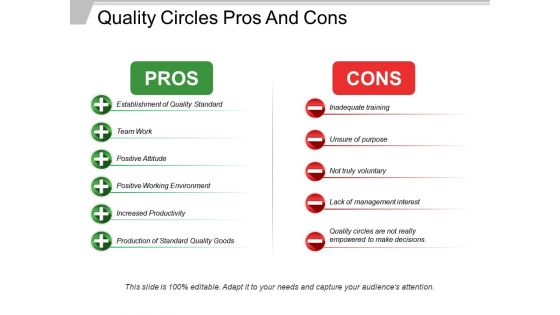
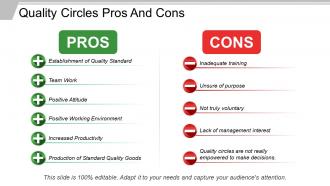
Ready to start your new business venture. Great! Get off on the right track by following our quality circles pros and cons PowerPoint template. In today’s business, it is quite essential that you carry out a proper business forecasting which will help to minimize the role of luck or chance in determining business success or failure. Planning plays an important role in various fields of the concern. As in the case of production planning, management has to decide what to produce and with what resources. This quality circles pros and cons PowerPoint visual enables you to highlight this aspect to your audience. Listing all the possibilities in a bullet form ensures smooth and continuous working of an enterprise, particularly to newly established ones. So take this opportunity to get edge over your competitors by download and inserting this awesome quality circles pros and cons PPT design in your presentation. Advise folks to cater for different concerns with our Quality Circles Pros And Cons. It encourages an inclusive approach.
People who downloaded this PowerPoint presentation also viewed the following :
Quality circles pros and cons with all 5 slides:
When you come to us, we use our Quality Circles Pros And Cons to convey the information you are trying to get across and also highlight your strengths and abilities. This well do at very limited cost.
FAQs for Quality circles
So basically you grab 6-12 people who actually want to be there (voluntary is key, trust me). Meet regularly to tackle problems in your work area. The cool part? Your team can actually implement fixes, not just make suggestions that disappear into the management void. Focus on stuff you can control and use proper problem-solving methods like root cause analysis. Makes sense since the people doing the job know it best, right? Oh, and start small - pick one specific problem you can realistically solve in about a month. Don't go crazy trying to fix everything at once.
So Quality Circles work because they actually let people fix the stuff that bugs them at work. Employees get to spot problems and come up with solutions as a team, which makes them feel like their opinion matters. It's pretty simple really - when you have a say in your daily grind, you care more about the outcome. Plus working together on these issues builds better relationships with your coworkers. Just make sure management doesn't ignore the good ideas that come out of it, or people will check out real quick. Nobody likes feeling like they're wasting their time in meetings.
Pick a problem that's actually bugging people at work, then grab 6-8 folks who deal with it every day. Getting management on board is honestly the hardest part - feels like pulling teeth sometimes. Train your group on basic problem-solving stuff and set up weekly meetings with clear ground rules. Here's the thing though: start ridiculously small. Don't try to fix the whole company right away. Find something your team can actually solve in a couple months. That early win is everything - it gets people hooked and shows the skeptics it actually works.
So Quality Circles are basically small groups of frontline workers who meet regularly to spot problems and figure out fixes. The cool thing is these people actually know the job inside out, way better than some manager making decisions from their office. Keep groups tiny - maybe 6-8 people tops. What makes them work is giving the team real power to implement their ideas, not just talk about them. When employees see their suggestions actually happen, they get way more invested. I've seen it work really well when done right. Just don't make it another useless meeting where nothing changes.
Honestly, the hardest part is usually getting your bosses on board and then keeping people interested once the novelty fades. Finding time for regular meetings when everyone's already buried in work? Good luck with that. You'll definitely hit pushback from folks who think it's just another corporate fad - and honestly, can you blame them? Some teams also get weirdly obsessed with minor stuff instead of real quality issues. My take: start with people who actually want to participate, make a big deal about early successes, and get leadership to show they care from the start.
Honestly, you gotta show up to their meetings regularly - not just send some delegate. Quick implementation of their good ideas matters way more than you'd think. Don't make them squeeze meetings into lunch breaks either; give them real time. I've watched so many of these things crash because managers basically turned them into glorified suggestion boxes, which is infuriating. Your job becomes removing whatever roadblocks they find and making their wins visible to everyone. Trust them to figure stuff out without hovering over every decision. Just set boundaries around what problems they can tackle, then back off.
So Quality Circles have a few go-to tools for finding process issues. Fishbone diagrams are great for cause-and-effect stuff. Pareto charts help you figure out which problems actually matter most. They'll map everything out with flowcharts too - super helpful for seeing where things get messy. Brainstorming sessions happen a lot, though honestly half the time people just complain about lunch options instead of focusing. Check sheets and basic stats tools like histograms round it out. The whole thing works best when it's visual and everyone throws in their two cents. Just pick whichever tool doesn't make your team's eyes glaze over.
Yeah, they totally work! Sometimes even better than in-person honestly - people seem less shy when they're in their own space. Just use video calls with breakout rooms for the small group stuff. Digital whiteboards are clutch for brainstorming too. Don't make meetings too long though - 45 minutes tops because staring at screens all day is exhausting. Monthly works well to start. Oh, and rotate your meeting times if you've got people in different time zones, otherwise someone's always getting screwed with weird hours. Shared docs help keep track of everything between sessions.
Track both the hard numbers and the softer stuff. Defect rates, cost savings, cycle times - that kind of thing. But honestly, participation rates are probably your biggest tell. If people aren't showing up or speaking up, you've got a problem. Survey them regularly about engagement and whether they feel heard. Oh, and actually count how many suggestions get implemented vs. just talked about to death. Review monthly and celebrate the wins publicly. People need to see their work matters, otherwise why bother?
Look, cultural differences absolutely make or break Quality Circles with global teams. Some cultures naturally speak up and collaborate. Others stick to hierarchy and stay quiet even with brilliant ideas. Problem-solving styles clash too - certain teams want deep analysis while others jump straight to solutions (which honestly gets messy fast). Time expectations vary wildly. Quick wins versus long-term thinking, you know? Ground rules help, but the real key is making everyone feel safe to participate. Otherwise you're just hearing from the same voices every time, and that defeats the whole point.
Quality Circles really live or die by their training - I can't stress this enough. Your team needs the basics first: problem-solving methods, how to collect data properly, facilitation skills. Otherwise you'll just get people venting about random stuff (trust me on this one). Don't make the rookie mistake of doing one workshop and calling it done. Keep doing refresher sessions and more advanced training as they get better. Honestly, the ongoing piece is what separates successful circles from the ones that fizzle out. Start simple with basic quality tools and build up from there.
Quality Circles basically give frontline workers a real way to talk to management instead of just complaining to each other. Workers meet regularly and pitch their ideas directly to bosses - sometimes even senior leadership shows up. It's honestly refreshing since these people usually get ignored. Their suggestions actually get written down and followed up on, which beats random conversations that go nowhere. Plus management finally hears about the messy stuff happening on the ground that they'd never know about otherwise. Monthly presentations work great - circle members present findings straight to the people who can make changes. Breaks down all those stupid communication walls.
Toyota and Honda are probably the best examples - they've made Quality Circles work amazingly well in manufacturing. Steel companies jumped on board too. Hospitals have had some great success with them, letting nurses and staff spot process problems they deal with every day. Tech companies do this stuff but they love giving it fancy new names like "improvement teams" or whatever. The thing is, it works best when you've got clear processes where small tweaks actually matter. Oh, and employees need to see the waste happening right in front of them daily. That's when you'll get real buy-in.
Document everything that actually worked from your pilot first - the meeting formats, how you ran things, the results that impressed leadership. Find your biggest supporters and turn them into trainers for other departments. Don't go company-wide right away though, that's a recipe for chaos. Roll out one division at a time instead. Yeah, create some standard training materials, but let each new circle tweak things for their specific work. I'd set up a support team for the first few months since that's when new circles struggle most. Keep talking about the wins openly and be honest when stuff doesn't work.
Toyota's the classic example - they cut defects by 50%+ in tons of plants with Quality Circles. Motorola hit Six Sigma levels using them too. Honda basically perfected the whole thing, and other car companies still copy their methods today. What's crazy is it works way beyond manufacturing. Hospitals use them, banks, even government offices. Honestly, if you're thinking about trying this, just study what Toyota did first - they've been refining it for like 40 years so there's tons to learn from their approach.
-
Innovative and attractive designs.
-
Really like the color and design of the presentation.
-
looks specific