


Quality circles six sigma




Try Before you Buy Download Free Sample Product
 Impress Your
 Audience
 100%
100% Editable
 Save Hours
 of Time


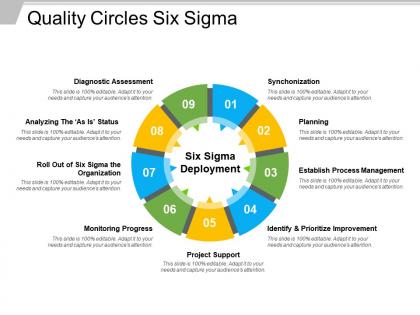
Incorporate this Quality Circles Six Sigma PowerPoint presentation to explain the standard management to your employees. You can discuss the six sigma deployment process using our quality circle PPT layout. Also, the six sigma methodologies can be illustrated using this total quality management PowerPoint theme. The features of the quality control circle can be listed by employing this process improvement PPT theme. The synchronization, planning, project management, identifying and prioritizing improvement and project support can be discussed with employees using this quality management tools PowerPoint template. Additionally, the monitoring progress, roll out of six sigma organization, and diagnostic assessment can be showcased using this six sigma deployment PowerPoint layout. You can employ this management method PPT theme to explain to your colleagues how they can increase productivity by implementing the six sigma techniques to their company and project. Hence download this process development PPT template to highlight the implementation of Six Sigma.
People who downloaded this PowerPoint presentation also viewed the following :
Content of this Powerpoint Presentation
Description:
The image displays a PowerPoint slide titled "Quality Circles Six Sigma," which is a visual representation of the Six Sigma deployment process within an organization. The central graphic is a circular diagram divided into nine segments, each corresponding to a step in the Six Sigma methodology. The segments are numbered and labeled as follows, indicating a cyclical process:
1. Synchronization: Aligning Six Sigma initiatives with business goals.
2. Planning: Strategizing the approach for Six Sigma deployment.
3. Establish Process Management: Setting up processes for managing and controlling Six Sigma projects.
4. Identify & Prioritize Improvement: Recognizing areas for improvement and ranking them in order of importance.
5. Project Support: Providing assistance and resources for Six Sigma projects.
6. Monitoring Progress: Keeping track of project advancements and performance.
7. Roll Out of Six Sigma the Organization: Expanding the implementation of Six Sigma throughout the company.
8. Analyzing The ‘As Is’ Status: Evaluating the current state before the implementation of Six Sigma.
9. Diagnostic Assessment: Assessing and diagnosing the existing processes to identify areas for Six Sigma intervention.
Use Cases:
This Six Sigma framework slide is applicable across various industries for quality management and process improvement presentations:
1. Manufacturing:
Use: Enhancing product quality and manufacturing efficiency.
Presenter: Quality Manager.
Audience: Operations Team.
2. Healthcare:
Use: Improving patient care and streamlining hospital processes.
Presenter: Quality Improvement Coordinator.
Audience: Healthcare Administrators.
3. Finance:
Use: Optimizing financial operations and risk management.
Presenter: Process Improvement Analyst.
Audience: Finance Department.
4. Information Technology:
Use: Software development lifecycle enhancement and IT service delivery.
Presenter: IT Project Manager.
Audience: IT Department.
5. Telecommunications:
Use: Network optimization and customer service improvement.
Presenter: Operations Director.
Audience: Service Management Team.
6. Automotive:
Use: Vehicle design, safety standardization, and production process optimization.
Presenter: Lean Six Sigma Specialist.
Audience: Engineering and Production Teams.
7. Construction:
Use: Project management efficiency and quality control of construction projects.
Presenter: Construction Manager.
Audience: Project Stakeholders.
Quality circles six sigma with all 5 slides:
Bolster your thoughts with our Quality Circles Six Sigma. They will be an added bonus.


FAQs for Quality
Key principles of quality improvement in healthcare include patient safety, evidence-based practice, continuous monitoring, interdisciplinary collaboration, and data-driven decision making. These approaches streamline care delivery by reducing medical errors, standardizing protocols, and enhancing patient outcomes, with many hospitals finding that systematic quality initiatives ultimately deliver faster recovery times, lower costs, and improved patient satisfaction across all departments.
Data analytics enhances quality improvement by identifying patterns in defects, predicting potential failures, and measuring performance metrics in real-time. Through advanced analytics tools, organizations streamline root cause analysis, optimize processes, and track improvement initiatives across manufacturing, healthcare, and service sectors, ultimately delivering reduced costs, faster issue resolution, and consistently higher quality outcomes.
Leadership plays a pivotal role in fostering quality culture by establishing clear quality standards, modeling commitment to excellence, providing necessary resources, and recognizing quality achievements throughout the organization. Through consistent communication and strategic accountability measures, leaders enable teams to prioritize continuous improvement, streamline processes, and deliver superior outcomes, with many organizations finding that engaged leadership ultimately drives both employee satisfaction and competitive advantage.
Common barriers to quality improvement initiatives include inadequate leadership support, insufficient employee training, poor communication across departments, lack of data-driven decision making, and resistance to organizational change. These challenges often emerge in healthcare systems, manufacturing facilities, and service organizations, with many companies finding that addressing cultural mindsets and resource allocation simultaneously enables more successful transformation outcomes and sustainable competitive advantages.
Organizations measure quality improvement project success through key performance indicators like defect rates, customer satisfaction scores, cycle times, cost reductions, and compliance metrics. These measurements enable businesses to track progress systematically, identify areas requiring further enhancement, and demonstrate ROI to stakeholders, with many companies finding that regular monitoring ultimately delivers sustained operational improvements and competitive advantage.
Employee training significantly enhances quality improvement outcomes by reducing errors, improving process adherence, standardizing procedures, and increasing problem-solving capabilities across teams. Through targeted skill development, organizations in manufacturing, healthcare, and financial services achieve measurable improvements in product consistency, customer satisfaction, and operational efficiency, while empowering employees to identify and address quality issues proactively.
Patient feedback can be integrated into quality improvement processes through structured surveys, real-time digital platforms, focus groups, complaint analysis systems, and patient advisory committees. These mechanisms enable healthcare organizations to identify service gaps, enhance care protocols, and streamline operational workflows, with many hospitals finding that systematic feedback integration ultimately delivers improved patient satisfaction scores and better clinical outcomes.
Sustainability strategies include embedding quality metrics into daily operations, establishing continuous monitoring systems, creating cross-functional improvement teams, implementing regular training programs, and developing robust feedback loops. These approaches streamline long-term success by fostering organizational culture change, ensuring leadership commitment, and maintaining employee engagement, with many healthcare systems and manufacturing organizations finding that systematic reinforcement ultimately delivers consistent operational excellence.
Technology and innovation drive quality improvement by automating processes, enhancing data analytics, and streamlining customer interactions through AI-powered systems, IoT monitoring, and cloud-based platforms. These solutions enable organizations to reduce errors, accelerate response times, and deliver personalized experiences, with many service providers finding that strategic technology adoption ultimately enhances operational efficiency and competitive advantage.
Quality assurance focuses on preventing defects through systematic processes, standards compliance, and consistent monitoring, while quality improvement actively seeks to enhance existing processes through data analysis, innovation, and continuous optimization. Manufacturing companies typically use QA for maintaining production standards and preventing recalls, while implementing QI initiatives to reduce waste, streamline operations, and ultimately deliver superior products with enhanced efficiency.
Interdisciplinary collaboration enhances quality improvement initiatives by combining diverse expertise, breaking down organizational silos, and fostering comprehensive problem-solving approaches across departments. Healthcare systems, manufacturing companies, and financial institutions increasingly find that cross-functional teams deliver faster implementation, reduced errors, and more sustainable improvements, ultimately creating competitive advantages through streamlined processes and enhanced operational efficiency.
Successful quality improvement projects include Toyota's lean manufacturing system, Six Sigma implementation at GE, healthcare infection control protocols, banking digital verification processes, and retail supply chain optimization. These initiatives streamline operations by reducing defects, minimizing waste, and enhancing customer experiences, with many organizations finding that systematic quality approaches ultimately deliver cost savings, faster service delivery, and significant competitive advantages.
Regulatory standards drive quality improvement initiatives by establishing mandatory compliance frameworks, defining measurable performance metrics, and requiring systematic documentation processes. These standards create structured improvement pathways for healthcare institutions, manufacturing companies, and financial services organizations, ultimately delivering enhanced patient safety, operational transparency, and competitive advantage while minimizing risks.
Continuous quality improvement (CQI) methodology is a systematic approach that focuses on ongoing enhancement of processes, products, and services through data-driven analysis and incremental changes. It enables organizations to reduce waste, minimize errors, and enhance customer satisfaction while maintaining competitive advantage, with many healthcare systems, manufacturing companies, and service providers finding that CQI delivers measurable cost reductions and operational efficiency gains.
Organizations leverage quality improvement frameworks by implementing data-driven methodologies that streamline processes, eliminate waste, and reduce defects through systematic analysis and continuous improvement cycles. These frameworks enable companies across manufacturing, healthcare, and financial services to achieve significant cost reductions, faster delivery times, and enhanced customer satisfaction, with many finding that strategic application delivers measurable competitive advantages.
-
Great experience, I would definitely use your services further.
-
Topic best represented with attractive design.