


Quality circles diagram




Try Before you Buy Download Free Sample Product
 Impress Your
 Audience
 100%
100% Editable
 Save Hours
 of Time


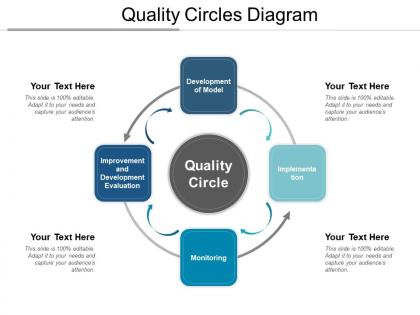
Improve the performance of the organization and the communication pattern within your business organization by incorporating the Quality Circles Diagram PPT template.Showcase how this participative management technique helps in solving the problems with the assistance of this quality circle PPT diagram. Make your viewers familiar with the basic quality improvement tools that will help you enhance organizational productivity. Depict how the quality circles help in enhancing decision making skills and motivating the employees. Showcase the factors that contribute to the team effectiveness by incorporating this quality circle PPT template. Involve your employees and subordinates in the decision making process and make them feel as an important asset of the organization. Illustrate the different steps that are involved in the quality circles process by downloading this amazingly curated quality improvement PPT slide show.
People who downloaded this PowerPoint presentation also viewed the following :
Quality circles diagram with all 5 slides:
Convince folks to alter their impressions with our Quality Circles Diagram. It helps change ingrained ideas.

FAQs for
So Quality Circles work on three main things: people join voluntarily, employees spot the problems themselves, and everyone works together on solutions. When your team actually chooses to participate and tackles stuff they deal with every day, you'll see way better teamwork. It's the complete opposite of those annoying top-down orders nobody wants. Here's what's cool - team members become real problem-solvers instead of just doing what they're told. They share knowledge across different skills and viewpoints. My advice? Start with one group that's actually excited about it and let them pick their first challenge. That buy-in is everything, trust me.
So Quality Circles basically flip the script - instead of bosses making all the calls, workers form these small groups to tackle problems in their own areas. They meet regularly and figure out solutions themselves. Honestly, it's pretty genius when you think about it since frontline people know what's actually broken better than executives sitting in boardrooms. The whole "management knows best" thing goes out the window. Innovation starts bubbling up from the bottom instead of being forced down from the top. My advice? Pick one team that's already pumped about it and see how it goes first.
Honestly, participation can make or break the whole thing. You want people who actually *want* to be there solving problems - not folks dragged in kicking and screaming. I've watched Quality Circles completely tank when management just assigned random people instead of asking for volunteers first. The magic happens when your team feels safe throwing out ideas and knows you'll actually listen. ownership really kicks in then. Don't mandate it from above, that's where things go sideways fast. Ask who wants to join instead of telling people they have to. Trust me on this one.
Track the obvious stuff first - productivity rates, defect reduction, cycle times, cost savings. But honestly? The engagement metrics are where you'll see the real magic happen. Check suggestion rates, attendance patterns, how people actually feel about work. Set your baselines before launching anything though, otherwise you're just guessing. Give it 6-12 months to really show results. Don't blame every improvement on the circles - correlation isn't causation and all that. Simple monthly dashboard works great. I'd probably throw together something basic in Excel first, see what sticks.
Look, the main issues you'll hit are management not really backing it, employees rolling their eyes thinking "here we go again," and momentum just dying out. I've seen this so many times honestly. Get leadership to actually put money behind it, not just say nice things. Train your facilitators well and celebrate wins loudly. But here's the kicker - you HAVE to implement what the circles suggest. Nothing pisses people off more than their good ideas sitting in a drawer. Oh, and start with volunteers only. Don't force it on everyone right away.
So Quality Circles are basically small groups of frontline workers who meet regularly to spot problems and fix them together. Way better than a suggestion box because they actually talk through solutions right there. These teams tackle workflow headaches, quality issues, random inefficiencies - you know, the stuff managers never see from up in their offices. Here's the thing though: don't bother starting one unless you'll actually let them implement their ideas. Otherwise it's just another useless meeting and people hate those enough already. The whole point is giving them real power to make changes happen.
Honestly, you don't need anything too crazy to start. Basic problem-solving stuff is key - root cause analysis, brainstorming, how to collect data properly. They'll probably teach you quality tools too (fishbone diagrams, Pareto charts). Communication skills matter more than you'd think since you're presenting to managers and working in groups. Some places go overboard with statistics training, but that's usually unnecessary. Keep it hands-on, not theoretical - that's what actually works. I'd say do a 1-2 day workshop first, then pick up advanced tools as your team works on real problems. Way better than trying to learn everything upfront.
Oh totally! They work in tons of places outside factories. Healthcare teams use them for stuff like cutting patient wait times. Retail uses them for customer service headaches - honestly, any place where the people doing the actual work know what's broken can make this work. Tech companies do it too. The whole point is letting frontline folks fix the problems they deal with every day instead of having management guess what's wrong. Just pick one team and one issue they actually care about solving. Start there and see what happens.
You've gotta be all-in on this or it won't work. Create that safe space where people can throw out ideas without getting shot down. Give them actual resources and training too. Here's the thing though - you absolutely have to act on their suggestions. I've seen so many of these programs die because good ideas just vanish into thin air. Be visible about supporting it, celebrate the wins loudly, and give teams real power to make changes happen. Oh, and don't forget the psychological safety part - that's honestly huge. If you're half-hearted about it, they'll pick up on that immediately.
Honestly, communication can make or break your Quality Circle. Set up clear ways for people to share ideas and give feedback first - trust me, it'll save you so much drama later. Without good protocols, you get people talking over each other and brilliant ideas just disappear into thin air. I've seen it happen too many times. Try rotating who speaks when and use whiteboards or sticky notes to capture everything visually. The structured approach might feel weird at first, but your team will actually start listening to each other instead of just waiting for their turn to talk.
Honestly, three big things kill Quality Circles: management thinks they're pointless time-wasters, people don't get proper training, and everyone loses interest fast. Super frustrating when leadership doesn't get it. Here's what works - get the bosses on board first, train your facilitators properly, and celebrate small wins early. Oh, and this is huge: give circles real power to actually fix things, not just make suggestions. Nothing kills motivation faster than having good ideas ignored. I'd start with maybe 2-3 pilot groups, prove it works, then expand. Works way better than going big right away.
Oh man, cultural stuff totally makes or breaks Quality Circles. Japan created them and they work great there because everyone's cool with group decisions and hierarchy. But drop that same system in America? People want individual credit and straight talk, not the whole group-harmony thing. Some cultures are fine questioning the boss in meetings, others absolutely won't do it. Honestly, you've got to tweak the format for each place - like, what motivates people varies so much. Power distance is huge too. Way better to adapt than force the original Japanese model everywhere and watch it flop.
Oh man, Toyota's the classic example here - they basically built their whole reputation on Quality Circles and became the gold standard for reliability. Motorola actually used them to create Six Sigma (which honestly everyone's heard of by now). Hospitals have had crazy success too - Virginia Mason cut wait times and medical errors big time. The thing that made all these work? Employees weren't just following orders from above. They had real ownership and could actually fix problems themselves. That bottom-up approach is what separates the success stories from the flops.
Dude, digital tools will totally change your Quality Circles game. I'd start with something like Miro or Teams - the virtual whiteboarding thing is honestly amazing for brainstorming when people can't physically be there. Data analytics tools are where it gets really interesting though. Instead of wondering if your improvements actually worked, you'll have real numbers. Project management apps help too since they keep everyone on track between meetings. Oh, and don't try implementing everything at once - pick one tool first and see how it goes. Trust me on this one.
So I'd track a few key things - participation rates first because honestly, empty chairs tell you everything. Employee engagement scores matter too. For hard data, look at defect rates, customer satisfaction, and how many improvement ideas actually get implemented. Cost savings are huge if you can measure them. Oh, and see if insights from one circle spread to other teams - that's when you know it's really working. Don't go crazy tracking everything though. Pick maybe 3-4 metrics that actually align with what you're trying to achieve. Time-to-resolution is solid too if problems drag on forever.
-
Content of slide is easy to understand and edit.
-
The Designed Graphic are very professional and classic.