


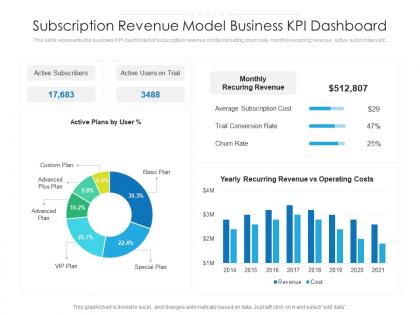
Subscription revenue model business kpi dashboard




Try Before you Buy Download Free Sample Product
 Impress Your
 Audience
 100%
100% Editable
 Save Hours
 of Time


Our Subscription Revenue Model Business Kpi Dashboard are topically designed to provide an attractive backdrop to any subject. Use them to look like a presentation pro.
People who downloaded this PowerPoint presentation also viewed the following :
Subscription revenue model business kpi dashboard with all 2 slides:
Use our Subscription Revenue Model Business Kpi Dashboard to effectively help you save your valuable time. They are readymade to fit into any presentation structure.
FAQs for Subscription revenue model
Honestly, subscription models are game-changers for cash flow. Instead of that crazy up-and-down revenue roller coaster, you get predictable monthly income. Makes planning so much easier. Your customers stick around longer too since they're already in the habit of paying you regularly. Way less exhausting than always chasing new leads, trust me. The data you get from recurring payments is gold for figuring out where your business is headed. Oh, and upselling existing subscribers? So much simpler than starting from scratch with strangers. I'd look at what you're already doing and see if any piece could become a monthly thing.
Here's the thing - subscription models work because people get lazy about canceling stuff (I'm guilty of this too lol). But there's more to it. You're building actual relationships instead of just selling once and disappearing. Customers start using your service regularly, which makes them stickier. Plus you can see exactly how they're engaging and send personalized offers when they're about to churn. The recurring revenue is huge because it lets you spend way more on keeping customers happy. Just nail the onboarding and give them some quick wins upfront.
Okay so MRR and ARR are your lifelines - they show predictable income coming in each month/year. Churn rate is brutal but you gotta track it (seriously, it'll stress you out but everyone deals with this). Customer Acquisition Cost vs Lifetime Value tells you if you're actually making money on each customer or just burning cash. Growth rate matters obviously, plus expansion revenue when existing customers upgrade their plans. Oh and honestly? Start simple with these basics before getting fancy with other metrics. You can always add more tracking later once you figure out what actually moves the needle for your business.
Honestly, start with what your customers actually get out of your product and price under that value. Most people screw this up by just adding margin to their costs - totally backwards. Yeah, check what competitors charge but don't copy them like a robot. That's how you miss good opportunities. Try different prices with small groups first to see what works. Tiered pricing is smart too since everyone's got different budgets. The main thing? Don't be greedy - fair pricing for good value always wins. I'd test small bumps every few months and see how it goes.
Honestly, cash flow is gonna be your biggest headache at first. You're trading those nice fat one-time payments for smaller monthly ones, so expect things to feel tight for a while. The flip side? Way more predictable income once you get rolling. But here's the thing - customers get super picky when they're paying monthly. They want constant value or they'll just cancel, which means you need killer onboarding and support now. I'd map out at least 18 months of cash projections so you don't panic when things get lean initially.
Look, companies just figure out what their customers actually want ongoing access to. Netflix? You're paying for the content library. Adobe ditched the whole "buy software once" thing for monthly creative suite access - honestly pretty genius from their perspective. SaaS folks bundle features into different price tiers. Gyms sell you facility access. Hell, even car companies are doing subscriptions now (which still feels weird to me). The trick is matching when you bill to how people actually use your stuff. What would your customers happily pay monthly for vs. wanting to own forever? That's where you want to be.
Honestly, customer feedback is like your secret weapon against churn. Collect it everywhere - surveys, support tickets, even how people actually use your product. We totally screwed this up once by ignoring onboarding complaints for way too long. Look for patterns though, that's the real gold. When five users complain about the same thing, drop everything and fix it. I'm probably too obsessive about this, but quick responses make people feel heard. Use what you learn to tweak pricing, improve features, whatever needs fixing. The whole cycle keeps customers around longer.
So billing platforms like Stripe or ChargeBee are gonna be your best friend here - they handle all the recurring payment headaches. Trust me, you don't want to build that from scratch. Customer data tracking is clutch too since you need to spot who's about to churn. The billing stuff honestly gets messy fast without automation. Analytics tools like Mixpanel help decode what subscribers actually do (versus what they say they do). CRM integration keeps sales happy. Oh, and start with billing infrastructure first - I've seen way too many subscription startups crash and burn because they treated payments as an afterthought.
Honestly, start with the basics - track churn rate, customer lifetime value, and see which features people actually use (spoiler: it's probably not what you think). Set up some simple dashboards first, then dig into when people cancel and how their engagement drops off. Once you get that data flowing, you can spot the customers about to bail and maybe save them. Try segmenting users into groups and test different pricing or features with each one. The patterns you'll find are pretty wild - I was shocked when I first started doing this stuff. Just don't get too fancy at first, focus on the core metrics that actually move the needle.
Honestly, most companies totally blow their onboarding and wonder why people bail. First thing - set up analytics to catch at-risk users before they disappear. Create a decent email sequence for newbies, and here's something most people miss: offer pause options instead of just cancellation. Way more people will hit pause than straight-up quit. Win-back campaigns work surprisingly well too - easier than hunting down fresh customers. Actually read your exit surveys instead of ignoring them. Map out where people typically drop off in your customer journey and fix those broken spots first.
So personalization is huge - it makes users feel like you built the whole thing just for them. I've had Netflix for forever because their recommendations are actually good, you know? Content suggestions, tweaking the interface based on how people use it, targeted messages that don't suck. The goal is using behavioral data to predict what they want before they do. Honestly, behavioral targeting can get a little creepy sometimes but it works. Start small though - segment your users and test different personalized experiences with smaller groups first. Way less risky.
Yeah, people are totally maxed out on subscriptions right now. They're canceling left and right and being super picky about new ones. Everyone I know is doing that thing where they actually read what they're paying for each month - wild concept, right? Free trials are huge now, plus those pay-per-use options instead of monthly commitments. My friend just canceled like six services last week alone. The whole game has changed - you can't just get people to sign up anymore without proving you're actually worth it. Maybe try different pricing levels or really show what value you're giving them consistently.
Don't just compete on price - that's a race to the bottom. Instead, figure out what makes you actually different. Maybe it's flexible pricing tiers or bundling stuff together that makes sense. Netflix crushed it early on not because they had the most content, but their interface was just... better. Way better recommendations too. Look at your whole experience - how's your onboarding? Support team actually helpful? Can people easily pause their subscription without jumping through hoops? Find that one thing competitors can't just copy overnight. Whether it's exclusive features, killer UX, or solving some annoying problem everyone else ignores.
Honestly, the biggest thing is getting your cancellation policy crystal clear from the start. People hate surprises with billing. Make sure you're upfront about auto-renewals and how someone can actually cancel - like, don't bury that stuff in tiny print. Each state has different rules about subscription disclosures, which is annoying but you gotta check. Privacy stuff matters too since you'll have their payment data sitting around. GDPR applies if any Europeans sign up. Being transparent saves you so many headaches later. Definitely have a lawyer look over your terms before you go live though.
So the main thing is solving a real problem people actually have, not just cramming random stuff together. Give them consistent value every month - new content, updates, whatever makes sense. Be super clear about what they're getting and when. Honestly, so many companies just slap a paywall on everything and act shocked when everyone bails. Try letting people test it first with a free trial or freemium thing. If they feel like they're getting way more than what they're paying, they won't leave. Oh and definitely ask your current subscribers what actually keeps them around - that'll tell you everything.
-
Easy to edit slides with easy to understand instructions.
-
Much better than the original! Thanks for the quick turnaround.
-
Really like the color and design of the presentation.
-
Out of the box and creative design.
-
Best way of representation of the topic.