

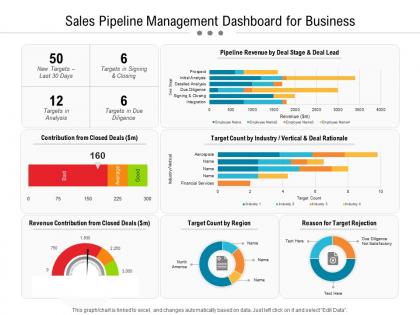
Sales pipeline management dashboard for business




Try Before you Buy Download Free Sample Product
 Impress Your
 Audience
 100%
100% Editable
 Save Hours
 of Time


Our Sales Pipeline Management Dashboard For Business are topically designed to provide an attractive backdrop to any subject. Use them to look like a presentation pro.
People who downloaded this PowerPoint presentation also viewed the following :
Sales pipeline management dashboard for business with all 2 slides:
Use our Sales Pipeline Management Dashboard For Business to effectively help you save your valuable time. They are readymade to fit into any presentation structure.
FAQs for Sales pipeline management
So most sales pipelines have like 5 main stages: lead gen, qualifying prospects, doing demos/proposals, negotiating terms, then closing the deal. Adding a post-sale follow-up stage is pretty smart too - honestly wish more teams did that. But here's the thing: don't just copy some template you found online. Your process should match how you actually sell. Each stage needs super clear criteria for moving people forward or back. Otherwise your reps will just push everyone through and you'll be wondering why your forecasts are always wrong. Trust me on that one.
Dude, a good CRM will literally save your sanity. No more sticky notes everywhere or wondering where that hot lead disappeared to. Everything's in one place, and you can see exactly which deals are moving and which ones are just sitting there collecting dust. The automated reminders are clutch - I used to forget follow-ups all the time before I had this stuff set up. Start with basic activity tracking and stage alerts first. The reporting will blow your mind too, but honestly that's just bonus points. You'll actually know what your pipeline looks like instead of just hoping for the best.
Track your conversion rates at each stage first - that's the big one. Deal size, sales cycle length, and how fast stuff moves through your pipeline matter too. Win rate is huge though. I swear, so many teams get obsessed with having tons of leads but can't actually close anything. Pipeline coverage shows you how much you need in your funnel to hit your numbers. Stage duration helps you find where deals get stuck. Oh, and monthly qualified leads coming in - gives you a sense of what's coming. Pull these weekly, then figure out where you're bleeding deals.
Check your conversion rates at each pipeline stage - that's where you'll find the mess. Calculate how long deals sit in each phase, then look for the stages where everything's taking forever or dying off. I do this weekly because honestly, things change fast and you don't want to miss it. Your reps are probably spending way too much time on certain stages too. Those bottlenecks where deals pile up? Fix those first. The data will basically scream at you which stages are broken. Track this stuff regularly so you can catch problems before they wreck your whole quarter.
Dude, lead qualification is like having a bouncer for your sales pipeline. You gotta filter out the time-wasters upfront so you're not chasing dead-end prospects for weeks. Set clear criteria - do they have budget? Decision-making power? Actual need? Timeline that makes sense? Stick to those rules or you'll end up with a bloated pipeline full of deals that'll never close. Your forecasting will be way off too. I learned this the hard way honestly - spent months on "leads" that were just shopping around. Score your leads properly and watch your conversion rates actually improve.
Honestly, I'd check it daily if you can - even just 15 minutes scanning for stuff that needs attention. Weekly at minimum though. Deals move way too fast to ignore them longer than that. Monday mornings work great for the weekly deep dive where you're actually updating stages, tossing dead leads, tweaking forecasts. Daily ones are more like... quick pulse checks, you know? What's been sitting around too long, what needs a nudge. I get it sounds like overkill, but things change so damn fast in sales. Start with weekly if that's all you can handle right now.
Honestly, just get way pickier about your leads upfront. I learned this the hard way - chasing every maybe-interested person is exhausting. Only go after prospects with actual budget, decision-making power, and something driving urgency. Templates are your friend for proposals and pricing. Don't reinvent the wheel every time. Always nail down specific next steps with dates, not just "we'll follow up soon." Oh and prep answers for the usual objections beforehand. Trust me, you'll sound way more confident when someone inevitably asks about price or timing.
Honestly, just get everyone looking at the same dashboard - shared CRM where you can actually see what's happening with leads and who's doing what. Weekly check-ins are clutch too, gives people a chance to ask for help or flag problems. I've watched so many teams implode because nobody talks to each other. Marketing tosses leads over the fence, sales does their own thing... it's a mess. Set up clear handoffs between stages and make your reps update stuff when they move prospects along. Oh, and don't make pipeline updates this big formal thing - just bake it into what you do every day.
Dude, the worst thing I see is reps being ridiculously optimistic about their deals. Like they'll mark everything as "90% to close" when it's probably 30% - drives me nuts. Pipeline data gets stale super fast too, nobody updates that stuff. Most teams have zero clarity on what moves a deal between stages. What's the difference between "qualified" and "proposal sent"? Who knows! Dead deals just sit there forever making your numbers look way better than reality. Oh and following up on stalled stuff? Forget about it. Start with your current stages and make sure everyone actually understands what each one means.
Market shifts can mess with your pipeline fast. Deals start stalling at weird stages. Conversion rates tank. New objections come out of nowhere - think how remote work suddenly became everyone's obsession in 2020. Your close rates will bounce around as prospects scramble to figure out new priorities and budgets. Honestly, forecasting becomes a nightmare during these periods. Track changes by stage so you catch patterns before they wreck your numbers. I'd check pipeline metrics weekly when things get crazy and adjust your forecasts way more often than usual.
Weighted probability forecasting works really well - just assign percentage chances to deals based on where they sit in your pipeline, then multiply by deal value. Historical conversion rates are huge for this too. Track how deals actually moved through stages over time. Velocity analysis is another game-changer (measuring typical deal duration per stage). Honestly, most people forget to clean out stale opportunities that are basically pipe dreams at this point. You'll want to run 3-month rolling forecasts and compare against actual results. That's how you dial in your accuracy over time.
So automation handles all that tedious stuff - moving leads around, firing off follow-ups, updating records. When someone opens your proposal? Boom, they're automatically in "negotiation" stage and everything gets logged. Lead scoring happens based on what people actually do, plus it assigns tasks and alerts you to dead deals. Honestly, the admin time you save is huge - you can focus on real conversations instead. Oh, and it'll send alerts when deals sit too long, which I always forget to track manually. Just start with whatever you're doing most often by hand.
Listen, your customers are basically telling you exactly how to fix your sales process if you pay attention. Drop-offs at specific stages? That's where you need to dig in and figure out what's broken. We had one team that completely flipped their demo timing because buyers kept asking for technical details way too early - sometimes you just gotta pivot, you know? Track the common objections and pain points people mention, then use that stuff to update your lead scoring. If three deals closed because they all had the same problem, weight that heavier. I'd start pulling feedback themes every month and see how they line up with your pipeline numbers.
Dude, I just score leads on three things: budget, timeline, and who I'm actually talking to. Are they the decision maker? Do they have money? Need something in the next 90 days? Used to make this way harder than it needed to be, honestly. Now I just ask straight up during calls. Hot ones get hit daily, warm leads twice a week. Cold ones? Toss 'em in email nurture and forget about it. Go through your pipeline right now and sort everything this way. You'll know exactly where your time should go.
Start with CRM basics - seriously, half your reps probably don't even log calls properly. Get them comfortable with updating deal stages and tracking interactions before anything else. BANT or MEDDIC frameworks help with lead qualification too. Forecasting is critical since bad predictions screw up planning for everyone. Pipeline hygiene matters - reps hate deleting dead deals but those "maybes" just clog everything up. Map out your specific sales stages and what actually moves deals forward. I'd honestly focus on the CRM fundamentals first though. You'll be shocked how many people are just winging basic data entry.
-
Excellent design and quick turnaround.
-
Good research work and creative work done on every template.
-
Much better than the original! Thanks for the quick turnaround.
-
Best way of representation of the topic.
-
Great product with effective design. Helped a lot in our corporate presentations. Easy to edit and stunning visuals.