


Race digital marketing planning framework decision making purchase





Try Before you Buy Download Free Sample Product
 Impress Your
 Audience
 100%
100% Editable
 Save Hours
 of Time


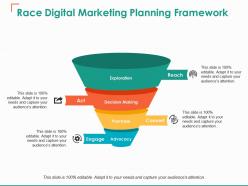
Have a look at our race digital marketing planning framework decision making purchase presentation design. The PPT template has been designed in the funnel shape to understand the concept of digital marketing in today's time. Whether you are looking to launch a new product or service or planning to re-launch the existing one, you have to ensure that you choose the best marketing strategy to engage the consumer. Our digital marketing planning structure helps you to present the information about the customer decision making process as how your marketing plan persuade them to go for the product or service you are offering. The important aspects shown in the PowerPoint slide are exploration, decision making, purchase, advocacy, act, engage and reach. People engaged in the digital marketing work can get the best value out of this presentation diagram as it perfectly delivers the message of consumer decision making and purchase. So, download race digital marketing planning framework PowerPoint graphic now and then share the message about the importance of right marketing strategy. Implement court directions with our Race Digital Marketing Planning Framework Decision Making Purchase. Elaborate on every clause of the decree.
People who downloaded this PowerPoint presentation also viewed the following :
Race digital marketing planning framework decision making purchase with all 5 slides:
Allow everyone to experience jolly good fun with our Race Digital Marketing Planning Framework Decision Making Purchase. Inject a dose of good humor.
FAQs for Race digital marketing planning framework
Dude, you gotta nail down your goals and who you're actually talking to first - that's where most people mess up. After that, figure out where your audience actually spends time online and create content that doesn't make people scroll past immediately. Track your results obsessively because otherwise you're just throwing money into the void. SEO and paid ads help too if you've got the budget. Oh, and make sure your messaging feels consistent everywhere - Instagram, Google, wherever. I learned this the hard way when my stuff looked completely different across platforms and confused everyone. Start with audience research though, seriously.
Look, you gotta stop caring about likes and followers - that stuff doesn't actually make you money. First thing: get your tracking set up properly in Google Analytics and whatever ad platforms you're using. Then figure out your customer acquisition cost vs lifetime value. Honestly, I see so many people obsessing over engagement rates while their bank account stays empty. Focus on the stuff that matters - cost per lead, conversion rates, actual sales from each channel. Oh and create a clear line from what you spend to what you earn back. That's how you'll know what's worth your time.
Honestly, audience segmentation is what makes or breaks your whole digital marketing thing. You're basically figuring out who you're talking to instead of just throwing stuff at the wall. Think about it - would you really send identical emails to your 22-year-old TikTok crowd and your 45-year-old LinkedIn users? That's just weird. Different groups need totally different content, timing, all of it. I'd start small though - pick maybe 2-3 segments based on age, behavior, whatever makes sense for your business. Then you can build separate campaigns for each group.
Dude, forget follower counts - they're basically meaningless now. What you really want is tracking engagement rates, reach, and conversions to see what actually gets people to do stuff. Check when your audience is online most, which hashtags work, and what format gets the most clicks or shares. I always peek at competitors too because sometimes you spot obvious gaps. Oh and pick like 3-5 metrics that matter for your goals instead of trying to track everything. Way less overwhelming that way. The data will show you what's working versus what you think should work.
Honestly, start with what people are actually typing into Google - that's way more important than cramming keywords everywhere. Research those search queries first, then write content that actually answers them. Yeah, use your keywords in titles and headers, but don't stress about hitting some magic percentage like we're back in 2010 or something. Make your pages load fast, work on mobile, write decent meta descriptions. The boring technical stuff still counts. But here's the thing - Google's gotten pretty good at spotting genuine value over keyword-stuffed garbage. I'd just audit what you've got now and pick a few easy wins to tackle this week.
Don't treat influencer marketing like this separate thing - weave it into everything else you're doing. Figure out where in your funnel they actually help (awareness vs getting people to buy) then match their content to your other campaigns. The biggest screw-up I see? Brands just randomly paying influencers without connecting it to their other marketing. Such a waste. Track the same metrics everywhere so you can see if their posts actually boost your other channels. UTM codes and custom landing pages are your friend here - otherwise you're flying blind on what's working.
Honestly, most people mess up by trying to be everywhere at once - total budget killer. Pick maybe 2-3 platforms tops when you're starting out. Also, don't chase every shiny trend just because it's buzzing (Clubhouse, anyone?). Your messaging gets all wonky when you're scattered across too many channels. Oh, and this drives me nuts - people expect instant results! Digital marketing takes time, like months not weeks. You've gotta actually look at your analytics instead of just posting and praying. The ongoing work is way more than most folks think too. Start small, be patient, and let the data tell you what's working.
Look, keeping customers happy is way more important than people think. It's so much cheaper than constantly hunting for new ones - like seriously, the cost difference is crazy. When you actually care about your existing customers with personalized emails and decent support, they become walking advertisements for you. Word-of-mouth is still king, honestly. They'll defend your prices when competitors try to poach them too. Oh and create content that actually helps instead of just selling constantly. Start by splitting up your email list so you're not sending the same generic stuff to everyone. Trust me, it works.
Honestly, start with the big three: open rates, click-through rates, and conversions. Your subject lines are working if people actually open your emails. CTR shows whether your content hits the mark. And conversions? That's where you see real business impact. Don't obsess over total subscriber count - I mean, it's nice watching that number climb, but it doesn't pay the bills. Keep an eye on unsubscribes and spam complaints too. Nobody wants to be *that* brand blowing up people's inboxes. Find your industry benchmarks first, then just focus on beating your last campaign. Way more motivating than chasing some random industry average.
Honestly, AI tools can make your marketing so much easier - they handle all the boring stuff automatically. Start with something simple like AI email segmentation or a writing tool. The predictive analytics are pretty wild too, they'll actually predict what your customers want before they know it themselves. Chatbots don't completely suck anymore either (finally). Your ad spend gets optimized in real-time, finding better audiences way faster than you could manually. Best part? The algorithms keep learning from your data, so targeting improves over time. I'd definitely try one tool first and see how it goes.
Honestly, multi-channel marketing is a game changer because you're hitting people where they actually spend time online. Don't put everything into just one platform - Instagram's algorithm could screw you over tomorrow, but you'll still have email and Google Ads running. Different channels work at different points too. Social media builds awareness with new people, while email converts the leads you already have. The best part? They all work together and keep hammering your message home. I'd start with maybe 2-3 that your audience uses most, then add more later. Way less risky than betting everything on one channel.
Build flexibility right into your strategy from day one. Monthly reviews are clutch - track your numbers religiously while watching for new platforms and industry shifts. Things move insanely fast now! Instead of those massive yearly plans, go modular so you can pivot without a headache. I always tell people to save 10-20% of budget for testing random stuff that pops up. You'll be ready when opportunities hit instead of playing catch-up later. Oh and honestly? The companies that adapt fastest usually win, even if their initial strategy wasn't perfect.
Honestly, stories are what make people actually give a damn about your brand. Like, you remember Nike's "Just Do It" campaigns way better than whatever tech they put in their shoes, right? That emotional connection is everything. People share stories, not product specs. Your brand needs personality - stories show that off better than any feature list ever could. Oh, and they help you stand out when everyone's screaming for attention online. Figure out what your brand really stands for first. Then tell stories your audience actually wants to hear, not just what you want to sell them.
Honestly, just ask your customers to share their stuff! Run some hashtag campaigns or contests - people love that. Their content is way more believable than anything you'll write about yourself. Put customer photos all over your social media and make those reviews super visible on your product pages. Oh, and create like a whole gallery section on your website for user content. Makes people feel special, you know? Start with your most active followers - just DM them asking if you can repost their photos. Most people are totally flattered by the attention and will say yes immediately.
Honestly, just be straight with people from day one. Get consent before grabbing their data and actually tell them what you're doing with it. Dark patterns are so annoying - nobody likes feeling tricked into stuff. Make opt-outs super simple too. Watch out for discriminatory targeting and definitely don't go after vulnerable groups like kids or people struggling financially. That's just gross. Also, play fair with competitors - fake reviews always get found out eventually. I'd start by looking at your current campaigns and trust your gut. If something feels sketchy, it probably is.
-
Good research work and creative work done on every template.
-
Excellent template with unique design.