


Graph for build vs buy decision framework




Try Before you Buy Download Free Sample Product
 Impress Your
 Audience
 100%
100% Editable
 Save Hours
 of Time


Our Graph For Build Vs Buy Decision Framework are topically designed to provide an attractive backdrop to any subject. Use them to look like a presentation pro.
People who downloaded this PowerPoint presentation also viewed the following :
Content of this Powerpoint Presentation
Description:
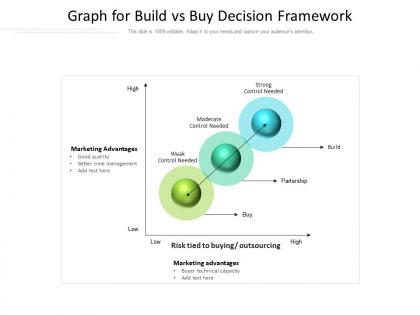
The image is a PowerPoint slide titled "Graph for Build vs Buy Decision Framework," which is a strategic tool used by businesses to decide whether to develop a product in-house (build) or purchase it from an external supplier (buy). The graph presents a two-dimensional matrix with the vertical axis labeled "Control Needed" ranging from low to high, and the horizontal axis labeled "Risk tied to buying/outsourcing" ranging from low to high.
Three circles represent different strategies based on the level of control and risk:
1. "Weak Control Needed" indicates a strategy where buying or outsourcing is suitable due to the low risk involved.
2. "Moderate Control Needed" suggests a partnership approach.
3. "Strong Control Needed" implies that building in-house is the best option due to the high necessity of control.
On the left, a list titled "Marketing Advantages" includes points like "Good quality," "Better time management," and a placeholder for additional text, suggesting benefits that can influence the build vs. buy decision. Another list on the bottom right, also titled "Marketing advantages" (presumably should be different, e.g., "Buying advantages"), mentions "Buyer technical capacity" and has another placeholder for further points.
Use Cases:
This slide can be utilized in multiple industries to facilitate decision-making regarding the development and procurement of products or services:
1. Technology
Use: Deciding on software development or purchase.
Presenter: CTO.
Audience: IT management team, stakeholders.
2. Pharmaceuticals
Use: Choosing between drug development or licensing.
Presenter: R&D Director.
Audience: Executives, R&D team.
3. Manufacturing
Use: Planning for machinery acquisition or in-house development.
Presenter: Operations Manager.
Audience: Production team, finance department.
4. Retail
Use: Determining whether to buy products or produce privately labeled goods.
Presenter: Procurement Manager.
Audience: Supply chain team, company executives.
5. Financial Services
Use: Considering fintech solutions to build or buy.
Presenter: Head of Innovation.
Audience: Innovation team, board members.
6. Automotive
Use: Evaluating parts manufacturing or sourcing.
Presenter: Supply Chain Director.
Audience: Engineers, procurement specialists.
7. Food and Beverage
Use: Deciding on creating new products or outsourcing.
Presenter: Product Development Manager.
Audience: Marketing team, suppliers.
Graph for build vs buy decision framework with all 2 slides:
Use our Graph For Build Vs Buy Decision Framework to effectively help you save your valuable time. They are readymade to fit into any presentation structure.
FAQs for Graph for build vs
Honestly, it comes down to money, time, and whether your team can actually pull it off. Building looks cheaper at first but you'll get crushed by maintenance costs later - trust me on that one. Buying something gets you up and running way faster. Do you guys even have the skills to build this properly? Most companies think their needs are super unique when they're really not. I'd make a list of what you absolutely need versus what would just be nice to have. Then see how close existing solutions get you. The "special requirements" thing is usually just ego talking.
Honestly, it all comes down to what your company actually needs right now. Building custom stuff makes sense if you're trying to be the innovation leader, but buying proven solutions is usually smarter for fast growth or tight budgets. I've watched so many engineering teams convince themselves they're special snowflakes when... they're really not lol. The trick is being brutally honest about whether building actually helps your strategic goals or just makes the devs happy. Whatever criteria you pick, make sure they tie back to what "winning" looks like for you this year.
The real costs hit you in years 2-5, trust me. Building means you're stuck with maintenance, security updates, scaling headaches, plus replacing developers who inevitably quit. Buying gets you subscription hikes and vendor lock-in - ugh, the worst. Then there's technical debt if you build, or having to hack workarounds when the tool can't do what you need. I've seen teams get completely burned by both routes. Honestly, sketch out what each option looks like 3-5 years from now, including all the annoying stuff nobody talks about upfront.
Look, UX is probably the biggest thing to think about here. Building gives you total control - you can make everything feel exactly right for your users. But damn, it's so much work. Third-party stuff? You're basically stuck with however they designed it, and sometimes it just looks weird next to your brand. Users notice when things don't match up. I'd say ask yourself if that perfect, seamless experience is actually worth months of extra dev time. Because you'll definitely be paying for it later with design debt too.
Dude, technical debt is your biggest enemy here - shortcuts now = headaches later. Your team gets stuck maintaining this thing instead of focusing on actual business growth. Timeline and budget? Yeah, you're gonna blow both (ask me how I know lol). Security's scary without dedicated people who know what they're doing. Finding developers who can work with your custom system when people quit is brutal. Oh, and scaling issues will creep up. Honestly, calculate what you'll spend over 3-5 years total, not just the upfront costs. That number might shock you into reconsidering.
Integration stuff is honestly huge when you're deciding build vs buy. Buying something with pre-built connectors? You'll dodge months of pain if you need to connect like 10 systems. Sure, you own all that integration code when you build - sounds cool until you're debugging at 2am lol. But here's the thing - if your systems are super weird or you've got strict data requirements, building lets you control exactly how everything talks to each other. I'd map out every integration point first though. Then see which option actually makes sense for your situation.
Scalability's huge for this decision. Buying usually wins if you're expecting rapid growth - vendors already figured out those scaling nightmares. Building gives you control, but honestly? Custom solutions get pricey to scale real quick. Think about where you'll be in 2-3 years, not just now. I'd map out a few growth scenarios first - like best case, worst case, that sort of thing. Then see which option actually handles your projected volume without breaking the bank or your sanity.
Honestly, if you need something fast, just buy it. You'll be live in weeks versus building from scratch which always takes way longer than planned - like 6-18 months minimum. Teams constantly underestimate dev time because there's always some random bug or feature creep that wasn't in the original plan. Sure, building gives you total control and the exact fit you want. But bought solutions just need integration work, maybe some workarounds if they're not perfect. I've seen too many "quick" builds turn into year-long projects. Speed matters? Go with buying.
Look, your team's skills will totally make or break this decision. Don't have the right people? Building gets crazy risky and expensive fast. I've watched so many teams think they can handle it, then crash and burn. You gotta be real about whether your current crew can actually pull this off - and I mean honestly, not just wishful thinking. Missing key skills or already swamped? Yeah, buying starts looking pretty smart even if it hits the wallet harder upfront. Better than a half-finished disaster, trust me.
Build means you're stuck with everything forever - bugs, security patches, updates, server headaches. Your team becomes tech support for life, which gets expensive and risky if people quit. Buying usually gets you vendor support and regular updates. Yeah, licensing costs more upfront, but honestly? Their expertise is worth it most of the time. You just can't control their timeline for fixes. Think about whether your team can actually handle long-term maintenance. Most people underestimate how much work that becomes down the road.
Look, getting stakeholder feedback can totally flip your whole build vs buy decision. I'd run some surveys or grab coffee with your key users first. They'll tell you what's actually broken with current tools versus what sounds cool in theory. Half the time people think they need custom software when tweaking an existing solution would work just fine. Focus groups are solid too if you have time. The real trick is figuring out which features are genuine blockers versus nice-to-haves. Trust me, their real-world insights will save you from building something that sits unused. Users know their pain points better than anyone.
Start with a solid RFP covering your exact needs - makes comparing vendors so much easier. Build a scoring matrix for functionality, cost, integrations, all that stuff. Don't trust their demos though, push for trials with your real data. I learned this the hard way once. Check references from companies like yours, not just their cherry-picked testimonials. Total cost matters more than sticker price - implementation and training add up fast. Their engineering team should do a deep technical dive with you. Otherwise you're flying blind on whether this thing will actually work long-term.
Honestly, compliance stuff can completely change whether you should build or buy. Healthcare and finance companies usually just buy existing solutions because they already have all the SOC 2 and HIPAA certifications. Building that from scratch? Total headache - way more expensive than you'd think too. I mean, maintaining those standards alone will drain your budget. Start by figuring out what compliance you actually need first. Then check if vendors meet those requirements. Sometimes though, if you've got really weird security needs, building might be your only choice.
Dude, regulated industries are brutal - healthcare, finance, government stuff. HIPAA, SOX, all those acronyms? Total compliance nightmare if you build custom. I've literally watched teams blow their entire budget just on making sure they don't get sued. Buy from established vendors and you're basically paying them to deal with all that regulatory headache. They already have the certifications and know how to handle audits. Your lawyers won't hate you, plus someone else worries about security patches at 3am. Worth it IMO.
Honestly? Hybrid's the way to go when you need to build your secret sauce but can buy the boring stuff. Like if you're making a custom analytics engine, just grab third-party auth instead of reinventing that wheel. Same with trading algos - write your proprietary code but run it on AWS or whatever. You'll hit the market faster without giving up what makes you special. Map out what absolutely has to be yours versus what you can just plug in from vendors. Focus your devs on the unique bits. It's usually the smartest move, even if it feels messy at first.
-
Content of slide is easy to understand and edit.
-
Unique design & color.
-
Great quality slides in rapid time.
-
Great product with effective design. Helped a lot in our corporate presentations. Easy to edit and stunning visuals.
-
Easily Editable.