

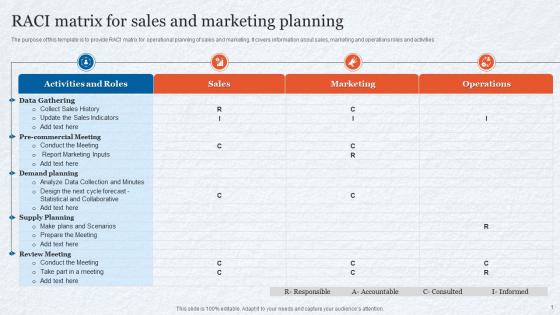
RACI Matrix For Sales And Marketing Planning




Try Before you Buy Download Free Sample Product
 Impress Your
 Audience
 100%
100% Editable
 Save Hours
 of Time


The purpose of this template is to provide RACI matrix for operational planning of sales and marketing. It covers information about sales, marketing and operations roles and activities.
People who downloaded this PowerPoint presentation also viewed the following :
RACI Matrix For Sales And Marketing Planning with all 6 slides:
Use our RACI Matrix For Sales And Marketing Planning to effectively help you save your valuable time. They are readymade to fit into any presentation structure.





FAQs for RACI Matrix For Sales
Oh, a RACI matrix! So it's this chart that shows who's responsible for what on your project. RACI means Responsible (actually does the work), Accountable (owns the final result), Consulted (you ask for their input), and Informed (just needs updates). Trust me, it saves so much drama when everyone's confused about roles. You make a grid - tasks on one side, team members on the other. Then assign each person R, A, C, or I for every task. No more "wait, wasn't Sarah supposed to do that?" moments. Honestly, I've seen projects go completely sideways without this. Start by listing your main deliverables and figuring out who needs to be involved.
RACI Matrix is basically your "who does what" cheat sheet. Maps out who's Responsible, Accountable, Consulted, and Informed for every task. No more of that "I thought Sarah was doing this" nonsense in meetings. Honestly saves so much drama. You'll know exactly who owns what and who just needs updates. Start with your current project - list the main stuff that needs doing, then assign the roles. Takes like 20 minutes but you'll spot potential confusion right away. Trust me, it's way better than playing detective when deadlines hit.
Oh RACI! So **Responsible** is whoever's actually doing the work - like hands-on stuff. **Accountable** is the person who signs off and owns the whole thing (seriously, pick just one person for this or you'll get chaos). Then **Consulted** people give you their input before you make decisions, and **Informed** folks just need updates after stuff happens. Honestly, mapping this out beforehand saves you from those super awkward meetings where everyone's like "wait... I thought YOU were handling that." It's weirdly effective once you get the hang of it.
So first thing - figure out who actually cares about your project. Decision makers, people doing the work, folks who need updates, anyone getting affected by it. I always go big at first because forgetting someone important later is way worse than having too many people initially. Look at what you're building and think: who signs off on stuff? Who's executing? Who gives input or has expertise you need? Who just wants to know what's happening? Honestly, don't stress too much about getting it perfect - you can totally adjust as things get clearer.
Yeah, they totally work for both! Just don't go overboard with the detail on smaller stuff. Small projects? One page covering the main deliverables is plenty. Big ones need more breakdown by phase or whatever. I've definitely overdone it on simple projects before - learned that lesson the hard way. Match your detail level to how complex things actually are. You can always start basic and add more if people start getting confused about who's doing what. Better to keep it simple than create some massive spreadsheet nobody wants to look at.
Oh man, the biggest mistake is putting multiple people as "Responsible" for one thing - total disaster. Nobody knows who's actually doing the work. Also don't go crazy with "Consulted" people or you'll be stuck in feedback hell forever. Trust me on this one. Keep it simple at first! One person responsible per task, spread out the "Accountable" stuff so you're not killing your manager, and honestly? Don't make it super detailed right away. Try it on like 3-4 tasks first and see what breaks.
Check your RACI matrix at big milestones and whenever scope or team members change. For longer projects, monthly works pretty well - though it really depends on your project's pace. Honestly, the biggest thing is spotting role confusion early. People getting confused about who does what? Time to update it right away. Don't just let it sit buried in some folder gathering digital dust. It needs to stay current with what's actually happening, not what you planned months ago when everything looked different.
Honestly, RACI matrices are lifesavers for avoiding those awkward "wait, whose job is this?" moments. You map out who's responsible, accountable, consulted, and informed for each task upfront. Then when drama starts - and it will - you've got this agreed-upon document to point to. No more finger-pointing or confusion about roles. I've seen teams waste hours arguing over stuff that could've been settled with five minutes of planning. Get everyone to sign off on it first though, otherwise people will just claim they "never agreed to that." Trust me, it's way better than playing workplace referee every week.
Excel or Google Sheets work great for RACI matrices - most people already know how to use them anyway. If you want something more integrated, tools like Monday.com or Asana let you connect the matrix directly to your actual tasks, which is honestly pretty cool. But don't overthink it. I've worked on tons of projects where we just used a basic Excel template and it was totally fine. The main thing is making sure everyone on your team can actually access and edit whatever you choose. Start simple first - you can always get fancy later if the project calls for it.
Yeah, totally doable! Just don't overcomplicate it. Focus on individual user stories or what you're delivering each sprint instead of mapping out the whole project. Product Owner usually owns accountability, devs handle the actual coding work, stakeholders get consulted or kept in the loop. Here's the thing though - you'll be tweaking these every sprint because priorities change constantly (kind of annoying but whatever). Start simple: figure out who's actually doing stuff vs who just needs updates. Your team will find their groove pretty quick. Oh, and skip the heavyweight charts - Agile's supposed to be flexible, right?
Yeah, totally! RACI works for day-to-day stuff too. I've seen it clear up so much confusion with things like customer onboarding or invoice processing. Even weekly meetings – honestly, those can turn into a disaster without someone owning the agenda. Map out your process steps and assign the R-A-C-I roles like you would for projects. It's especially helpful when different departments are involved because everyone knows their lane. Try it with whatever process currently has those annoying handoff moments where nothing gets done.
Honestly, just get everyone in a room and hash it out face-to-face. I've watched teams waste entire sprints arguing about this stuff when a 30-minute conversation would've solved it. Break that big task into smaller pieces so there's zero ambiguity about boundaries. You might find what looked like overlap is actually just different parts of the same work. Be really specific about where one person stops and the next starts. Then update your RACI so it's crystal clear – nobody wants to deal with this drama twice.
So RACI matrices are actually pretty great for presentations because everyone can see at a glance who does what. No more awkward "wait, is that my thing?" moments. Colors help a ton - like green for responsible, blue for accountable, whatever. You'll catch problems fast too, like when three people think they're in charge of the same thing (been there). Honestly, stakeholders tune out dense docs but they'll actually look at a nice visual layout. Walk through the big deliverables during the meeting so people can speak up if something seems off.
Oh man, RACI gets weird fast when you've got different cultures on your team. People from hierarchical backgrounds might totally defer to their boss even when they're supposed to be the "Accountable" person. Then you've got consensus cultures wanting to loop in literally everyone - even people who should just be "Informed." Power distance is another thing that'll trip you up. Some folks just won't feel right pushing back or owning decisions if it goes against how they view authority. Honestly, I've watched this derail entire projects. Talk through what each role actually looks like during setup, then check back regularly to make sure people are actually comfortable with their responsibilities.
Honestly, they're perfect for healthcare since patient safety can't have any confusion about who does what. Construction loves them too - those projects are chaos without clear approval chains. My software friends swear by RACI matrices because nobody wants another "wait, who was supposed to handle that database thing?" moment. Manufacturing relies on them big time for quality control stuff. Really though, the more regulated your field is or the more teams you're juggling, the more you'll want everything spelled out super clearly. It just saves so much headache later.
-
Awesome presentation, really professional and easy to edit.
-
“I really like the convenient operation and professionalism I saw on the SlideTeam website. I want to express my regards and appreciation to the team.”