


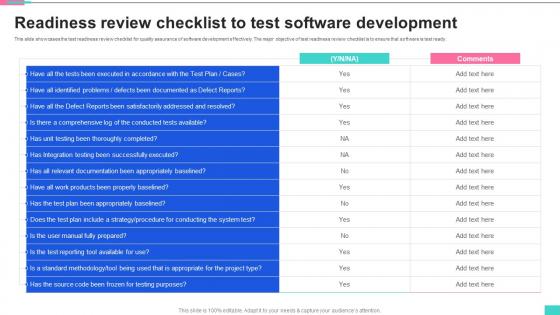
Readiness Review Checklist To Test Software Development




Try Before you Buy Download Free Sample Product
 Impress Your
 Audience
 100%
100% Editable
 Save Hours
 of Time


This slide showcases the test readiness review checklist for quality assurance of software development effectively. The major objective of test readiness review checklist is to ensure that software is test ready.
People who downloaded this PowerPoint presentation also viewed the following :
Readiness Review Checklist To Test Software Development with all 9 slides:
Use our Readiness Review Checklist To Test Software Development to effectively help you save your valuable time. They are readymade to fit into any presentation structure.








FAQs for Readiness Review Checklist To
The key objectives of conducting a readiness review include assessing organizational preparedness, identifying potential risks and gaps, validating resource allocation, ensuring stakeholder alignment, and confirming timeline feasibility. These comprehensive evaluations streamline project execution by minimizing unexpected obstacles, enhancing coordination across departments, and ultimately delivering greater operational efficiency, with many organizations finding that thorough readiness reviews significantly reduce implementation costs and accelerate time-to-market.
A checklist improves readiness review effectiveness by ensuring systematic evaluation, standardizing assessment criteria, and minimizing oversight of critical components. Through structured frameworks, organizations streamline their review processes, enhance consistency across departments, and accelerate decision-making timelines, with many companies finding that comprehensive checklists reduce preparation time while delivering more thorough evaluations and strategic insights.
Project readiness reviews should assess resource availability, stakeholder alignment, scope clarity, risk mitigation strategies, timeline feasibility, and budget allocation. These comprehensive evaluations enable organizations to identify potential bottlenecks, ensure team preparedness, and validate project assumptions, with many companies finding that thorough readiness assessments significantly reduce implementation delays and enhance overall project success rates.
Organizations should perform readiness reviews quarterly for ongoing projects, annually for strategic initiatives, and before major implementations or market changes. This regular cadence enables companies to identify gaps early, adjust resource allocation, and maintain competitive positioning, with many financial services and healthcare organizations finding that consistent quarterly reviews significantly reduce project risks and accelerate successful outcomes.
Common pitfalls include inadequate stakeholder involvement, insufficient documentation review, overlooking interdependencies between systems, rushing timeline assessments, and failing to validate resource availability. These oversights often result in project delays, budget overruns, and implementation challenges, with many organizations finding that thorough preparation and cross-functional collaboration significantly enhance project success rates.
Stakeholder involvement enhances readiness reviews by providing diverse perspectives, identifying overlooked risks, ensuring comprehensive requirements gathering, and building consensus around implementation strategies. Through collaborative input from departments like IT, operations, finance, and end-users, organizations streamline decision-making, reduce project delays, and ultimately deliver more successful outcomes with broader organizational buy-in.
Readiness evaluation metrics include completion rates, competency assessments, resource availability scores, timeline adherence, stakeholder alignment indicators, and risk mitigation status. These metrics enable organizations to measure preparedness across operational, financial, and strategic dimensions, with many institutions finding that combining quantitative benchmarks with qualitative assessments delivers comprehensive readiness visibility and competitive implementation advantage.
Readiness review checklists can be customized by incorporating industry-specific compliance requirements, operational protocols, risk factors, technology standards, and regulatory frameworks unique to each sector. Healthcare organizations emphasize patient safety and HIPAA compliance, while financial services focus on fraud prevention and regulatory audits, and manufacturing prioritizes equipment safety and supply chain resilience, ultimately delivering targeted assessments that address sector-specific challenges and operational excellence.
A readiness review contributes to risk management by identifying potential vulnerabilities, assessing operational gaps, and evaluating resource adequacy before implementation begins. Through systematic evaluation processes, organizations can proactively address compliance issues, technical limitations, and process bottlenecks, while minimizing project delays and cost overruns, ultimately delivering more predictable outcomes and enhanced strategic positioning.
Tools that facilitate readiness review processes include project management platforms like Asana and Monday.com, compliance software such as MetricStream, audit management systems, automated checklist applications, and integrated dashboard solutions. These technologies streamline assessment workflows by centralizing documentation, automating compliance tracking, and providing real-time progress visibility, with many organizations finding that digital readiness platforms reduce review cycles significantly while enhancing accuracy.
Successful case studies inform readiness review checklist development by revealing critical success factors, common failure points, and essential preparation elements across different implementations. These real-world examples help organizations identify key milestones, resource requirements, and risk mitigation strategies, with many companies finding that case study insights significantly enhance their checklist comprehensiveness and implementation success rates.
Documentation serves as the foundation for readiness review processes, providing auditable evidence of compliance, risk assessments, operational procedures, training records, and system configurations. Through comprehensive documentation, organizations can demonstrate regulatory adherence, identify potential gaps, and ensure stakeholders have clear visibility into project status, ultimately enabling faster approvals and reducing deployment risks across complex business environments.
Feedback from readiness reviews can be integrated into project planning by updating risk assessments, adjusting timelines, reallocating resources, and modifying deliverable specifications based on identified gaps. This strategic integration enables project managers to address potential issues proactively, enhance stakeholder alignment, and streamline execution phases, with many organizations finding that incorporating review insights ultimately delivers higher success rates and reduced project overruns.
Essential readiness review checklist templates include project scope verification, resource allocation assessment, stakeholder alignment confirmation, risk mitigation strategies, and timeline validation milestones. These comprehensive frameworks streamline project launches by ensuring operational preparedness, identifying potential bottlenecks, and validating delivery capabilities, with many organizations finding that structured readiness assessments ultimately reduce project delays and enhance overall execution success rates.
Organizations ensure continuous improvement by establishing regular review cycles, creating action plans from assessment findings, and implementing feedback mechanisms that track progress over time. This approach enables companies to identify operational gaps, enhance strategic alignment, and strengthen competitive positioning, with many enterprises finding that systematic readiness evaluations ultimately deliver measurable performance gains and organizational resilience.
-
Wonderful templates design to use in business meetings.
-
Top Quality presentations that are easily editable.
-
Very well designed and informative templates.
-
Excellent work done on template design and graphics.