

Rehabilitation Equipment Powerpoint Template Bundles Ppt Template





Try Before you Buy Download Free Sample Product
 Impress Your
Audience
 100%
Editable
 Save Hours
of Time


Our Rehabilitation Equipment Powerpoint Template Bundles Ppt Template are topically designed to provide an attractive backdrop to any subject. Use them to look like a presentation pro.
People who downloaded this PowerPoint presentation also viewed the following :
Content of this Powerpoint Presentation
Slide 1: This slide introduces Rehabilitation Equipment. State your company name and begin.
Slide 2: The purpose of this slide is to compare different types of rehabilitation equipment and provide insights based on specific purposes and use in rehabilitation programs. It includes elements such as bosu ball, medicine ball, etc.
Slide 3: The purpose of this slide is to showcase key advancements from various companies to inform stakeholders about notable advancements shaping field of rehabilitation technology. It includes elements such as year, company, headquarters, etc.
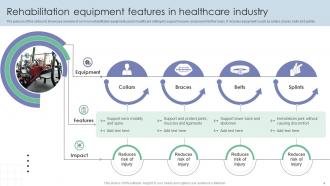
Slide 4: The purpose of this slide is to showcase overview of common rehabilitation equipment used in healthcare settings to support recovery and prevent further injury. It includes equipment’s such as collars, braces, belts and splints.
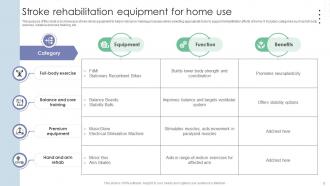
Slide 5: The purpose of this slide is to showcase stroke rehab equipment to help in decision-making processes when selecting appropriate tools to support rehabilitation efforts at home. It includes categories such as full-body exercise, balance and core training, etc.
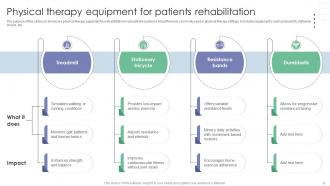
Slide 6: The purpose of this slide is to showcase physical therapy equipment for rehabilitation to educate the audience about the tools commonly used in physical therapy settings. It includes equipment’s such as treadmill, stationery bicycle, etc.
Slide 7: The purpose of this slide is to showcase essential physiotherapy equipment for home rehabilitation to assist in improving coordination, strength, stamina. It includes equipment such as nordictrack, treatment tables, etc.
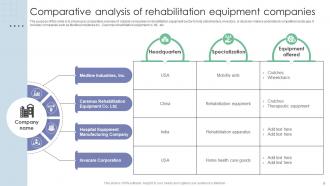
Slide 8: The purpose of this slide is to showcase comparative overview of notable companies in rehabilitation equipment sector to help stakeholders, investors, or decision-makers understand competitive landscape. It includes companies such as Medline industries inc., Caremax rehabilitation equipment co. ltd., etc.
Slide 9: The purpose of this slide is to showcase inform audience about types of equipment and tools commonly used in pediatric physical therapy sessions. It includes equipment such as balance equipment, parallel bars, etc.
Slide 10: The purpose of this slide is to showcase current and emerging trends in rehabilitation robotic equipment market to inform audience about key developments and innovations shaping industry. It includes trends such as home-based rehabilitation solutions, rise of soft robotics, etc.
Slide 11: The purpose of this slide is to showcase equipment to assist healthcare professionals, therapists, and facility managers in selecting most appropriate hydrotherapy equipment. It includes elements such as underwater bicycle, underwater T treadmill, etc.
Slide 12: The purpose of this slide is to showcase overview of key neurological rehabilitation equipment used for patient recovery by improving quality of care. It includes elements such as active and passive trainers, cardio equipment, etc.
Slide 13: The purpose of this slide is to showcase market share by region estimated to contribute to growth of global market during forecast period. It shows North America as largest market due to prevalence of non-communicable diseases, etc.
Slide 14: The purpose of this slide is to showcase key market drivers that are shaping rehabilitation equipment market. It includes drivers such as growing geriatric population, technological advances in rehabilitation technology, etc.
Slide 15: The purpose of this slide is to showcase rehabilitation equipment market size forecast between year 2024 to 2031 at a CAGR of 4.68%. It includes key insights such as increase in ageing populations and chronic diseases, etc.
Slide 16: This slide shows Stoke patients rehabilitation equipment icon.
Slide 17: This slide presents Physical therapy rehabilitation equipment icon.
Slide 18: This slide displays Sports rehabilitation equipment icon for athletes.
Slide 19: This is a Thank You slide with address, contact numbers and email address.
Rehabilitation Equipment Powerpoint Template Bundles Ppt Template with all 27 slides:
Use our Rehabilitation Equipment Powerpoint Template Bundles Ppt Template to effectively help you save your valuable time. They are readymade to fit into any presentation structure.













FAQs for Rehabilitation Equipment Powerpoint Template
AI exoskeletons are crazy right now - they actually learn how each patient moves and adjust automatically. VR rehab is where it's at though, turns boring exercises into games and patients actually want to do them. Smart sensors track everything and send data straight to apps so you can monitor remotely. Robot therapy devices used to cost a fortune but they're way more accessible now. Oh and the integration is sick - one dashboard shows progress from all your different tools. Honestly just depends what kind of patients you're working with mostly.
Honestly, rehab equipment is a game changer - way more precise than just doing manual stuff. You can dial in exactly which muscles you're hitting and track real numbers, which patients actually get excited about (makes them way less whiny lol). The resistance adjustments are super gradual too, something you just can't do by hand. What's cool is you can set up movements that match what they'll actually do at home or work. I'd grab some basic resistance bands and balance boards first - you'll notice people bouncing back faster. Oh and the data tracking keeps everyone honest about progress.
So telehealth is pretty much a lifesaver for remote patient monitoring with rehab equipment. Post-COVID especially, it's been huge. You can jump on video calls to check their form, tweak settings on smart equipment remotely, and see their progress data without them schlepping to your clinic. The newer stuff has cameras and sensors that actually catch when patients mess up exercises - which honestly blows my mind sometimes. Your patients stay motivated with home programs while you're still giving them real guidance. I'd start with your most reliable current patients as test cases since they'll probably adapt quicker to the tech side of things.
Start with your patient mix - what ages and conditions you're dealing with. Budget and space matter more than people realize (some machines are literally massive). Your staff has to actually want to use this stuff, so don't pick something that'll scare them off. Maintenance costs can bite you later, and honestly, half the vendors won't tell you upfront how much training really takes. Make sure it can scale if you grow. Write down your top 3 priorities before you meet with anyone - they'll try to sell you everything otherwise. Trust me on that one.
So adaptive tech is pretty cool - it personalizes rehab based on your specific situation instead of generic exercises. You get programs that adjust as you improve. Smart prosthetics learn how you move, VR makes physical therapy way less boring (thank god). The tracking is super precise compared to old-school methods, so therapists can tweak things quickly. Most of it works at home too between sessions, which is clutch. Honestly, if you're dealing with rehab patients, look into what's available - I've seen way better results with this stuff than traditional approaches.
So you'll mainly see parallel bars for gait training, plus standing frames that help rebuild leg strength. There's tons of upper body stuff too - arm bikes, functional electrical stimulation units, that kind of thing. Physical therapy mats are literally everywhere (honestly they're like the duct tape of rehab). Balance training gear is huge - wobble boards, weight-shifting platforms. Oh, and ADL equipment for practicing daily tasks. The trick is matching gear to where they are in recovery. Don't throw someone on complex equipment if they're still figuring out basic motor control, you know?
Oh man, kids' rehab gear is totally different from adult stuff. First off, everything needs to be adjustable - like wheelchairs that grow with them or therapy bikes where you can pop off the training wheels. Make it fun though, that's key. Bright colors, games, maybe some cartoon characters - basically anything to trick them into thinking it's playtime instead of therapy. Safety's obviously huge too, so extra padding and rounded edges everywhere. Honestly, I'd just find suppliers who do pediatric-only equipment since they actually get what different age groups need.
Yeah, so the expensive stuff costs like 3-5x more upfront but honestly? It usually works out better long-term. Better patient results, less maintenance headaches, lasts way longer. We made the mistake of going cheap on our first PT setup and regretted it - constant repairs are the worst. Budget gear looks tempting but you'll be replacing it sooner than you think. Here's what I'd do: figure out what features you actually NEED vs what sounds cool. Then compare the total cost over like 5-7 years, not just the initial price tag. There's definitely a sweet spot where you get good functionality without paying for fancy stuff you'll never use.
Honestly, design is everything for user engagement. If your equipment looks boring or feels clunky, people just won't use it - period. You want smooth functionality and intuitive interfaces that don't frustrate someone who's already dealing with recovery stuff. Appealing colors help too. Gaming elements are surprisingly effective - progress bars, achievement badges, whatever keeps them coming back. I've seen rehab bikes that look straight out of a 1985 hospital basement, and yeah, compliance rates were terrible. Make it feel more like consumer tech than medical equipment whenever you can. Way better results that way.
Definitely check for emergency stops first - those things are lifesavers, literally. Weight limits should be super obvious, not hidden in fine print somewhere. Non-slip surfaces are a must too. Most newer stuff has automatic shut-offs which is nice, plus harness points for fall protection. Adjustable safety straps and rounded edges matter more than you'd think. Oh, and make sure there's clear indicators showing when it's running - sounds basic but you'd be surprised. Just verify it meets FDA standards and train your people on where everything is. Trust me on the emergency stops though.
Dude, the newer rehab gear has sensors that track everything - range of motion, how much force they're putting out, balance scores, all that stuff. You can literally watch their progress update live on your screen which is honestly pretty satisfying. Everything gets saved to the cloud so pulling up trends between sessions is super easy. Oh and some machines will actually ping you when someone hits a milestone or if they're struggling. Just make sure whatever you get plays nice with your EMR system because bouncing between different platforms all day is the worst. Trust me on that one.
Honestly, just get into a solid routine with it. Daily quick checks, then do a thorough cleaning weekly. Monthly mechanical stuff too. Actually follow what the manufacturer says - I learned that one the hard way when warranty got voided. Write down everything: hours used, when you cleaned it, if it starts making weird sounds. Oh and make sure everyone on your team knows how to clean properly since each machine is different. Don't be that person who waits until it breaks to call service. Trust me, preventive stuff costs way less than emergency repairs, plus your patients are counting on it working right.
Dude, VR basically turns those mind-numbing rehab exercises into actual games people want to play. Patients get real-time feedback and the difficulty adjusts to them automatically - no more dreading therapy sessions. The immersive stuff is amazing for distracting from pain too. I watched this one patient reaching for virtual butterflies while working on range of motion and honestly got a little jealous of how fun it looked lol. Compliance rates shoot up because it doesn't feel like "medical stuff" anymore. Plus you get crazy precise data on their progress that beats traditional tracking by miles. I'd say start with just one system and test it out.
Honestly, the money thing hits first - that equipment costs a fortune. Your staff won't know how to use half of it without serious training, which is another expense. Space becomes this weird puzzle, especially in smaller places. Oh and equipment WILL break at the worst possible moment, trust me on that one. Some patients just hate new tech and want the old-school approach. Technology moves so fast too, so whatever you buy feels ancient in like two years. I'd say go for stuff that's actually user-friendly and don't cheap out on training your people properly upfront.
So there's some cool stuff happening right now. AI therapy programs that actually adapt as patients get better - pretty wild. VR rehab is getting big too, way more engaging than traditional methods. Wearable sensors let you track people at home, which honestly saves everyone time. Robotic exoskeletons are still expensive but coming down in price. The telehealth thing is massive - you can adjust treatment plans remotely instead of dragging patients in constantly. Everything's shifting toward this data-heavy approach that follows patients wherever they are. I'd start looking at what plays nice with your current EMR system first.
-
My search for complete decks ended with SlideTeam. Such a surplus collection of HD PowerPoints. Moreover, their standard and widescreen formats have helped me in delivering bullseye presentations.
-
Great combination of visuals and information. Glad I purchased your subscription.