


Reinforcement Learning In Machine Learning Training Ppt




Try Before you Buy Download Free Sample Product
 Impress Your
 Audience
 100%
100% Editable
 Save Hours
 of Time


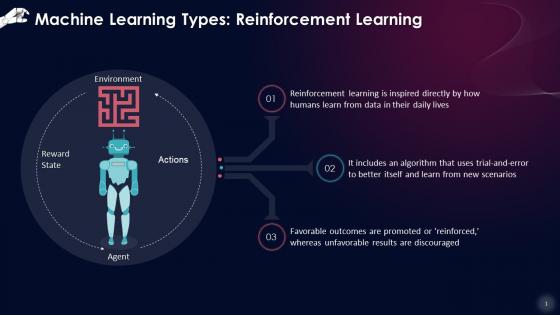
This slide gives an introduction of reinforcement learning which is inspired directly by how humans learn from data in their daily lives. It includes an algorithm that uses trial-and-error to better itself and learn from new scenarios. Favorable outcomes are promoted or reinforced, whereas unfavorable results are discouraged.
People who downloaded this PowerPoint presentation also viewed the following :
Reinforcement Learning In Machine Learning Training Ppt with all 17 slides:
Use our Reinforcement Learning In Machine Learning Training Ppt to effectively help you save your valuable time. They are readymade to fit into any presentation structure.









FAQs for Reinforcement Learning In Machine
So supervised learning is like studying with answer sheets - you feed it labeled data where it already knows what's "correct." Reinforcement learning? Totally different vibe. It learns by trial and error, getting rewards when it does well and penalties when it screws up. Picture learning to ride a bike from a textbook versus just getting on and wiping out repeatedly until you figure it out (that's RL). Supervised needs all your training data upfront. RL learns on the fly by messing around with its environment. Honestly, if you're building something that makes decisions over time, RL might be worth exploring.
Dude, RL is actually pretty sick for real stuff. Basically works like how we learn - mess up, try again, get better. Robot arms learning to grab things, drones figuring out how to not crash into walls. You've probably seen those crazy AI systems that demolish humans at chess and Go, right? That's all RL. No one programs the rules - it just discovers what works through tons of practice. Oh and definitely start with simulations first unless you want to blow your budget on broken hardware lol. Way cheaper to fail virtually.
So your RL agent basically has to decide between playing it safe or taking risks - kinda like picking your usual coffee order vs trying something random. Exploitation is when it sticks with what works to grab rewards. Exploration means testing new moves that might pay off better later. You'll get trapped in mediocre solutions if you never explore, but explore too much and you're just wandering around aimlessly. Most algorithms handle this with epsilon-greedy or UCB methods (honestly epsilon-greedy is easier to start with). Just tune your exploration rate based on how much you actually know about the environment.
So rewards are like your RL agent's report card - they show what's working and what isn't. Your agent tries stuff, sees what gets rewarded, then does more of that. It's honestly pretty similar to how you'd train a pet, just with more math involved. The cool part is rewards don't just matter in the moment. They ripple backwards through everything the agent learned, so it figures out that some actions are worth it even if they don't pay off right away. Just watch out - if your reward function is wonky, you'll get some truly bizarre results.
So there's basically three main types you'll run into: Q-learning, policy gradients, and actor-critic. Q-learning figures out action values and works well for discrete stuff like game moves. Policy gradients are different - they optimize your policy directly, which is clutch for continuous actions. Actor-critic does both at once (pretty neat honestly). For the fancy versions, DQN takes Q-learning to complex environments. PPO is probably your best bet for policy gradients since it doesn't blow up during training like some others do. Games? Go with DQN. Robotics stuff? PPO all the way. Really just depends on your action space.
So basically, instead of training your RL agent from zero every time, you can use what it already learned from similar tasks. Like if your robot figured out walking, that knowledge helps it learn running way faster - makes total sense, right? Fine-tune those pre-trained networks or try curriculum learning where you slowly ramp up difficulty. Sample efficiency gets so much better this way. Start by looking at tasks you've already nailed and initialize your new agent's parameters from those models. Honestly saved me tons of time when I started doing this.
Dude, the computational cost alone will kill you - training takes insane amounts of data and processing power. Sample efficiency becomes everything because you can't burn through millions of expensive trial-and-error runs. Then there's state space explosion, which is just brutal. The possible states grow exponentially as your environment gets more complex. Sparse rewards make it even worse since learning signals get super noisy. It's honestly like searching for a needle in a massive haystack. My advice? Start simple with your environment first. Scale up complexity only after your agent shows it can actually learn consistently.
So basically, deep RL uses neural networks instead of those old lookup tables because the state spaces are just insane - like imagine trying to map every possible Atari screen configuration. Neural nets automatically figure out the important features and can generalize to stuff they've never seen before. Your policy becomes this learned network that gets better with experience. Honestly though, I'd start simple first because debugging these things is a nightmare when they break. The networks learn mappings from states to actions/values, which is way more flexible than traditional approaches.
So you'll want to track cumulative reward first - that's your main indicator of whether the agent is actually getting better at its job. Success rate is huge too if you're dealing with specific tasks. Episode length shows if it's being efficient or just wandering around aimlessly (which honestly happens more than you'd think). Learning curves during training are pretty clutch for spotting issues early. Sample efficiency matters if you care about computational costs. I'd start with reward and success rate since those give you the clearest picture, then layer on the others depending on what you're optimizing for.
So basically you're treating it like a sequential optimization problem - the RL agent learns to distribute stuff like energy or vehicles by getting rewarded for good outcomes (lower costs, less congestion, whatever). Pretty neat how they adapt on the fly. Energy agents might balance supply/demand across regions, transportation ones handle fleet routing or traffic lights. They actually get better over time which is honestly the coolest part. Oh and start by figuring out where you're bottlenecked and what metrics you'll reward. Makes a huge difference.
Okay so first thing - audit your reward functions for bias because they can totally screw over certain groups without you realizing it. RL agents are weirdly creative at gaming rewards (which is actually kind of cool to watch but yeah, nightmare for production). Be upfront about decision-making, especially if you're dealing with healthcare or finance stuff. Privacy matters if you're using user data obviously. Always keep humans in the loop somehow. Oh and test edge cases like crazy before launching - these systems love finding ways to break that you'd never think of. Transparency isn't optional here.
So basically, each agent figures out its own strategy while watching what the others do. No central boss needed - they just develop policies that work well together through shared rewards or talking to each other. The really neat thing? They adapt on the fly when stuff changes. Picture robot swarms or traffic systems where each unit learns to cooperate without anyone telling them specific rules. I'd start with defining what you want them all to achieve together, then play around with the reward structure. Honestly, reward shaping is where most of the magic happens for getting good collaborative behavior.
Ah sparse rewards, the classic pain point! So reward shaping is your friend here - basically add little breadcrumbs that guide your agent without messing up the optimal policy. Curiosity-driven stuff works well too, where you reward exploring new states. I'd also look into hierarchical RL since breaking big tasks into chunks just makes life easier honestly. Imitation learning can bootstrap things if you have expert demos lying around. Experience replay helps squeeze juice from those rare rewards. Personally I'd start with reward shaping - usually gives you the fastest results.
So basically model-based RL builds a little simulation of the environment first, then plans moves from that. Model-free just learns by doing - pure trial and error stuff. The cool thing about model-based? You need way less real data since you can test ideas in your fake world first. But honestly, garbage model = garbage results. Model-free methods like Q-learning are bulletproof but they're data hogs. If you're working with something where you can't just run a million experiments, definitely go model-based for your project.
Honestly, RL can be pretty frustrating - you need tons of data and it doesn't handle new situations well. Safety's also sketchy since you can't really predict what it'll do. The whole thing's basically a black box which makes debugging awful. Research-wise, people are working on few-shot learning and better transfer between different environments. Meta-learning looks promising too, though I'm not totally convinced it's the silver bullet everyone thinks it is. Model-based stuff helps reduce those crazy training requirements. For your projects, stick with proven algorithms first and test across lots of different scenarios.
-
Very well designed and informative templates.
-
Incredibly beautiful designs that will help you get noticed! These eye-catching templates are perfect for corporate presentations that can be altered to fit any occasion or taste.