


Mlops Lifecycle Model For Successful Process Automation





Try Before you Buy Download Free Sample Product
 Impress Your
 Audience
 100%
100% Editable
 Save Hours
 of Time


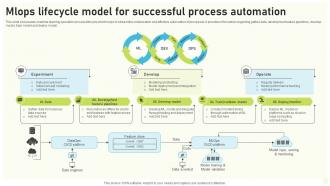
This slide showcases machine learning operation process lifecycle which helps to streamline collaboration and effective automation of processes. It provides information regarding gather data, develop test feature pipelines, develop model, train model and deploy model.
People who downloaded this PowerPoint presentation also viewed the following :
Mlops Lifecycle Model For Successful Process Automation with all 6 slides:
Use our Mlops Lifecycle Model For Successful Process Automation to effectively help you save your valuable time. They are readymade to fit into any presentation structure.





FAQs for Mlops Lifecycle Model For
First thing - get your data and model versioning locked down, that's your foundation. Then build out CI/CD pipelines around it. Docker containers are basically mandatory at this point. You'll need experiment tracking and model monitoring too, because honestly models just... drift without warning. Testing is where most teams face-plant but you can't skip it. Data validation, orchestration tools, infrastructure as code - yeah it sounds like a lot. Start small though. Version control everything first, then automate piece by piece. The monitoring stuff will save you headaches later when your model starts acting weird in production.
Basically MLOps stops the whole "data scientists vs ops teams" thing by giving everyone the same playbook. Both sides use the same tools for version control, testing, automated deployments - all that good stuff. No more of that annoying "works on my machine" back-and-forth (seriously, we've all been there). The magic happens when your dev and production environments actually match, plus you get monitoring that tracks both model accuracy and system performance. Honestly? Just start with one shared tool for model tracking. Forces everyone to finally speak the same language about what's getting deployed when.
Honestly, automation is what keeps MLOps from being a total nightmare. It takes care of all the tedious stuff - data prep, training, testing, deployment. The best part? It spots problems before they blow up your production models. No more getting woken up at 3 AM because something crashed. Your models stay fresh too since they retrain automatically when new data shows up. Oh, and definitely start small - just pick whatever manual task is annoying you most right now and automate that first. You can always expand later once you've got the hang of it.
Honestly, just focus on deployment frequency first - how fast you're actually getting models live. Model drift is huge too, plus how quickly you catch problems when they pop up. Time-to-market matters most to the bosses, so track that for sure. Are your data scientists doing real work or just fighting with broken systems all day? That's a good sanity check. I'd also watch rollback rates and recovery time when stuff inevitably breaks. Pick maybe 2-3 things that match your biggest headaches right now. Don't overthink it.
Honestly, data versioning will make you want to pull your hair out. Model drift detection is another nightmare, plus scaling infrastructure when things actually matter. The worst part? Getting data scientists (who live in Jupyter notebooks) to play nice with DevOps people who want everything containerized. It's genuinely painful sometimes. Monitoring models in production gets messy fast, and don't get me started on feature stores - they're way more complex than they look. My take: start with just one pipeline, nail down monitoring first, then slowly expand. Don't try to build everything at once or you'll go crazy.
Dude, Git's awesome for code but absolutely useless for anything else ML-related. Try versioning a 50GB dataset with it - good luck! You're dealing with way more stuff now: datasets, model weights, hyperparameters, even the environment everything ran on. Plus you need to track lineage - like knowing exactly which data and code combo gave you that one amazing model you can't reproduce anymore (been there). Tools like DVC or MLflow handle this mess way better. Honestly, just pick one experiment tracker before you lose your sanity trying to remember what actually worked.
Automated monitoring is a must - track your core stuff like accuracy, precision, recall over time. Watch for data drift too since that'll kill your model performance fast. System health matters just as much honestly, users will complain if things get laggy. Don't go crazy with alerts though, you'll hate yourself when you're getting notifications constantly. I'd start with basic dashboards first, then build out from there. Oh and prediction distributions - super helpful for catching weird shifts early. Trust me, I've watched models slowly die because no one was actually monitoring them properly.
Build compliance into your MLOps pipeline from day one - don't try adding it later, it's a nightmare. Automated bias detection and fairness checks should run at training, validation, and production. Document absolutely everything because auditors are obsessed with paper trails (learned this the hard way). Role-based access controls are crucial so random people can't mess with your models. Also set up governance committees with both tech and business folks. Honestly, the whole point is making compliance automatic so your team doesn't have to constantly think about it.
MLflow's probably your best bet to start - it's free and pretty straightforward to get running. Kubeflow works great if you're already doing Kubernetes stuff. SageMaker's solid when you're on AWS. Honestly? DataBricks has this whole unified thing going that's pretty slick. Weights & Biases has insane visualizations too, like seriously impressive dashboards. There's also Airflow for orchestration but that's more general workflow stuff, not ML-focused. I'd just go with MLflow first since it won't cost you anything, then see what else you actually need. No point overcomplicating it right away.
So MLOps basically takes regular CI/CD and extends it for ML workflows - handles data validation, model training, deployment, monitoring, the whole thing. It's pretty neat because it deals with ML-specific stuff like model versioning and A/B testing that regular software pipelines don't need. When your model starts going haywire in production, you've got automated rollback strategies ready. Plus there's continuous retraining as fresh data flows in, which honestly is where things get interesting. My advice? Don't overthink it - just pick one model and automate its deployment first. You can always build from there.
Dude, MLOps is a game changer for scaling. You automate deployments and standardize model packaging, which means no more manually pushing updates everywhere - that was the worst. Monitoring becomes automatic, plus you get containerization and version control so your team can deploy stuff independently. The CI/CD workflows let you iterate way faster too. Honestly, I'd just start small - containerize one model and set up basic monitoring first. You'll be shocked how much smoother everything runs. Also the automated scaling based on demand is pretty sweet once you get it going.
Dude, data quality will make or break your whole MLOps setup. Bad data in = garbage models out, and those flaws just cascade through everything. I watched one team nail their deployment process but totally bomb because they skipped proper data validation - such a waste of time. You gotta build in automated quality checks before training even starts. Monitor for data drift once you're in production too. Short version: clean your data religiously or you're basically setting money on fire. Trust me on this one.
Honestly, just think of it like having separate playgrounds. Your data scientists need their own dev/staging spaces to mess around without breaking anything live. Feature flags are clutch here - you can test new models on like 5% of traffic while the old one handles everything else. Set up clear benchmarks ahead of time (accuracy scores, speed tests, whatever matters) so you know when something's actually ready to promote. The whole dev→staging→prod thing works great, though I'd start simple since these pipelines can get crazy complex fast. Oh, and automated testing saves your butt - don't skip that part.
Honestly, MLOps is about to get way smarter - think platforms that automatically retrain your models when they spot drift. Deployment's becoming almost effortless with better cloud integration. Those drag-and-drop ML tools for non-tech people? They're actually taking off faster than I expected. Edge computing is where the real action's happening though - real-time inference at massive scale. Oh, and definitely get comfortable with model versioning and monitoring now. Trust me on this one. Organizations are maturing fast and you don't want to be scrambling to catch up later.
Honestly, MLOps is a game-changer for data handling. It automates validation and tracks where everything comes from - no more mystery datasets! Data drift detection is huge too; catching problems early beats scrambling when your model randomly starts sucking in production. The real magic happens with consistent pipelines from dev to deployment. Oh, and definitely start with validation checks first (learned that the hard way). You'll actually know what's happening with your data instead of just crossing your fingers and hoping it works.
-
Easily Understandable slides.
-
What an exhaustive collection of templates you guys have there in slideteam. Impressive!!!