

Mlops Process Lifecycle Maturity Model





Try Before you Buy Download Free Sample Product
 Impress Your
 Audience
 100%
100% Editable
 Save Hours
 of Time


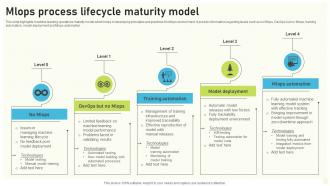
This slide highlights machine learning operations maturity model which helps in developing principles and practices for Mlops environment. It provide information regarding levels such as no Mlops, DevOps but no Mlops, training automation, model deployment and Mlops automation.
People who downloaded this PowerPoint presentation also viewed the following :
Mlops Process Lifecycle Maturity Model with all 6 slides:
Use our Mlops Process Lifecycle Maturity Model to effectively help you save your valuable time. They are readymade to fit into any presentation structure.





FAQs for Mlops Process
Honestly, start with automating your deployment pipeline - that's gonna save you the most headaches. Version control is obvious but don't forget to track your data changes too, not just code. MLflow works great for experiment tracking once you get there. You'll need some model registry to keep versions straight. Data validation is clutch because garbage data kills everything downstream. Oh and monitoring is probably more important than people think - models just... drift sometimes and you won't even notice until it's too late. Build the basics first, then add the fancy experiment stuff as you grow.
MLOps basically fixes that whole mess where data scientists build models and then ops teams have no clue how to deploy them. You get everyone using the same tools for version control, monitoring, testing - all that stuff. Both teams can actually see what's happening with model performance instead of playing telephone when something breaks. Honestly, the shared dashboards alone will save you so many headaches. No more 2am panic calls about models acting weird. Start there and work backwards - once everyone can see the same metrics, collaboration gets way easier and deployments stop being such a nightmare.
Dude, automation is what saves your sanity in MLOps. Without it you'd be manually retraining models every time data shifts - which happens way more than you'd think. Start with whatever manual task is driving you nuts right now, then expand from there. It handles data pipelines, training, testing, deployments, monitoring... basically everything repetitive. Consistency across environments? Automated. Early bug catching? Also automated. I learned this the hard way after spending weekends babysitting model deployments. Trust me, automate early and often.
Track your code with Git for sure, but ML is messier than regular dev work. Data versioning is huge - DVC works well for this. Models are weird because they're basically code + data + hyperparameters all smooshed together, so you can't just commit them like normal files. MLflow or Weights & Biases are solid for model registries. Honestly, I'd start simple - just auto-tag each model with the commit hash, dataset version, and key metrics. That way you can trace back to how you built anything later when things inevitably break.
Honestly, start with data drift monitoring - your input distributions will shift and mess everything up if you're not watching. Track model performance over time too, because accuracy drops are sneaky. Set up dashboards for both of these. A/B testing frameworks are clutch for safe deployments. Oh, and definitely version your models with rollback options - I learned that one the hard way lol. MLflow or Weights & Biases work great as starter tools before you go building anything custom. Automated alerts will save your sanity when things inevitably break at 3am.
So basically you're adding data validation and model testing on top of your regular CI/CD stuff. The weird thing is now you're dealing with models and datasets as your main artifacts instead of just code - which honestly took me a while to wrap my head around. You'll want tools like DVC for versioning and MLflow for tracking experiments. Set it up so models automatically retrain when performance tanks, and definitely build in rollbacks for when new models suck worse than the old ones. Oh, and don't forget data drift checks - that'll bite you later. Start simple with basic model validation tests first.
Track your usual suspects first - accuracy, precision, recall, F1 score. Same metrics from training basically. But real-world data gets weird fast, so watch for drift and model decay too. Latency and error rates matter on the ops side, plus resource usage if you're not trying to bankrupt the company. Oh and don't ignore business stuff like conversion rates - that's what actually pays the bills. Honestly though? Pick like 3-5 metrics max. Nobody's gonna look at 20 different dashboards anyway.
So MLOps basically saves your butt by building validation checks right into your pipelines. Catches stuff like schema changes or missing data before it breaks everything. Version control is huge too - track your datasets, models, code, the whole mess. Way better than the chaos I used to deal with honestly. Distribution shifts used to kill me until I got this setup running. Start small though - just add some basic data tests to your pipeline first and version your datasets with your code. Trust me, you'll thank yourself later when compliance comes knocking.
So the main ones everyone's using are Kubeflow, MLflow, plus all the cloud stuff - AWS SageMaker, Google Vertex AI, Azure ML. Docker and Kubernetes are basically mandatory now for containerization. GitHub Actions and Jenkins handle most CI/CD workflows. Oh, and you'll want Weights & Biases for tracking experiments, DVC for data versioning. Honestly though? Just start with MLflow. It's free, doesn't take forever to figure out, and handles the basics you actually need. You can always add more tools later once you're not drowning in setup.
Honestly, start with baseline metrics before you implement anything - that's key. Track deployment times dropping from weeks to hours, plus fewer production fires. Infrastructure costs usually go down too once you're managing resources better. The time-to-value piece is where you'll see the biggest wins though. Models that took forever now deploy in days. Your data scientists will thank you since they can focus on actual modeling instead of dealing with ops headaches. I'd measure deployment frequency, model consistency, and how fast you handle incidents. Check these quarterly and you'll have solid ROI numbers.
The hardest part? Completely flipping how you think about ML work. Instead of just making models function, you're suddenly worrying about keeping them stable long-term. Docker, CI/CD, monitoring - it's a lot of new tech to absorb honestly. Your coding needs to get way cleaner too since those messy Jupyter notebooks won't fly anymore. Data versioning becomes this whole thing, plus you're constantly dealing with model drift and governance issues. I'd say start simple though - pick one tool, maybe focus on containerizing stuff first. Don't try tackling the entire production pipeline right away or you'll go insane.
Dude, ethics aren't just something you tack on at the end - they're literally part of every step. Your training data has bias. Your predictions might be unfair to certain groups. Monitoring becomes critical because you're watching for discrimination or weird drift that actually hurts people. I learned this the hard way when I saw a job rec system only showing certain ads to specific demographics - yikes. Short version: build bias checks into your automated tests and make it standard validation stuff. Otherwise you'll be fixing problems after they've already screwed people over.
Honestly, you can't skip explainability if you want people to actually trust your models. When things break in production (and they will), you need to know why your model made weird predictions. Healthcare, finance, hiring - try telling stakeholders "the algorithm just decided" and see how that goes. Explainability also catches drift and bias before they tank your metrics. I always throw SHAP or LIME into my monitoring setup from day one. Yeah, it's extra work upfront, but beats scrambling to debug a mysterious model failure at 2am. Trust me on this one.
So basically MLOps tracks everything - your data, models, code, all of it. Version control becomes your best friend because you'll know exactly what went into each model. Trust me, this saves you from those awkward "uh... how did we even build this?" conversations. The compliance part is huge too. You get automatic audit trails that document your whole pipeline, which makes regulatory stuff way less of a headache. Honestly, the bias testing and performance tracking documentation pretty much writes itself. I'd start with experiment tracking first - stakeholders always come asking questions later and you'll actually have answers ready.
MLOps is getting way more automated - like, everything from model retraining to monitoring will run itself soon. Platforms are finally becoming user-friendly enough that you don't need a PhD to deploy stuff. Prompt engineering completely flipped the script too (still can't believe how fast that happened). Regulatory tools are exploding since everyone's freaking out about AI governance now. Honestly? Just get familiar with whatever automation your company's using. Manual model management is basically dead already. Oh, and the monitoring tools actually catch problems before they blow up your system, which is nice for once.
-
Unique and attractive product design.
-
I have been using SlideTeam for the past six months. Very happy and satisfied!