Vulnerability Management Maturity Model Process Flow
Try Before you Buy Download Free Sample Product
Audience
Editable
of Time
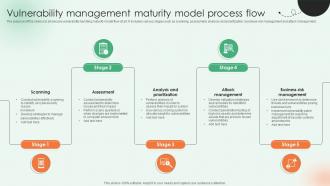
The purpose of this slide is to showcase vulnerability handling maturity model flow chart. It includes various stages such as scanning, assessment, analysis and prioritization, business-risk management and attack management.
People who downloaded this PowerPoint presentation also viewed the following :
Vulnerability Management Maturity Model Process Flow with all 6 slides:
Use our Vulnerability Management Maturity Model Process Flow to effectively help you save your valuable time. They are readymade to fit into any presentation structure.
FAQs for Vulnerability Management Maturity
Vulnerability assessment involves identifying and cataloging security weaknesses through scanning and testing, while vulnerability management encompasses the complete lifecycle of discovering, prioritizing, remediating, and continuously monitoring vulnerabilities. Through comprehensive management programs, organizations streamline security operations, reduce exposure windows, and maintain stronger defense postures, with many enterprises finding that integrated approaches deliver faster incident response and improved regulatory compliance.
Organizations prioritize vulnerabilities through risk-based scoring systems that evaluate factors like exploit likelihood, asset criticality, business impact, and threat intelligence data. This strategic approach enables security teams to address high-risk vulnerabilities first, allocate resources efficiently, and minimize exposure windows, with many enterprises finding that contextual prioritization reduces remediation time while enhancing overall security posture.
Automation streamlines vulnerability management by accelerating discovery, prioritizing risks, and orchestrating remediation workflows across complex IT environments. Through automated scanning tools and response systems, organizations minimize manual oversight, reduce response times, and ensure consistent security protocols, with many enterprises finding that automation enables faster threat mitigation while optimizing resource allocation.
In dynamic IT environments, vulnerability scans should be conducted weekly for critical systems, monthly for standard infrastructure, and continuously for high-risk assets using automated tools. Organizations with frequent deployments, cloud integrations, and evolving threat landscapes increasingly implement real-time scanning solutions, ultimately delivering faster threat detection and enhanced security posture.
Best practices for remediating high-risk vulnerabilities include establishing automated patch management systems, implementing risk-based prioritization frameworks, creating dedicated security response teams, maintaining comprehensive asset inventories, and developing standardized remediation workflows. These approaches streamline security operations by reducing response times, minimizing exposure windows, and ensuring consistent protection across enterprise environments, with many organizations finding that strategic automation delivers faster incident resolution and enhanced operational resilience.
Vulnerability management integrates into SDLC through threat modeling during design phases, static code analysis during development, dynamic testing in staging environments, and automated security scanning in CI/CD pipelines. This strategic combination enables organizations to identify and remediate security flaws early, significantly reducing remediation costs while accelerating secure software delivery and maintaining competitive advantage.
Effective continuous vulnerability monitoring tools include Nessus, Qualys VMDR, Rapid7 InsightVM, OpenVAS, and Greenbone Security Manager. These platforms streamline threat detection by automating scans, prioritizing critical vulnerabilities, and integrating with existing security frameworks, with many organizations finding that real-time monitoring significantly reduces exposure windows and enhances overall security posture.
Regulations and compliance standards significantly shape vulnerability management strategies by mandating specific security controls, reporting requirements, and remediation timelines across industries. Organizations in healthcare, finance, and government must align their vulnerability programs with frameworks like HIPAA, PCI DSS, and NIST, ultimately delivering enhanced security posture while meeting regulatory obligations and avoiding costly penalties.
Common challenges include resource constraints, tool sprawl across multiple security platforms, prioritizing vulnerabilities based on actual risk, coordinating remediation across different teams, and maintaining visibility into complex hybrid environments. These obstacles often result in delayed patch cycles, inconsistent risk assessment, and communication gaps between security and IT operations teams, with many organizations finding that establishing clear workflows and automated prioritization systems significantly improves their overall security posture.
Organizations should handle third-party vulnerabilities through comprehensive vendor assessments, continuous monitoring, contractual security requirements, regular security audits, and incident response coordination. Through strategic vendor management programs, companies can minimize supply chain risks, ensure compliance standards, and maintain operational resilience, while establishing clear accountability frameworks that ultimately deliver enhanced security posture and reduced exposure across their extended business ecosystem.
Key vulnerability management metrics include mean time to detection, patch deployment rates, vulnerability recurrence rates, risk score reductions, and compliance adherence percentages. These measurements enable organizations to track remediation efficiency, assess security posture improvements, and demonstrate program value to stakeholders, with many enterprises finding that combining technical metrics with business impact data delivers clearer strategic insights.
Threat intelligence enhances vulnerability management by providing real-time insights into active exploits, prioritizing patches based on actual threat landscapes, and identifying emerging attack vectors before widespread exploitation. Through automated feeds and analysis platforms, organizations can focus resources on vulnerabilities actively targeted by cybercriminals, ultimately reducing response times and strengthening security postures against sophisticated threats.
Zero-day vulnerabilities significantly challenge traditional vulnerability management by exploiting unknown security gaps that signature-based detection cannot identify, requiring organizations to shift from reactive patching to proactive threat hunting and behavioral analysis. These unknown threats force companies across sectors like banking, healthcare, and retail to implement advanced endpoint detection, threat intelligence integration, and incident response automation, ultimately delivering faster threat containment and enhanced security resilience.
Employee training and awareness strengthens vulnerability management by educating staff on security protocols, threat recognition, and incident reporting procedures. Through regular training sessions, organizations enhance their human firewall capabilities, reduce social engineering risks, and accelerate vulnerability detection, with many companies finding that well-informed employees ultimately deliver faster response times and stronger overall security posture.
Patch management serves as a critical remediation component within vulnerability management strategies, directly addressing known security weaknesses through systematic software updates, security fixes, and system configurations. This proactive approach enables organizations across healthcare, financial services, and manufacturing to minimize exposure windows, maintain compliance requirements, and reduce attack surfaces, while streamlining operational security and ultimately delivering enhanced cyber resilience.
-
The PPTs are extremely simple to modify. Thank you for providing the slides that are ready to be used. They assist me in saving a lot of time.
-
Been using SlideTeam for some time now…can’t imagine why I wasted all that time in front of the screen trying to make the perfect presentation.