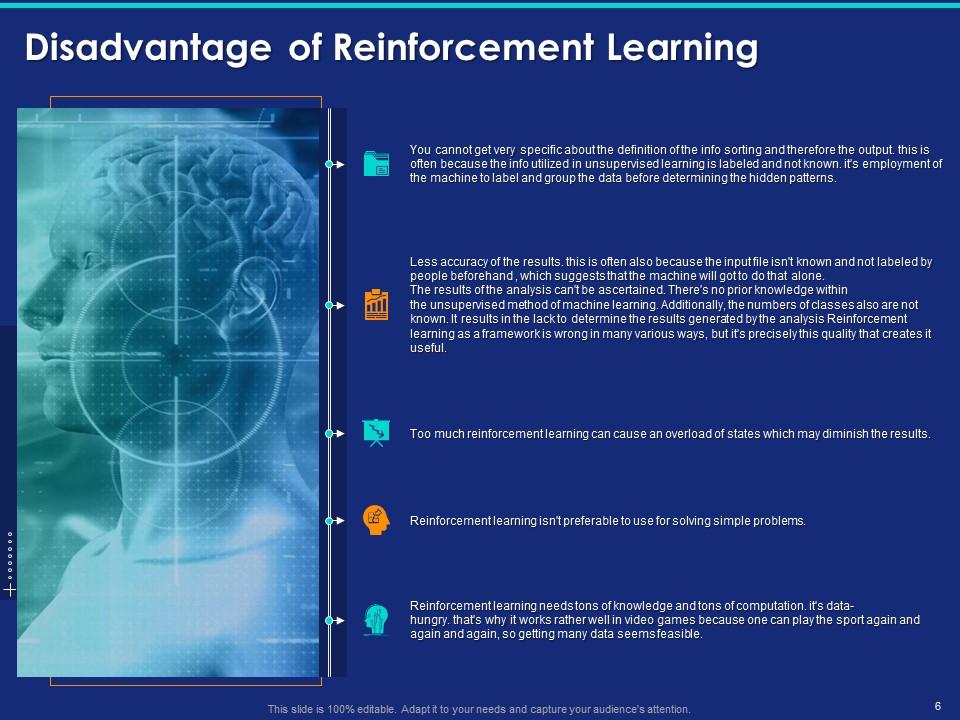
Reinforcement Learning Overview With Types Advantages And Disadvantages
Try Before you Buy Download Free Sample Product
Audience
Editable
of Time
Our Reinforcement Learning Overview With Types Advantages And Disadvantages are topically designed to provide an attractive backdrop to any subject. Use them to look like a presentation pro.
People who downloaded this PowerPoint presentation also viewed the following :
Reinforcement Learning Overview With Types Advantages And Disadvantages with all 6 slides:
Use our Reinforcement Learning Overview With Types Advantages And Disadvantages to effectively help you save your valuable time. They are readymade to fit into any presentation structure.
FAQs for Reinforcement Learning Overview With Types
Reinforcement learning operates on core principles including agent-environment interaction, reward-based feedback, policy optimization, value function estimation, and exploration-exploitation balance. These principles enable systems to learn optimal decision-making through trial and error, with applications in autonomous vehicles, trading algorithms, and robotics ultimately delivering adaptive intelligence and improved performance outcomes.
Reinforcement learning differs by learning through trial-and-error interactions with environments to maximize rewards, while supervised learning uses labeled datasets and unsupervised learning finds patterns in unlabeled data. Through dynamic feedback mechanisms, organizations in gaming, robotics, and financial trading leverage reinforcement learning to optimize decision-making, automate complex processes, and ultimately deliver adaptive solutions that improve performance over time.
Common reinforcement learning algorithms include Q-learning, Deep Q-Networks (DQN), Policy Gradient methods, Actor-Critic algorithms, and Proximal Policy Optimization (PPO). These algorithms enable organizations to optimize decision-making processes by learning from interactions, with financial institutions using them for algorithmic trading, retailers for dynamic pricing, and manufacturers for supply chain optimization, ultimately delivering enhanced operational efficiency and competitive advantage.
Deep learning enhances reinforcement learning through neural networks that approximate value functions, policy gradients that optimize decision-making strategies, and convolutional networks that process complex visual environments. These approaches enable RL systems to handle high-dimensional data, learn from raw inputs like images, and scale across diverse applications from autonomous vehicles to financial trading, ultimately delivering more sophisticated and adaptable AI solutions.
Environments in reinforcement learning significantly shape agent behavior by providing feedback mechanisms, reward structures, and complexity levels that determine learning pathways. Through varied environmental challenges, agents adapt their decision-making strategies, with dynamic environments like financial trading or robotics requiring continuous adaptation, while stable environments enable faster convergence, ultimately delivering more robust and efficient learning outcomes.
Exploration vs. exploitation represents the fundamental trade-off in reinforcement learning, where agents must balance discovering new actions and environments against leveraging known high-reward strategies. This strategic balance enables businesses to optimize decision-making processes across diverse applications, from financial portfolio management to supply chain optimization, ultimately delivering adaptive systems that continuously improve performance while maintaining operational efficiency.
Overfitting in reinforcement learning can be mitigated through regularization techniques, experience replay, environment randomization, early stopping, and dropout layers during training. These approaches work by diversifying training experiences, preventing memorization of specific scenarios, and ensuring robust policy generalization, with many organizations finding that combining multiple techniques delivers more reliable performance across varied real-world applications.
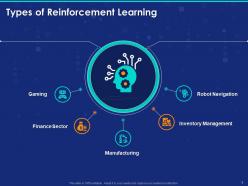
Reinforcement learning applications include autonomous vehicles, algorithmic trading, recommendation systems, robotics automation, and dynamic pricing optimization. These technologies enhance operational efficiency by enabling real-time decision-making, reducing human error, and continuously improving performance through data-driven learning, with many financial services and e-commerce companies finding significant competitive advantages in customer personalization and risk management.
Reward shaping and intrinsic rewards significantly enhance agent performance by providing additional guidance signals beyond basic task completion, accelerating learning through structured feedback mechanisms and curiosity-driven exploration. These approaches enable more efficient training in complex environments like autonomous vehicles and robotic systems, with many organizations finding that combining extrinsic task rewards with intrinsic motivation delivers faster convergence and improved strategic decision-making capabilities.
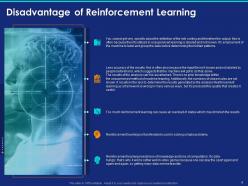
Reinforcement learning algorithms face challenges including sparse reward signals, sample inefficiency, high computational costs, safety concerns in critical applications, and difficulty generalizing across environments. These obstacles are particularly pronounced in sectors like autonomous vehicles, healthcare robotics, and financial trading, where algorithms must navigate complex, unpredictable conditions while ensuring reliability and minimizing risks to achieve scalable deployment.
Transfer learning in reinforcement learning involves applying knowledge from previously trained models to new tasks, significantly reducing training time and computational requirements. This approach enables agents to leverage existing policies, value functions, and learned behaviors across similar environments, with applications in robotics, game AI, and autonomous systems finding faster convergence and improved sample efficiency.
Ethical considerations include algorithmic bias, accountability for autonomous decisions, transparency in decision-making processes, privacy protection, and potential job displacement. These challenges present both risks and opportunities, with many organizations finding that implementing robust ethical frameworks, diverse training data, and human oversight mechanisms ultimately delivers greater public trust and regulatory compliance in increasingly automated environments.
Multi-agent reinforcement learning models enhance cooperative environments by enabling distributed decision-making, shared reward optimization, and coordinated task execution across multiple intelligent agents. Through strategic collaboration protocols, organizations in manufacturing, logistics, and financial trading streamline complex operations, reduce resource conflicts, and achieve superior collective outcomes, with many finding that cooperative agent systems deliver significantly higher efficiency than traditional centralized approaches.
Reinforcement learning agents are best evaluated using cumulative reward, sample efficiency, convergence speed, policy stability, and generalization across environments. These metrics enable organizations to assess learning effectiveness by measuring total performance outcomes, training resource requirements, and adaptability to new scenarios, with many financial services and gaming companies finding that balanced evaluation across multiple metrics ultimately delivers more robust and commercially viable AI systems.
Reinforcement learning will increasingly integrate with large language models, quantum computing, and edge devices, while expanding into autonomous systems, personalized healthcare, and real-time financial trading. These advances will enable more sophisticated decision-making across industries, with many organizations finding that hybrid AI approaches combining reinforcement learning with other technologies deliver unprecedented operational efficiency and competitive advantage.
-
Attractive design and informative presentation.
-
Appreciate the research and its presentable format.