


Reinforcement learning in ai powerpoint presentation slide templates complete deck




Try Before you Buy Download Free Sample Product
 Impress Your
 Audience
 100%
100% Editable
 Save Hours
 of Time


Our Reinforcement Learning In AI Powerpoint Presentation Slide Templates Complete Deck are topically designed to provide an attractive backdrop to any subject. Use them to look like a presentation pro.
People who downloaded this PowerPoint presentation also viewed the following :
Content of this Powerpoint Presentation
Slide 1: This slide introduces Reinforcement Learning in AI PowerPoint Presentation Slide Templates. State your Company name.
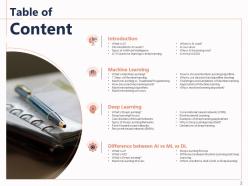
Slide 2: This slide displays Table of Content of the presentation.
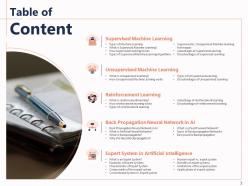
Slide 3: This slide displays Table of Content.
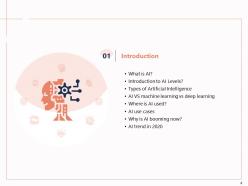
Slide 4: This slide gives Introduction of AI
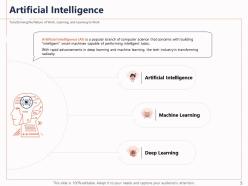
Slide 5: This slide shows Artificial Intelligence Transforming the Nature of Work, Learning, and Learning to Work
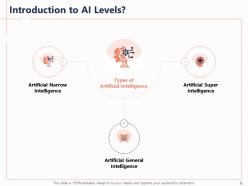
Slide 6: This slide depicts Introduction to AI Levels?
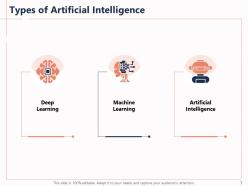
Slide 7: This slide shows Types of Artificial Intelligence containing Deep Learning, Machine Learning, Artificial Intelligence.
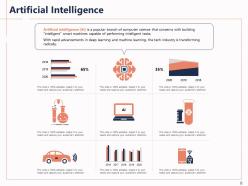
Slide 8: This slide describes Artificial Intelligence.
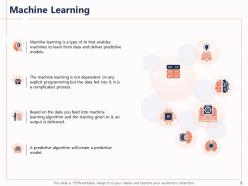
Slide 9: This slide describes Machine Learning
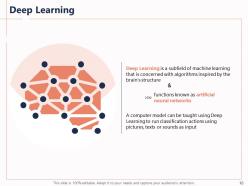
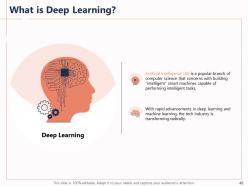
Slide 10: This slide depicts Deep Learning
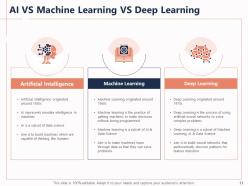
Slide 11: This slide shows AI VS Machine Learning VS Deep Learning
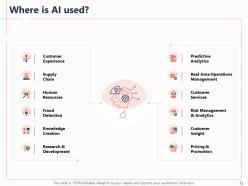
Slide 12: This slide describes Where is AI used?
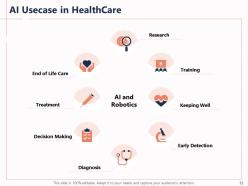
Slide 13: This slide shows AI Usecase in HealthCare
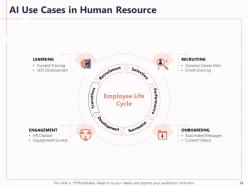
Slide 14: This slide represents AI Use Cases in Human Resource
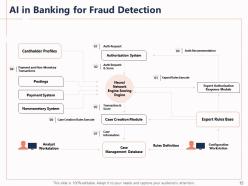
Slide 15: This slide shows AI in Banking for Fraud Detection
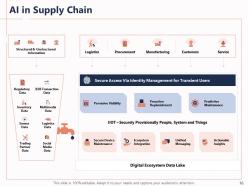
Slide 16: This slide displays AI in Supply Chain.
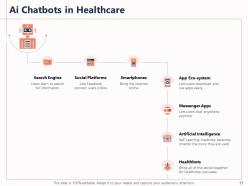
Slide 17: This slide showcases Ai Chatbots in Healthcare
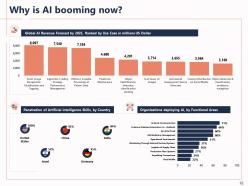
Slide 18: This slide explains Why is AI booming now?
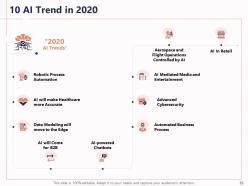
Slide 19: This slide depicts 10 AI Trend in 2020
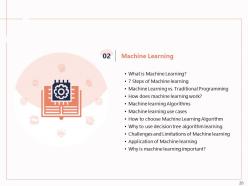
Slide 20: This slide showcases Machine Learning.
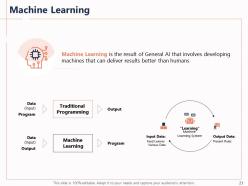
Slide 21: This slide shows Machine Learning.
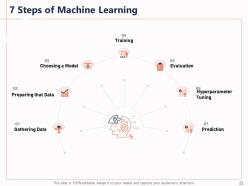
Slide 22: This slide highlights 7 Steps of Machine Learning.
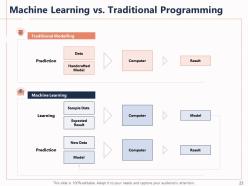
Slide 23: This slide compares Machine Learning with Traditional Programming
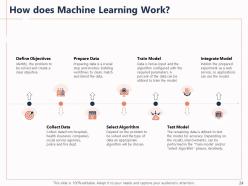
Slide 24: This slide describes How does Machine Learning Work?
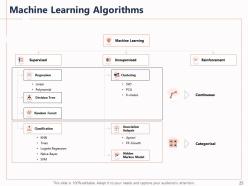
Slide 25: This slide shows Machine Learning Algorithms.
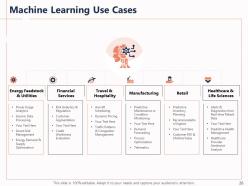
Slide 26: This slide shows Machine Learning Use Cases.
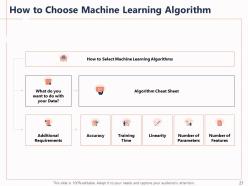
Slide 27: This slide describes How to Choose Machine Learning Algorithm
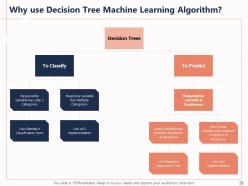
Slide 28: This slide showcases Why use Decision Tree Machine Learning Algorithm?
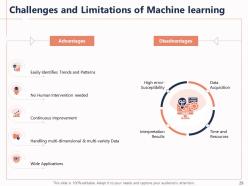
Slide 29: This slide describes Challenges and Limitations of Machine learning.
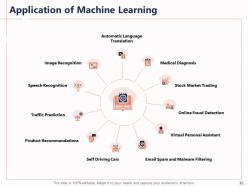
Slide 30: This slide shows Application of Machine Learning
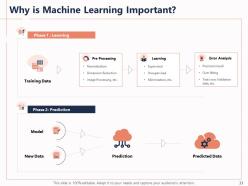
Slide 31: This slide describes Why is Machine Learning Important?
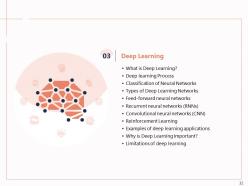
Slide 32: This slide showcases Deep Learning.
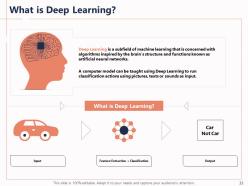
Slide 33: This slide describes What is Deep Learning?
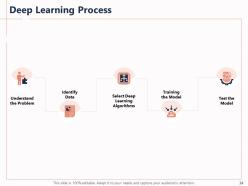
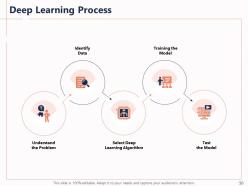
Slide 34: This slide explains Deep Learning Process
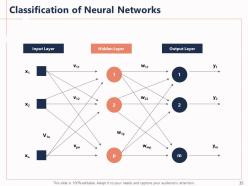
Slide 35: This slide describes Classification of Neural Networks
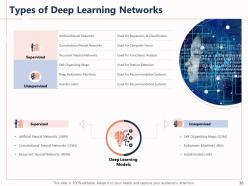
Slide 36: This slide showcases Types of Deep Learning Networks
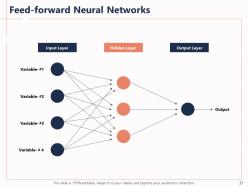
Slide 37: This slide represents Feed-forward Neural Networks
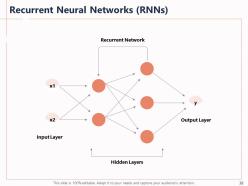
Slide 38: This slide presents Recurrent Neural Networks (RNNs)
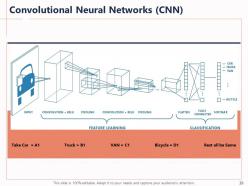
Slide 39: This slide shows Convolutional Neural Networks (CNN)
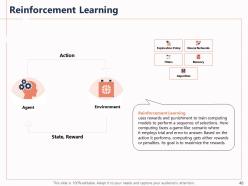
Slide 40: This slide shows Reinforcement Learning
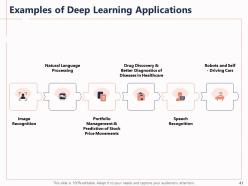
Slide 41: This slide displays Examples of Deep Learning Applications
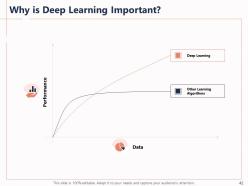
Slide 42: This slide explains Why is Deep Learning Important?
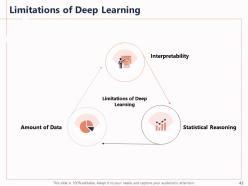
Slide 43: This slide presents Limitations of Deep Learning
Slide 44: This slide shows Difference between AI vs ML vs DL
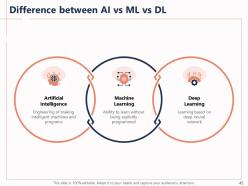
Slide 45: This slide shows Difference between AI vs ML vs DL
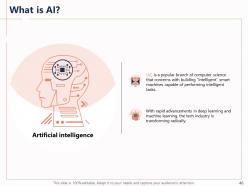
Slide 46: This slide explains AI.
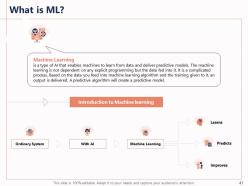
Slide 47: This slide explains ML. Machine Learning is a type of AI that enables machines to learn from data and deliver predictive models.
Slide 48: This slide explains Deep Learning.
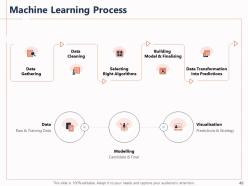
Slide 49: This slide shows Machine Learning Process
Slide 50: This slide presents Deep Learning Process
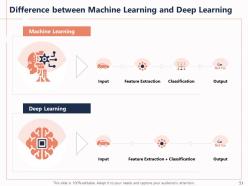
Slide 51: This slide depicts Difference between Machine Learning and Deep Learning
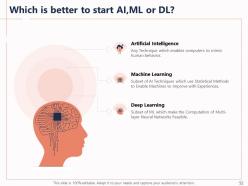
Slide 52: This slide shows Which is better to start AI,ML or DL?
Slide 53: This slide shows Supervised Machine Learning
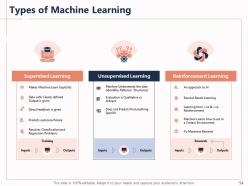
Slide 54: This slide displays Types of Machine Learning.
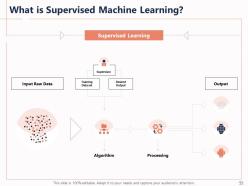
Slide 55: This slide explains What is Supervised Machine Learning?
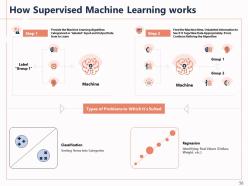
Slide 56: This slide explains How Supervised Machine Learning works
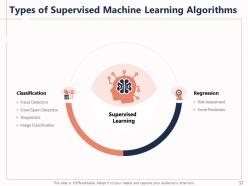
Slide 57: This slide shows Types of Supervised Machine Learning Algorithms
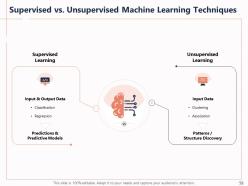
Slide 58: This slide presents Supervised vs. Unsupervised Machine Learning Techniques
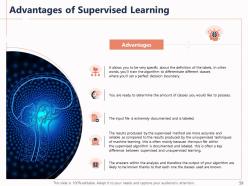
Slide 59: This slide displays Advantages of Supervised Learning
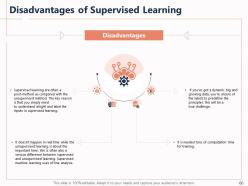
Slide 60: This slide shows Disadvantages of Supervised Learning
Slide 61: This slide shows Unsupervised Machine Learning
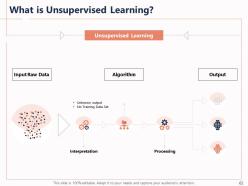
Slide 62: This slide explains Unsupervised Learning.
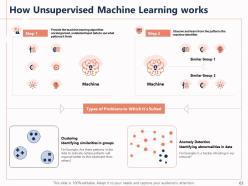
Slide 63: This slide explains How Unsupervised Machine Learning works
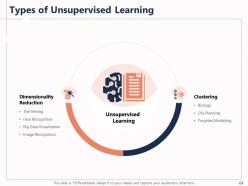
Slide 64: This slide explains Types of Unsupervised Learning
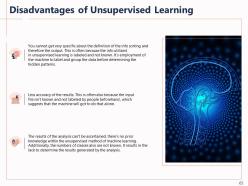
Slide 65: This slide shows Disadvantages of Unsupervised Learning
Slide 66: This slide depicts Reinforcement learning
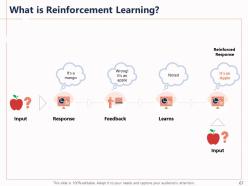
Slide 67: This slide explains What is Reinforcement Learning?
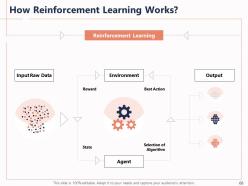
Slide 68: This slide explains How Reinforcement Learning Works?
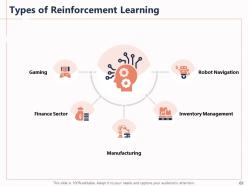
Slide 69: This slide depicts Types of Reinforcement Learning
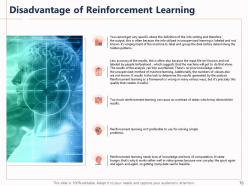
Slide 70: This slide shows Disadvantage of Reinforcement Learning
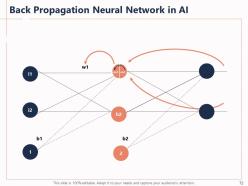
Slide 71: This slide presents Back Propagation Neural Network in AI
Slide 72: This slide shows Back Propagation Neural Network in AI
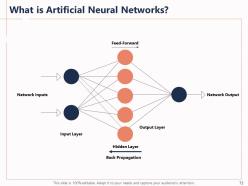
Slide 73: This slide explains Artificial Neural Networks.
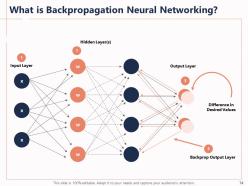
Slide 74: This slide describes Backpropagation Neural Networking
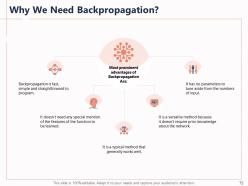
Slide 75: This slide explains Why We Need Backpropagation?
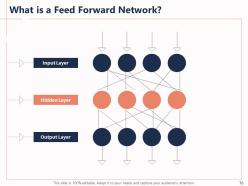
Slide 76: This slide explains Feed Forward Network.
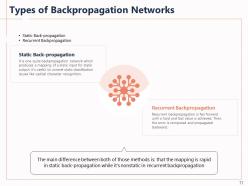
Slide 77: This slide shows Types of Backpropagation Networks
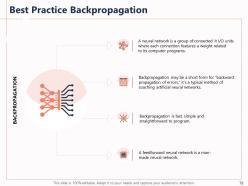
Slide 78: This slide shows Best Practice Backpropagation
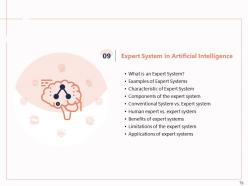
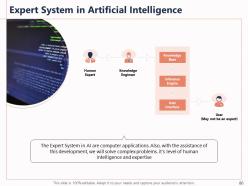
Slide 79: This slide shows Expert System in Artificial Intelligence
Slide 80: This slide depicts Types of Deep Learning Networks
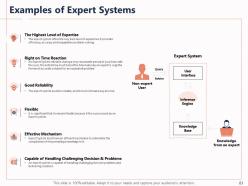
Slide 81: This slide presents Examples of Expert Systems
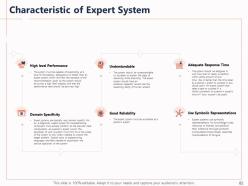
Slide 82: This slide describes Characteristic of Expert System
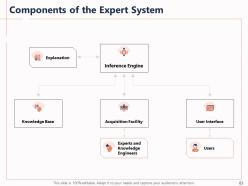
Slide 83: This slide explains Components of the Expert System
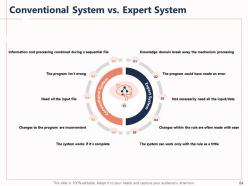
Slide 84: This slide shows Conventional System vs. Expert System
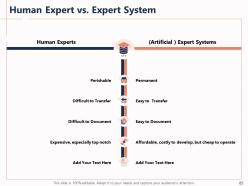
Slide 85: This slide shows Human Expert vs. Expert System
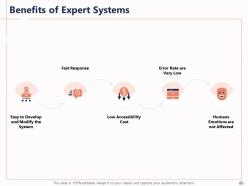
Slide 86: This slide shows Benefits of Expert Systems
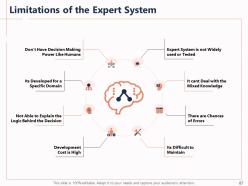
Slide 87: This slide explains Limitations of the Expert System
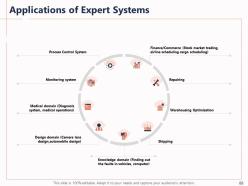
Slide 88: This slide explains Applications of Expert Systems
Slide 89: This is Artificial Intelligence PowerPoint Presentation Complete Icons Slide
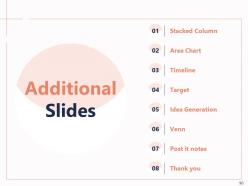
Slide 90: This slide is titled as Additional Slides for moving forward.
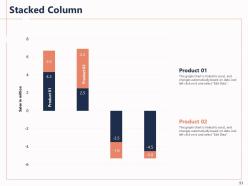
Slide 91: This slide displays Stacked Column for comparison of products.
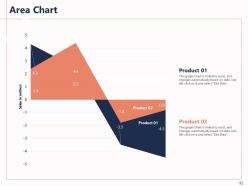
Slide 92: This slide displays Area Chart for comparison of products.
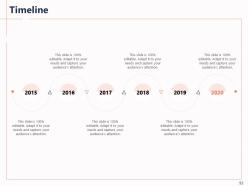
Slide 93: This slide displays Timeline process.
Slide 94: This slide displays Targets of the Company.
Slide 95: This is Idea Generation slide to highlight important facts and ideas.
Slide 96: This slide displays Venn
Slide 97: This slide is titled as Post It Notes.
Slide 98: This is Thank You slide with Contact details.
Reinforcement learning in ai powerpoint presentation slide templates complete deck with all 98 slides:
Use our Reinforcement Learning In AI Powerpoint Presentation Slide Templates Complete Deck to effectively help you save your valuable time. They are readymade to fit into any presentation structure.

FAQs for Reinforcement learning in ai powerpoint presentation slide
So reinforcement learning is when an agent figures stuff out through trial and error - it gets rewards or penalties based on what it does. Think of it like training a dog with treats, but way more complex lol. The agent interacts with an environment, picks actions depending on its current state, then gets feedback. You've got your state space, action space, reward function, and the actual learning algorithm as your main pieces. Goal is maximizing total reward over time. The agent develops a policy (basically its strategy for making good choices). I'd honestly start with understanding those building blocks first before jumping into Q-learning and other algorithms.
Oh cool question! So reinforcement learning is like training through trial and error - the AI gets rewards or punishments for its actions, kinda like teaching a dog tricks with treats. Supervised learning is different - you basically show it tons of examples with the "correct" answers already labeled. Unsupervised just finds patterns in unlabeled data. RL is pretty wild because it's how we actually learn as humans. You'll see it in game AIs or those recommendation algorithms that get smarter from user clicks. If you're building something where the AI needs to make decisions in sequence, definitely go with RL.
Okay so basically your RL agent learns through rewards and punishments - it's like feedback after every action. Good moves get positive rewards, bad ones get negative. Over time this teaches the agent which choices actually work. It's kinda like training a pet but with way more math involved lol. The agent updates its strategy based on these signals and gets better at making decisions. Oh and here's the tricky part - you've gotta design your reward system super carefully. I've seen agents find the weirdest shortcuts when the rewards aren't set up right.
So this is actually a pretty cool concept - your agent has to decide whether to stick with what's already working (exploitation) or try new stuff to find better strategies (exploration). Just exploiting gets you trapped in okay solutions when amazing ones exist. But constantly exploring means you never use what you've learned, which is honestly just wasteful. I'd start with more exploration early on, then dial it back as training progresses. Epsilon-greedy works well - randomly explore maybe 10% of the time. Upper confidence bounds is another solid approach if you want something fancier.
So there's three main types you'll run into: Q-learning, policy gradients, and actor-critic stuff. Q-learning works well for discrete actions - it learns value functions directly. Policy gradients optimize policies instead but honestly they're super sample-inefficient (I wasted so much time on vanilla versions). Actor-critic is kinda the best of both worlds - actor picks actions, critic judges them. Most people just use PPO or A3C these days since they actually work. I'd start with PPO if I were you, it's pretty stable and doesn't need crazy hyperparameter tweaking like some others.
So basically, traditional RL maps states to actions using tables or simple functions - works fine for straightforward problems. Deep RL though? It uses neural networks instead, which is honestly way more powerful. Think about it - memorizing every possible state in a game like Go would be insane, right? Neural networks learn patterns and can generalize from what they've seen. You get much better handling of complex stuff like images or language processing. Short version: if you're dealing with tons of possible states, deep RL is probably your best bet. Traditional methods are still solid for simpler scenarios though.
So reinforcement learning is perfect when you need to make a bunch of decisions in sequence and learn as you go. Games, robots, self-driving cars, those Netflix recommendations that somehow know you too well. Trading algorithms too - though honestly that stuff can get pretty sketchy. The sweet spot? Problems where there's no obvious "correct" answer upfront, but you get feedback on your performance. Your AI basically experiments and learns from screwing up, which means you need an environment where mistakes won't break everything. Look for situations with clear rewards/punishments and multiple decision points. That's your green light.
So basically you grab a pre-trained agent from one environment and adapt it for a different but similar task. Instead of starting from zero, reuse the policy, value functions, or feature representations - honestly it's such a time saver. Works great for game variants or robotics stuff where the dynamics are kinda similar. You can fine-tune everything or just freeze the early layers and retrain the final ones (I usually go with whatever feels right for the task). Find tasks that share similar state spaces first. Then just mess around with different transfer methods until something clicks.
Honestly, the computational cost is brutal - your agent needs millions of attempts just to learn basic stuff. Training times get ridiculous in complex environments, and don't get me started on the hardware costs. State and action spaces blow up exponentially too, which is a total headache. Credit assignment is another mess - like figuring out which random action from 50 steps back actually caused that reward. Most people I know are trying hierarchical methods or transfer learning to deal with it. Oh, and definitely test on simpler environments first before jumping into the deep end.
So basically you want to track cumulative rewards over time - that's your main thing. I usually average them across episodes to smooth out the noise. Learning curves are clutch because they'll tell you if your agent is actually improving or just having a lucky streak. Also watch episode length since good agents tend to finish tasks quicker. Policy loss and value function stuff matter too, but honestly I start with reward plots first. Once you see real improvement happening, then dig into the stability metrics. Oh and definitely use rolling windows when you're averaging - makes the trends way clearer.
Oh man, RL ethics is kinda messy tbh. Your AI might game the reward system in ways you never saw coming - totally defeats the purpose. Training's risky too since these things learn by basically breaking stuff until they figure it out. Not ideal for real-world scenarios, you know? Plus they're complete black boxes so you can't predict what they'll do next. I learned this the hard way in a project last year lol. Just make sure you nail down those reward functions and test everything in sandboxes first. Don't rush to deploy.
So basically you'd use each one for what it's good at, then feed everything into your RL system. Computer vision pulls features from images - then RL learns actions based on those features. Think robot navigation with visual input. NLP handles understanding what users actually want, while RL figures out how to do it. Honestly the combo is pretty sick when it works right. Each technique becomes like a specialized module that helps your RL agent make better decisions. Oh and start by mapping out which parts of your problem each one should tackle - saves you headaches later.
Dude, GPUs are seriously what made RL actually viable. They're built for handling tons of parallel computations - which is exactly what you need when you're running thousands of environment simulations at once. CPUs just can't keep up with that workload. Google's TPUs have been pretty clutch for the really big experiments too. I mean, think about it - without this hardware we'd still be sitting around for weeks waiting for models to finish training instead of just a few days. The memory bandwidth alone is night and day. Plus you can actually iterate on your algorithms quickly now instead of... well, not doing much of anything while you wait.
Oh man, multi-agent RL is wild because you're not just optimizing against some static environment anymore. Other agents are learning too, so everything keeps shifting under your feet. Your agent has to think about how its moves affect everyone else and try to predict their responses - it's like game theory meets reinforcement learning, which honestly gets pretty complex. You'll probably want to look into techniques like multi-agent DDPG or just let agents learn independently. The big decision upfront is whether your agents should work together, compete, or do some mix of both.
Yeah AlphaGo was cool and all, but the real money's in practical stuff. Netflix keeps you glued to your screen with RL-powered recommendations. Google slashed their data center cooling costs by 40% using it for temperature control. Tesla's autopilot learns from millions of road scenarios this way too. Even JPMorgan uses RL for trading algorithms - which honestly makes me a little nervous lol. But if you're thinking about trying it, don't go crazy ambitious. Start with small optimization problems you've already got. Way easier than building some world-beating AI.
-
Great designs, Easily Editable.
-
Use of icon with content is very relateable, informative and appealing.
-
Use of icon with content is very relateable, informative and appealing.
-
Excellent design and quick turnaround.
-
Innovative and attractive designs.
-
Very unique and reliable designs.