


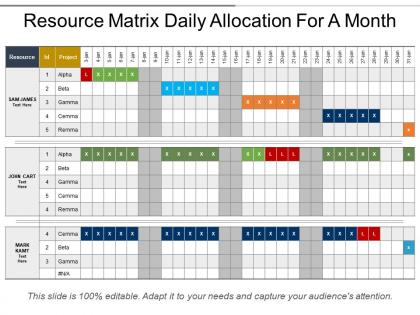
Resource matrix daily allocation for a month




Try Before you Buy Download Free Sample Product
 Impress Your
 Audience
 100%
100% Editable
 Save Hours
 of Time


Feel a distinct difference with our Resource Matrix Daily Allocation For A Month. Your creative energy will get a boost.
People who downloaded this PowerPoint presentation also viewed the following :
Resource matrix daily allocation for a month with all 5 slides:
Strike a chord with our Resource Matrix Daily Allocation For A Month. Get your team going for you.




FAQs for Resource matrix daily allocation
Look at three key things: project impact, resource constraints, and timeline pressure. Figure out which tasks hit your critical path or main deliverables first - those are your priority. Then see what resources you actually have (people, budget, tools) vs what you need. This part's honestly like Tetris with everyone's schedules! Dependencies between tasks matter too, plus what stakeholders expect. Always build in buffer time because something will go wrong - trust me on that one. I'd map out your high-impact, urgent stuff first, then work backwards from there.
Honestly, try doing like 70/30 - most of your resources on immediate stuff, then 30% for future planning. Though that ratio shifts depending on your industry obviously. Map out what you're actually spending time on right now - bet it's way more short-term focused than you think. The trick is protecting those long-term buckets so they don't get cannibalized when things get crazy. I've watched too many teams just become firefighters 24/7 and wonder why they never move forward. Set up monthly check-ins to rebalance when priorities shift. Short bursts work better than trying to plan everything perfectly upfront.
Honestly, DEA is probably your best bet for comparing efficiency across departments - it's what most people use. Real-time dashboards in Tableau or Power BI are solid for tracking resource utilization. Activity-based costing helps you figure out what things actually cost (which is surprisingly hard to nail down sometimes). Don't overlook Excel though - a decent model with the right KPIs can be just as useful. Zero-based budgeting makes you justify everything from scratch, which sucks but works. Portfolio optimization is good for balancing priorities. Just start with whatever data you've got.
So stakeholder input is honestly what shapes your whole allocation game. Finance wants cuts, sales screams for more people, IT's begging for server upgrades - you're stuck juggling all these voices. The loudest person usually wins (which sucks but it's reality). Weight their input based on actual business impact and who has real pull in the organization. My advice? Run regular check-ins with everyone and build some kind of scoring system they can all see. Makes the whole "why didn't I get what I wanted" conversation way easier when you've got clear criteria to point to.
Honestly, the worst thing you can do is overcommit your resources right off the bat. I've watched so many teams completely flame out because they planned for everything going perfectly - which, let's be real, never happens. You gotta track your actual usage against what you planned, and don't forget to build in buffer time. Things always take longer than expected. Also, priorities shift constantly, so if you're not reassessing regularly you'll waste time on stuff that doesn't matter anymore. My advice? Start conservative with your estimates, check burn rates weekly, and keep like 10-15% capacity as backup. And seriously, don't hesitate to shuffle things around mid-project when needed.
Honestly, data analytics just shows you where your money's actually going instead of guessing. You can see real patterns - like which departments are hogging resources or what's actually giving you decent ROI. Way better than relying on last quarter's messy spreadsheet, you know? Plus you'll catch inefficiencies you totally missed before and predict what you'll need down the road. That one department that always whines for more budget? Yeah, the numbers will expose them. Just start tracking a few basic metrics consistently. Even simple usage data will show you obvious wins sitting right there.
So basically you want tech to handle the grunt work instead of passing Excel files back and forth like it's 2005. AI platforms can crunch real-time demand data and shift budgets automatically. Pretty cool how some tools actually predict what you'll need based on past projects. Cloud dashboards let everyone see what's up for grabs versus what's taken - no more "wait, who signed off on this?" drama. Honestly, I'd start by sketching out your current mess of a process first. Then find software that tackles whatever's driving you crazy the most.
Oh man, this stuff gets tricky fast. Some cultures won't speak up about what they need because they don't want to rock the boat. Others will straight-up tell you exactly what's missing. Time planning is weird too - certain teams focus on right now while others are already thinking months ahead. Honestly, the hierarchy thing probably causes the most headaches though. You've got to set up different ways for people to communicate with you, not just the usual channels. Check in with each region regularly because what works in one place totally bombs in another. It's like each team has its own resource language.
So risk management is basically your backup plan for when stuff hits the fan - and trust me, it will. First thing I'd do is figure out which projects are most likely to blow up in your face, then either throw some extra resources at those or just pivot to safer options. Don't dump everything into one area, even if it looks super promising right now. I learned this the hard way last year, honestly. You gotta balance the juicy potential payoffs with realistic disaster scenarios. Quick tip: rank everything you're working on by how risky it feels, then build some cushion into the scary ones.
Track your ROI and budget variance first - those are non-negotiables. Then look at deadlines and quality stuff. But honestly? Don't ignore team utilization and how stressed everyone is. Perfect spreadsheets mean nothing if people are miserable. Set up monthly check-ins to compare what actually happened vs what you planned. Pick maybe 3-4 metrics that actually matter for your situation and stick with those. I learned the hard way that tracking everything just creates noise. Focus beats trying to measure every little thing.
Dude, you absolutely need to stay flexible with this stuff. Business priorities shift constantly - what matters today might be irrelevant in six months. I've watched teams get burned when they lock themselves into rigid annual plans. Then they're stuck with people working on dead-end projects while missing the next big thing. Build in quarterly reviews to see what's actually working. Keep some buffer resources you can move around quickly. Honestly, think of your allocation plan like a Google doc, not something carved in stone. You'll thank yourself later when you can pivot fast instead of being that team still throwing money at last year's priorities.
Transparency is huge here - you've got to keep people updated on budget decisions and why you made them. Regular check-ins where you actually walk through allocations work wonders. People get frustrated (rightfully so) when resource decisions feel like they're happening behind closed doors. When you explain budget constraints and priority shifts upfront, your team won't be blindsided later. Plus it opens the door for feedback, which honestly catches problems before they blow up. I'd start with monthly meetings where everyone can ask questions about current allocations. Beats dealing with those awkward "why didn't my project get funded?" conversations down the line.
Honestly, the biggest thing I've noticed from studying this stuff is that constantly adjusting your resource allocation beats trying to nail it perfectly upfront. Amazon's a great example - they're always moving money and people around based on what's actually working, not what they planned six months ago. Most successful companies use some kind of impact vs effort framework to decide what gets priority. The frustrating part? Politics still mess up good decisions way too often (shocking, I know). My advice would be quarterly check-ins with your team where you look at real numbers and have clear rules for shifting resources when something's not hitting targets.
Regulation basically hijacks your budget whether you like it or not. Healthcare companies get stuck hiring for mandatory patient ratios and compliance roles. Banks have to throw money at risk management teams - honestly feels like paying a tax just to operate. Manufacturing? Safety and environmental stuff eats up tons of resources. Here's the thing though - you can't pretend these costs don't exist. Build them into your planning right away, and maybe try finding people who can wear two hats. Like compliance folks who actually help improve operations too.
Honestly, just figure out what 20% of your work actually moves the needle and go all-in on that stuff. Customer acquisition and building your product should eat up most of your time - forget the fancy office for now (learned this the hard way lol). Watch your burn rate like a hawk and set milestones for every dollar. Automate the boring tasks even if it feels too early. Here's the thing though - you've got to review this monthly and be brutal about cutting dead weight. Start by looking at where your time and cash went last month.
-
Commendable slides with attractive designs. Extremely pleased with the fact that they are easy to modify. Great work!
-
Out of the box and creative design.