


Revenue cycle management framework for healthcare sector




Try Before you Buy Download Free Sample Product
 Impress Your
 Audience
 100%
100% Editable
 Save Hours
 of Time


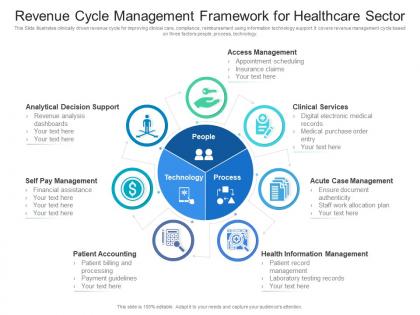
This Slide illustrates clinically driven revenue cycle for improving clinical care, compliance, reimbursement using information technology support. It covers revenue management cycle based on three factors people, process, technology.
People who downloaded this PowerPoint presentation also viewed the following :
Revenue cycle management framework for healthcare sector with all 2 slides:
Use our Revenue Cycle Management Framework For Healthcare Sector to effectively help you save your valuable time. They are readymade to fit into any presentation structure.

FAQs for Revenue cycle management framework
Key components of an effective RCM system include patient registration and eligibility verification, charge capture and coding, claims processing and submission, payment posting, and denial management. These integrated processes streamline healthcare operations by reducing billing errors, accelerating reimbursements, and improving cash flow, with many healthcare organizations finding that comprehensive RCM systems ultimately deliver enhanced financial performance and operational efficiency.
Technology revolutionizes revenue cycle management by automating billing processes, enhancing claim accuracy, and accelerating payment collection through AI-powered analytics and integrated systems. Through these digital solutions, healthcare organizations streamline administrative workflows, reduce manual errors, and improve cash flow, with many hospitals finding that automated systems deliver faster reimbursements and significantly lower operational costs.
Patient engagement significantly impacts revenue cycle optimization by improving appointment adherence, reducing claim denials, enhancing payment collection rates, and streamlining prior authorization processes. Through digital portals and automated communication systems, healthcare organizations enable faster insurance verification, more accurate patient information collection, and proactive payment discussions, with many hospitals finding that engaged patients reduce administrative costs while improving overall financial outcomes.
Healthcare organizations can identify revenue cycle inefficiencies through comprehensive data analysis, denial rate tracking, days in accounts receivable monitoring, and automated workflow auditing. By implementing analytics dashboards and conducting regular process reviews, hospitals and medical practices streamline billing operations, reduce claim rejections, and accelerate payment collections, ultimately delivering improved cash flow and operational efficiency.
Key RCM metrics include days in accounts receivable, clean claim rate, denial rate, collection rate, and cost-to-collect ratios. These indicators streamline financial performance by tracking payment velocity, billing accuracy, and operational efficiency, with many healthcare organizations finding that comprehensive metric monitoring ultimately delivers faster reimbursements and enhanced revenue optimization.
Coding accuracy directly impacts revenue cycle performance by reducing claim denials, accelerating reimbursement timelines, and minimizing costly rework processes. Accurate coding enables healthcare organizations to capture appropriate revenue while avoiding compliance penalties, with many hospitals and medical practices finding that improved coding precision increases cash flow by 15-25% and significantly reduces administrative overhead.
Strategies to reduce days in accounts receivable include implementing automated invoicing systems, establishing clear payment terms, conducting regular aging analysis, offering early payment discounts, and streamlining collections processes. These approaches enhance cash flow by accelerating payment cycles, minimizing manual errors, and improving customer communication, with many healthcare organizations and service providers finding that automated follow-ups and electronic payment options significantly reduce collection timeframes.
Regulatory policy changes significantly impact revenue cycle management by altering billing requirements, compliance protocols, and reimbursement structures, requiring healthcare organizations to adapt coding practices, documentation standards, and audit procedures. These modifications often necessitate system updates, staff retraining, and process redesigns, with many hospitals and medical practices finding that proactive compliance strategies ultimately enhance operational efficiency and reduce financial risk.
Small practices face challenges including limited staff resources, manual billing processes, insurance claim denials, patient payment collection difficulties, and compliance with changing regulations. These operational constraints often result in delayed reimbursements, increased administrative costs, and cash flow issues, with many practices finding that implementing automated billing systems and outsourcing specialized functions significantly improves their revenue cycle efficiency.
Automation enhances RCM efficiency by streamlining claims processing, reducing manual data entry errors, and accelerating payment cycles through intelligent workflow management. Healthcare organizations implementing automated systems see significantly faster reimbursements, improved cash flow, and reduced administrative costs, with many hospitals finding that automated prior authorization and denial management ultimately delivers 30-40% efficiency gains.
Training staff in revenue cycle management ensures accurate billing, reduces claim denials, and accelerates payment processing through proper coding, documentation, and compliance procedures. Well-trained teams significantly enhance cash flow optimization, minimize revenue leakage, and improve patient satisfaction, with many healthcare organizations finding that comprehensive staff education ultimately delivers faster reimbursements and sustainable financial performance.
Healthcare organizations can prepare for value-based care by implementing comprehensive RCM systems that track quality metrics, patient outcomes, and cost-per-episode data alongside traditional billing processes. These strategic approaches enable hospitals and clinics to monitor population health indicators, streamline care coordination workflows, and optimize resource allocation, ultimately delivering improved patient experiences while reducing operational costs in an increasingly outcome-focused healthcare landscape.
Multi-payer billing considerations include diverse reimbursement rates, varying prior authorization requirements, different claim submission formats, complex denial management processes, and coordinated benefits verification. Healthcare organizations streamline these challenges through automated eligibility verification, payer-specific workflow customization, and integrated revenue cycle platforms, ultimately reducing claim rejections and accelerating collections across insurance types.
Proper documentation significantly influences the revenue cycle by ensuring accurate coding, reducing claim denials, expediting reimbursements, and maintaining compliance with regulatory requirements. Healthcare organizations with comprehensive documentation practices experience fewer billing errors, faster payment processing, and improved cash flow, while minimizing costly rework and audit risks, ultimately enhancing operational efficiency and financial performance.
Best practices for managing denials and appeals include implementing automated denial tracking systems, conducting root cause analysis, establishing standardized appeal workflows, training staff on payer-specific requirements, and maintaining comprehensive documentation protocols. These approaches streamline the appeals process by reducing manual errors, accelerating response times, and improving success rates, with many healthcare organizations finding that systematic denial management ultimately delivers faster reimbursements and enhanced revenue recovery.
-
Unique and attractive product design.