


Risk Management And Communication Plan After Event




Try Before you Buy Download Free Sample Product
 Impress Your
 Audience
 100%
100% Editable
 Save Hours
 of Time


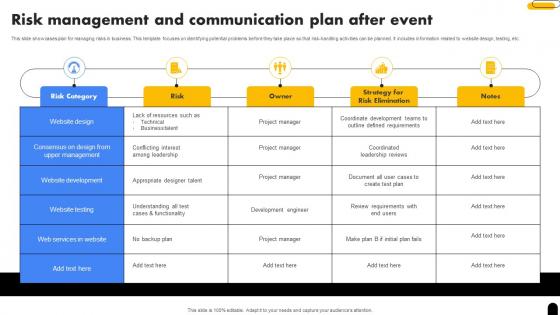
This slide showcases plan for managing risks in business. This template focuses on identifying potential problems before they take place so that risk handling activities can be planned. It includes information related to website design, testing, etc.
People who downloaded this PowerPoint presentation also viewed the following :
Risk Management And Communication Plan After Event with all 6 slides:
Use our Risk Management And Communication Plan After Event to effectively help you save your valuable time. They are readymade to fit into any presentation structure.





FAQs for Risk Management And Communication
Honestly, it comes down to four things. First, ditch the corporate jargon - talk like a normal human being. Second, timing is everything. Don't wait until it's too late for people to actually do something about it. Also, know your audience and adjust accordingly - what works for executives won't work for frontline staff. Oh, and here's the thing most people mess up: make it a conversation, not a lecture. You'll be shocked how much you learn when you actually let people ask questions and push back. That's where the real problems surface anyway.
Honestly, the magic is in being super specific about three things: what exactly could go wrong, who's handling it, and when they need to get moving. Don't just say "cyber risk" - spell out the actual nightmare scenario. I've sat through way too many meetings where people just list vague scary stuff without any real plan. Makes me want to scream lol. Skip the fancy jargon that puts everyone to sleep. Always give hard deadlines and assign owners. Try a basic "what-when-who" format - works every time.
Honestly, stakeholder engagement can make or break your whole risk communication thing. First step is figuring out who actually gives a damn about each risk - sounds obvious but you'd be surprised how many people skip this. Board members need completely different info than your average employee, so tailor accordingly. Two-way conversations are huge because people will bring up stuff you never even thought of. I'd start by mapping out stakeholders for your biggest risks, then maybe set up regular check-ins with the VIPs. Oh and don't just talk AT them - actually listen to their feedback and questions.
Oh totally! Risk stuff is so much easier when people can actually see it instead of just staring at boring spreadsheets. Heat maps are clutch for showing what's dangerous vs. what's not - way better than rows of random numbers. Charts work great too, especially those probability ones. Color-coded systems are perfect when you're dealing with people who aren't super technical. I always start basic and then add more detail once they get it. Dashboards with live data are pretty cool too, though honestly sometimes they can be overkill depending on your audience.
Honestly, most people mess up by being way too vague or waiting until it's already a disaster to say anything. Don't drown everyone in technical jargon either - like, speak human. The whole "everything's totally fine!" approach when stuff is clearly falling apart? Yeah, people aren't stupid. They see through that immediately. Also build regular check-ins instead of only talking during emergencies. Different groups need different amounts of detail too - your CEO doesn't need the same info as your dev team. Oh, and definitely test your messages on actual people first. Trust me on that one.
Honestly, the right tech makes sharing risk info so much easier. Dashboards show you everything in real-time, which is clutch. Automated alerts hit people when something's actually wrong - no more playing phone tag. Your field teams will love mobile apps too since they're never at their desks anyway. AI can customize who gets what info based on their role, though sometimes it feels like overkill. Don't overthink it though - just pick something that plays nice with whatever system you're already stuck with. Adding more complexity defeats the whole point.
Dude, culture totally changes how people read risk messages. Some cultures want you to be super direct with data and clear steps. Others need more indirect, relationship-based approaches - it's wild how different it can be. Authority figures work better in certain places, but peer messaging hits harder elsewhere. Even your color choices can accidentally offend people (learned that one the hard way). Time orientation affects urgency too. People handle uncertainty differently across cultures. Honestly? Test everything with locals first. Map out who you're talking to before you send anything out.
So you'll want to do surveys before and after to see if people actually remembered what you told them. Focus groups are honestly your best bet though - people will straight up tell you when your message makes zero sense, which they'd never admit on a survey. Also track if they actually DO anything about it, not just whether they understood. I mean, knowing smoking is bad doesn't stop half the people I know, you know? The tricky part is measuring both the "got it" and the "acted on it" pieces since those are totally different things.
So here's the thing - most people totally bomb at risk communication because they never ask if it's actually working. You need to close that loop somehow. After your presentations, grab a few people and ask what would've been more helpful. Track which channels people actually respond to (spoiler: it's probably not email). Quick surveys work great too. I mean, it sounds obvious but you'd be shocked how many teams skip this step entirely. Then you can tweak your approach based on real feedback instead of just guessing. Honestly, just start with asking three people after your next presentation what they needed to hear differently.
Skip all the fancy jargon - nobody cares about technical terms they don't get. Instead, use stuff they already know, like "this is basically leaving your front door wide open." When you're dealing with numbers or stats, those little icon charts work way better than just throwing percentages at people. Here's the thing though - don't pretend you have all the answers. People actually trust you more when you admit what's still unclear. Start with whatever's keeping them up at night, then maybe get into the nerdy details if they're still listening. It's all about meeting them where they are.
You'll want to sort your audience into different groups and figure out what each actually needs to know. Some risks can be shared openly, others need tight distribution because of competitive or legal stuff. With your internal teams, go transparent as possible - just use NDAs when you have to. External folks? Focus on impacts and what you're doing about it, not every little vulnerability. Honestly, they don't want to hear about every possible disaster scenario anyway - that just freaks people out. The trick is being upfront when you can't share something and explaining why, instead of just going radio silent. That silence makes everyone way more anxious.
Hey! So ServiceNow's pretty good for risk registers, and Teams/Slack for quick updates. SharePoint works for docs too. But honestly? Most teams just use whatever they already have - budget's always tight, right? The main thing is having one spot where everyone can find current risk stuff and chat about updates. GRC platforms like MetricStream are nice if you've got money to burn. Otherwise a shared drive with decent file names does the trick. I'd say start with your current setup and only upgrade when something's really driving you crazy.
Honestly, crisis communication is a whole different beast than regular risk management stuff. Normal updates? You've got weeks to plan those out carefully. But when shit hits the fan, you're basically live-tweeting updates to keep everyone in the loop. Your audience explodes too - suddenly it's not just your usual stakeholders, but reporters, customers, sometimes the whole public watching. The tone has to change completely. Drop the corporate jargon and actually sound human for once. Oh, and definitely draft some templates ahead of time because trust me, you don't want to be writing from scratch during an actual crisis.
Honestly, I'd focus on just 2-3 things max or you'll go crazy trying to track everything. Start with the obvious stuff - are people actually opening your emails or showing up to meetings? Then quiz them somehow (surveys work) to see if they get it. The tricky part is measuring if behavior actually changes. Look at your incident reports or safety violations before and after - that's where you'll see real impact. I mean, someone can ace a quiz but still ignore safety protocols, right? Oh, and don't overthink it. Pick metrics that match what you're trying to accomplish with each campaign.
Honestly, it's just about getting everyone on the same page with how you talk about risks. No more of those annoying meetings where someone says "high risk" and half the room thinks they mean something totally different. You want standardized terms, clear escalation steps, the whole deal. That way whether IT or finance is presenting, stakeholders get consistent info they can actually compare. The key is mapping out who needs what risk information and when - sounds boring but it'll show you exactly where your communication is falling apart. Trust me, it makes everything flow way smoother.
-
Perfect template with attractive color combination.
-
The templates you provide are great! They have saved me tons of time and made my presentations come alive. Thank you for this awesome product. Keep up the good work!