


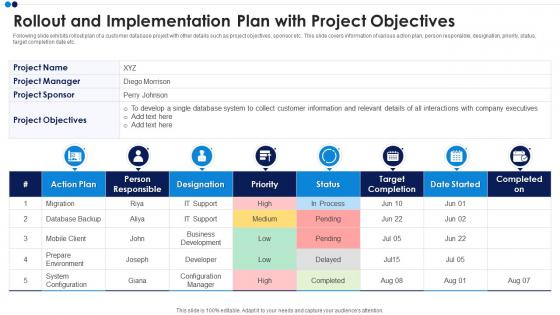
Rollout And Implementation Plan With Project Objectives




Try Before you Buy Download Free Sample Product
 Impress Your
 Audience
 100%
100% Editable
 Save Hours
 of Time


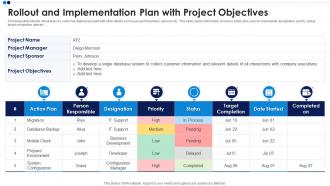
Following slide exhibits rollout plan of a customer database project with other details such as project objectives, sponsor etc.. This slide covers information of various action plan, person responsible, designation, priority, status, target completion date etc.
People who downloaded this PowerPoint presentation also viewed the following :
Rollout And Implementation Plan With Project Objectives with all 6 slides:
Use our Rollout And Implementation Plan With Project Objectives to effectively help you save your valuable time. They are readymade to fit into any presentation structure.





FAQs for Rollout And Implementation Plan
You'll want a solid timeline with milestones mapped out first. Get your stakeholder communication sorted - regular check-ins are a lifesaver. Resource allocation and risk plans are obvious must-haves. Honestly, rollback procedures saved my butt more times than I care to admit, so don't skip those! Clear roles so nobody's confused about who does what. Training materials and documentation - users will thank you later. Oh, and seriously consider starting with a pilot group instead of throwing everyone in the deep end. Way less stressful that way. Success metrics help prove it actually worked too.
Okay so basically don't just update people when stuff breaks - that's the worst. Set up regular check-ins and actually ask what they think about problems you're hitting. People absolutely hate surprises with project changes, trust me on this one. Also remember your CEO needs totally different info than the people actually using the system. Make it super easy for them to give you feedback too. Oh and those progress dashboards? They're actually pretty helpful for keeping everyone on the same page. Treat them more like partners who care about this succeeding, not just people you have to report to.
Track the technical stuff first - uptime, error rates, performance metrics. Basically make sure you're not breaking anything lol. Then look at business impact: user adoption, how fast people get value from it, whether you're actually hitting your goals. Honestly though, resist the urge to create a million dashboards. I've seen teams drown in their own data. Stick to maybe 5-6 metrics that your stakeholders actually care about. Set up automated reports too so you're not stuck pulling numbers manually every week like some kind of data intern.
Don't treat risk management like some separate thing you'll deal with later. Figure out your biggest risks first - tech breaking, users not adopting it, running out of resources, whatever. Then actually work your mitigation plans into the timeline itself. Honestly, I've watched so many teams skip this step and then panic when stuff inevitably goes wrong. Set up checkpoints after each phase to reassess what's working. Build in extra time for the risks you know will probably hit. The whole point is making it part of your normal planning, not something you're frantically trying to fix when everything's already falling apart.
Oh man, communication is HUGE for this stuff. Seriously, I've seen rollouts crash and burn just because nobody knew what was happening when. Keep everyone in the loop about timelines and what they need to do at each step. People hate being left in the dark - that's when you get all the resistance and pushback. Also, if you're updating regularly, you'll spot problems way earlier before they turn into disasters. Honestly, just pick a communication schedule from the start and actually stick to it, even when everything's chaos.
Look, first figure out what business goals this thing actually supports - revenue, costs, whatever matters to your bosses. Then build your timeline around those priorities, not just the tech stuff. Honestly, I've watched so many rollouts nail the technical side but completely whiff on what leadership cared about. Track metrics that actually matter at each phase. Don't just measure because you can - measure because it shows you're moving toward those bigger objectives. Oh, and set up regular check-ins with stakeholders. Priorities change fast and you'll want to pivot before you're too far down the wrong path.
For tracking phases, grab something like Asana or Trello - way easier than overcomplicated systems. Gantt charts help too if your team's into that visual timeline thing. Slack or Teams are clutch for keeping everyone updated (seriously, most rollouts fail because nobody talks to each other). Risk tracking? Honestly just use a Google sheet unless you're feeling fancy. Oh, and here's the thing - don't pick some shiny new tool everyone has to learn. Stick with whatever your team already uses. Trust me on this one.
Set up feedback loops at different stages - pulse surveys at milestones, weekly team check-ins, stakeholder meetings. Anonymous surveys work better honestly, people actually tell you what they think. Do your lessons learned session within 2-3 weeks max while it's all still fresh. I learned this the hard way - wait a month and everyone's like "wait, what happened again?" Document everything in one shared spot so the next person doesn't have to reinvent the wheel. Quick retrospectives with your team are gold too.
Dude, don't rush the timeline - that's where most people screw up. Also, talk to your stakeholders way more than you think you need to. Never roll out to everyone at once, trust me on this one. When things break (and they will), you'll want that rollback plan ready. Test everything properly first. Train your users beforehand too - I've watched projects totally bomb because nobody knew what the hell they were doing with the new system. Start with a small pilot group, test twice if you can swing it, and just overcommunicate the whole timeline to everyone involved.
Don't treat training like some box you check at the end - weave it right into your rollout plan. Find your power users first, they're usually game for new tech and can help sell others on it. Mix up how you deliver support: kickoff sessions, cheat sheets, maybe weekly drop-in hours. Honestly, people will forget half of what you taught them the second they're actually trying to use the thing. That's why you need a Slack channel or help desk ready to go. Budget for like 2-3 weeks of hand-holding after launch - trust me, they'll need it.
Dude, you absolutely need timelines and milestones or your project will turn into a complete mess. Think of them like a roadmap - without one, people work at totally different paces and miss important stuff. They're lifesavers for catching problems before they explode into disasters. Your stakeholders get clear checkpoints to see what's actually happening, and honestly? Your team needs those small victories to stay sane. I always map out the critical path first, then add buffer time because something weird always happens. Make them realistic but not too easy - you want momentum, not boredom.
Okay so first thing - figure out what you actually need vs. when you need it. Map your skills, people, and budget against each phase of the rollout. I learned this the hard way when our design team got pulled into another project right when we needed them most! Build a resource calendar that shows when you'll be slammed vs. when things are lighter. That way you can either shuffle tasks around or fight for extra help before it becomes a crisis. Honestly, most rollouts fail because people just assume resources will magically appear. If you can spot the bottlenecks early, you're golden.
Honestly, just set up a formal change process from day one - make people get approval before adding anything new. I learned this the hard way when a "simple tweak" turned into a three-week nightmare. Document everything so you can see what's shifting and why. Regular check-ins with stakeholders help catch changes early before they snowball. Always figure out how any change hits your timeline and budget first. Oh, and tell your whole team immediately when something gets approved - nothing worse than half the team working on the old scope while the other half moved on.
Don't just announce what's happening - actually bring people into the planning. Sarah could run training sessions, Mark might handle the communication schedule. Ask them about potential problems since they know the actual work way better than you do. Honestly, people eat this stuff up when they feel like the expert on something. Make them co-creators instead of just... people getting stuff dumped on them, you know? Oh and definitely celebrate small wins as you go. It keeps momentum going.
Honestly, start with your project charter and timeline - those two will basically drive everything else. Risk assessment docs are crucial because something ALWAYS breaks (learned that the hard way). Communication plans, training stuff, resource sheets, success metrics - you need all of it. Oh, and rollback procedures! Seriously, having an exit strategy has saved my butt more times than I can count. Get stakeholder sign-offs on the big stuff or you'll be fighting uphill battles later. The charter gives you scope and objectives, then build your detailed timeline with all the milestones and dependencies mapped out.
-
Thrilled to see several customizable templates catering various verticals and industries.
-
Perfect template with attractive color combination.