

Role And Responsibilities Of The Key Personnel Cafe Business Plan BP SS




Try Before you Buy Download Free Sample Product
 Impress Your
 Audience
 100%
100% Editable
 Save Hours
 of Time


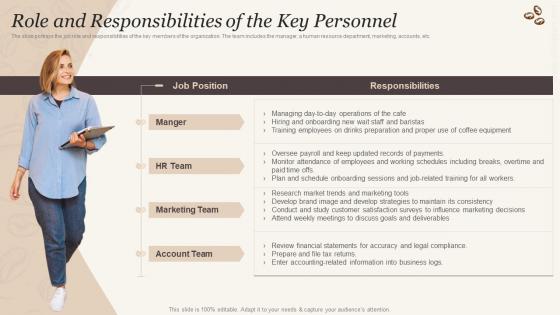
The slide portrays the job role and responsibilities of the key members of the organization. The team includes the manager, a human resource department, marketing, accounts, etc.
People who downloaded this PowerPoint presentation also viewed the following :
Role And Responsibilities Of The Key Personnel Cafe Business Plan BP SS with all 9 slides:
Use our Role And Responsibilities Of The Key Personnel Cafe Business Plan BP SS to effectively help you save your valuable time. They are readymade to fit into any presentation structure.








FAQs for Role And Responsibilities Of The Key Personnel Cafe Business
Key personnel responsibilities in project management include strategic planning, resource allocation, risk management, stakeholder communication, and quality assurance. These leaders streamline operations by coordinating cross-functional teams, monitoring project milestones, and ensuring deliverables meet specifications, with many organizations finding that effective personnel management ultimately delivers faster project completion and enhanced operational efficiency.
Effective communication strategies enhance key personnel performance by establishing clear expectations, facilitating cross-departmental collaboration, and enabling rapid decision-making through streamlined information flow. These approaches deliver improved project outcomes, reduced operational bottlenecks, and stronger team alignment, with many organizations finding that strategic communication frameworks ultimately boost productivity and employee engagement across leadership levels.
Key personnel should possess strategic thinking, emotional intelligence, effective communication, decision-making capabilities, and adaptability to change. These leadership competencies enable managers to navigate complex business challenges, foster team collaboration, and drive organizational growth, with many companies finding that leaders who combine technical expertise with strong interpersonal skills ultimately deliver higher employee engagement and improved operational performance.
Accountability among key personnel significantly enhances organizational efficiency by establishing clear ownership of outcomes, reducing decision-making delays, and minimizing resource waste through focused responsibility structures. This strategic approach streamlines operations across departments, with many organizations finding that accountable leadership delivers faster project completion, improved cross-functional collaboration, and ultimately measurable performance improvements.
Technology supports key personnel through automated reporting systems, real-time analytics dashboards, collaborative platforms, AI-powered decision support tools, and mobile workforce management solutions. These technologies streamline administrative tasks, enhance data-driven decision making, and enable seamless communication across teams, with many organizations finding that executives can focus more strategically while delivering faster responses and improved operational efficiency.
Key personnel balance strategic and operational duties by establishing clear time boundaries, delegating operational tasks to capable team members, and implementing systematic review cycles. Through structured planning frameworks, leaders in sectors like manufacturing and financial services streamline daily operations while dedicating focused periods to long-term planning, ultimately delivering both immediate results and sustainable competitive advantage.
Key personnel play critical roles in risk management by identifying potential threats, developing mitigation strategies, implementing control measures, and monitoring ongoing risk exposure across organizational functions. Through strategic oversight and cross-departmental collaboration, executives and department heads ensure comprehensive risk assessment protocols, regulatory compliance, and crisis response capabilities, ultimately delivering enhanced operational resilience and competitive advantage in increasingly complex business environments.
Key personnel should adapt by enhancing digital communication skills, establishing structured virtual team management protocols, and implementing robust performance monitoring systems. Through cloud-based collaboration tools and regular video check-ins, leaders can maintain team cohesion, ensure accountability, and deliver consistent project outcomes, while many organizations finding that remote leadership ultimately streamlines operations and reduces overhead costs.
Metrics for evaluating key personnel effectiveness include performance KPIs, revenue impact, team productivity rates, customer satisfaction scores, and strategic goal achievement. These measurements enable organizations to assess leadership quality, operational efficiency, and business outcomes, with many companies finding that comprehensive evaluation frameworks ultimately deliver improved accountability, enhanced team performance, and stronger competitive advantage.
Cultural differences significantly impact key personnel responsibilities through varied communication styles, decision-making processes, leadership expectations, and conflict resolution approaches across global teams. These variations require leaders to adapt their management techniques, enhance cross-cultural communication skills, and develop culturally sensitive policies, with many multinational organizations finding that embracing diverse cultural perspectives ultimately delivers improved innovation, broader market insights, and stronger competitive advantage.
Essential training opportunities for key personnel include leadership development programs, technical skill enhancement, strategic decision-making workshops, cross-functional collaboration training, and industry-specific certifications. These comprehensive development approaches enable organizations to build stronger leadership pipelines, improve operational efficiency, and maintain competitive advantage, with many companies finding that strategic investment in key personnel development ultimately delivers higher retention rates and enhanced organizational performance.
Key personnel foster positive workplace culture by establishing clear communication channels, recognizing achievements regularly, promoting collaboration through team-building initiatives, and providing professional development opportunities. Through transparent leadership approaches, many organizations find that teams become more engaged, productive, and loyal, ultimately delivering enhanced performance and reduced turnover while creating competitive advantage in talent retention.
Unclear key personnel responsibilities create project delays, duplicated efforts, accountability gaps, and communication breakdowns that significantly impact delivery timelines and budget control. These ambiguities lead to confused decision-making processes, missed critical milestones, and reduced team productivity, with many organizations finding that role clarity directly correlates with project success rates and stakeholder satisfaction.
Key personnel should prioritize tasks by focusing on critical deadlines, high-impact activities, and strategic objectives that directly affect business outcomes. In high-pressure environments, successful leaders streamline decision-making processes, delegate operational tasks to trusted team members, and maintain clear communication channels, ultimately enabling faster response times and preserving organizational stability while delivering competitive advantage.
Key personnel influence stakeholder engagement through strategic communication, relationship building, transparent decision-making processes, and proactive conflict resolution, while demonstrating thought leadership and maintaining consistent touchpoints across all stakeholder groups. These approaches enable organizations to build stronger partnerships, enhance project buy-in, and streamline collaboration, with many finding that dedicated personnel ultimately deliver improved stakeholder satisfaction and accelerated business outcomes.
-
Awesome presentation, really professional and easy to edit.
-
Presentation Design is very nice, good work with the content as well.