

Snack Vending Machine Business Plan Powerpoint Presentation Slides




Try Before you Buy Download Free Sample Product
 Impress Your
 Audience
 100%
100% Editable
 Save Hours
 of Time


Discover the untapped business potential behind office snacks with a vending machine business. Our professionally crafted Snack Vending Machine Business Plan presentation provides all the essential elements required for a comprehensive business plan. It offers detailed insights into vending machine statistics, growth drivers, market trends, lucrative opportunities, and key restraints. From entity details to target market, company summary, products and services, mission and vision, and milestones, our retail vending machine deck has it all. Delve into Porters framework, go to marketing strategy, and competitive landscape to gain a competitive edge. The financial summary section covers revenue models, economic impact, profit and loss statement, and break even analysis. Dont miss out on this opportunity to explore the potential of a vending machine business. Download our fully editable PPT now and embark on a successful venture.
People who downloaded this PowerPoint presentation also viewed the following :
Content of this Powerpoint Presentation
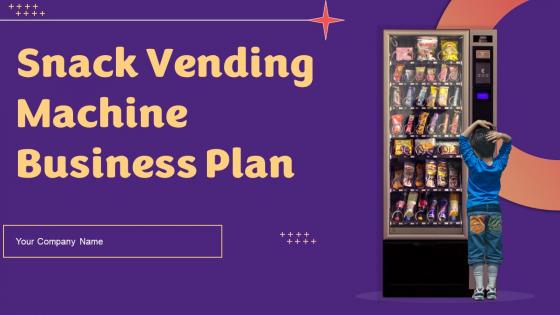
Slide 1: This slide introduces Snack Vending Machine Business Plan. Commence by stating Your Company Name.
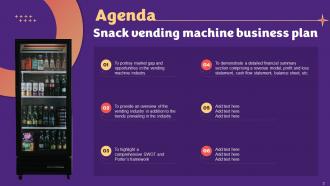
Slide 2: This slide depicts the Agenda of the presentation.
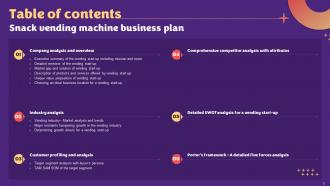
Slide 3: This slide includes the Table of contents.
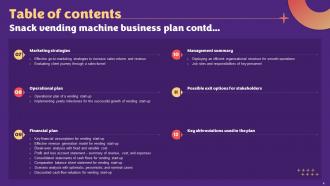
Slide 4: This is yet another slide continuing the Table of contents.
Slide 5: This slide highlights the Title for the Topics to be covered further.
Slide 6: The purpose of this slide is to provide a broader overview of the vending industry.
Slide 7: This slide presents a Detailed overview of the vending start-up.
Slide 8: This slide highlights the market gap and focus on devising solution to overcome those challenges.
Slide 9: The purpose of this slide is to express the benefits the firm provides to its customers or clients.
Slide 10: This slide portrays the Unique value proposition of vending start-up.
Slide 11: This slide portrays an ideal business location for vending start-up that minimize the risk of failure.
Slide 12: This slide includes the Heading for the Contents to be discussed next.
Slide 13: The purpose of this slide is to conduct a thorough assessment of the vending industry in addition to its market trends.
Slide 14: This slide continues a thorough assessment of the vending industry in addition to its market trends.
Slide 15: The purpose of this slide is to conduct a thorough assessment of the vending industry in addition to its market trends.
Slide 16: This slide aims to conduct a thorough assessment of the vending industry in addition to its market trends.
Slide 17: The purpose of this slide is to guide stakeholders about the problems prevailing in the industry.
Slide 18: This slide caters to details about various growth drivers resulting in the firm’s progress.
Slide 19: This slide includes the Title for the Ideas to be covered further.
Slide 20: This slide shows the Target segment analysis with buyer’s persona.
Slide 21: This slide continues the Target segment analysis with buyer’s persona.
Slide 22: This slide reveals the TAM SAM SOM of the target segment.
Slide 23: This slide contains the Heading for the Ideas to be discussed next.
Slide 24: This slide reveals the Comprehensive competitor analysis with attributes.
Slide 25: This slide continues the Comprehensive competitor analysis with attributes.
Slide 26: This slide mentions the Title for the Contents to be covered in the upcoming template.
Slide 27: The slide includes the strengths, weaknesses, opportunities, and threats analysis of the vending start-up.
Slide 28: This slide portrays the Heading for the Topics to be discussed further.
Slide 29: The slide highlights porter’s framework and its implications in the vending industry.
Slide 30: This slide exhibits the Title for the Ideas to be covered next.
Slide 31: This slide shows the Effective go-to-marketing strategies to increase sales volume and revenue.
Slide 32: This slide reveals Effective go-to-marketing strategies to increase sales volume and revenue.
Slide 33: The purpose of this slide is to implement an effective go-to-market strategy .
Slide 34: This slide deals with Evaluating client journey through a sales funnel.
Slide 35: This slide contains the Heading for the Ideas to be discussed further.
Slide 36: The purpose of this slide is to highlight the operational flow of the firm.
Slide 37: This slide focuses on Implementing yearly milestones for successful growth of start-up.
Slide 38: This slide displays the Title for the Contents to be covered in teh upcoming template.
Slide 39: This slide provides a glimpse of important financial assumptions that are to be made while setting up the firm.
Slide 40: The slide shows the Effective revenue generation model of the vending start-up.
Slide 41: The slides highlights the Break-even analysis with fixed and variable cost.
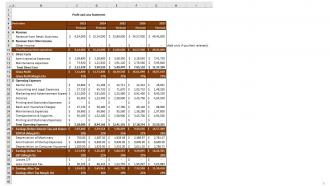
Slide 42: This slide provide a glimpse of the projected profit and loss statement.
Slide 43: This slide continues the projected profit and loss statement.
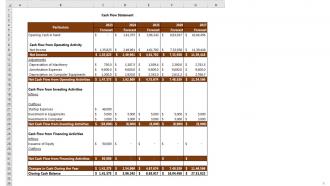
Slide 44: This slide reveals the Consolidated statements of cash flow of the vending start-up.
Slide 45: This slide continues the Consolidated statements of cash flow of the vending start-up.
Slide 46: The slides cover the snapshot of the company's financial position at a specific time.
Slide 47: This slide continues the company's financial position at a specific time.
Slide 48: This slide showcases the Scenario analysis with optimistic, pessimistic, and nominal cases.
Slide 49: This slide continues the Scenario analysis with optimistic, pessimistic, and nominal cases.
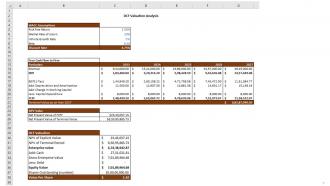
Slide 50: This slide reveals the Discounted cash flow valuation of the vending start-up.
Slide 51: This slide contains the Heading for the Topics to be coveerd next.
Slide 52: The purpose of this slide is to craft a successful hierarchical framework for the firm to ensure smooth operations.
Slide 53: This slide exhibits the Job roles and responsibilities of key personnel.
Slide 54: This slide mentions about the Title for the Ideas to be further discussed.
Slide 55: This slide represents exit strategy for stakeholders.
Slide 56: This slide highlights the Heading for the Ideas to be coveerd in the upcoming template.
Slide 57: This slide reveals the Key abbreviations used in the plan.
Slide 58: This is the Icons slide containing all the Icons used in the plan.
Slide 59: This slide is used for displaying some Additional information.
Slide 60: This is the Quotes slide for motivation.
Slide 61: This slide incorporates the firm's mission, Vision and Goal.
Slide 62: This is the Idea generation slide for encouraging fresh ideas.
Slide 63: This is the Venn diagram slide.
Slide 64: This slide presents the Bar graph.
Slide 65: This slide portrays the organization's Timeline.
Slide 66: This is the Idea generation slide for encouraging fresh ideas.
Slide 67: This slide is used for the purpose of Comparison.
Slide 68: This slide elucidates the SWOT analysis.
Slide 69: This is the Thank You slide for acknowledgement.
Snack Vending Machine Business Plan Powerpoint Presentation Slides with all 71 slides:
Use our Snack Vending Machine Business Plan Powerpoint Presentation Slides to effectively help you save your valuable time. They are readymade to fit into any presentation structure.





FAQs for Snack Vending Machine Business Plan
So start with market research on your target spots - that's honestly make-or-break for this whole thing. Map out startup costs for machines and inventory, plus your route planning. Financial projections are huge too. Monthly revenue expectations, restocking costs, location fees, all that. Don't skip the operational stuff like maintenance and supplier relationships. Location analysis matters most since foot traffic literally determines if you'll make money or not. Oh, and figure out your product mix strategy and how you're handling cash collection. Security's important too obviously. Just use a simple template first - you can always add more detail later.
Look for spots where people are stuck waiting and can't just run out for food - hospitals, office buildings, gyms, schools, transit hubs. I made the mistake of putting one right next to like three convenience stores once, total waste. High foot traffic is obviously key, but you want places with limited nearby options. Break rooms and waiting areas are goldmines. Honestly, you gotta scout at different times though - what seems busy at noon might be dead by 3pm. Map out maybe 10-15 potential locations first, then start negotiating placement fees with the good ones.
Dude, healthy snacks are crushing it right now - protein bars, nuts, dried fruit, veggie chips. Anything that says "organic" flies off the shelves. People also can't resist nostalgic stuff though, like those snacks that remind you of being a kid. Honestly, the energy drinks and protein options make the most money from what I've seen. Oh and grab-and-go is huge since everyone's always rushing. I'd probably do like 70% healthy and 30% comfort food - covers everyone's cravings that way.
Honestly, start with your upfront costs - equipment runs about $3,000-$8,000 per machine, plus inventory and permits. Revenue wise, you're looking at maybe 20-50 sales daily at $1-3 profit each, but location is literally everything here. I can't stress this enough - a machine in a busy office lobby will make bank while one in some random corner collects dust. Go scout locations during rush hours and actually count foot traffic. Sounds boring but it works. Make a simple spreadsheet tracking numbers for a week before you drop any cash. Trust me on the research part.
So first thing - grab a business license from your city or county. Most places also want a vending operator permit. Food handling permits are usually mandatory too, even for packaged stuff which is kinda annoying but whatever. Schools and hospitals might throw extra hoops at you. Health departments love their paperwork - they'll want cleaning schedules and temp logs if you're doing refrigerated items. The rules are honestly all over the place depending where you live. Just call your local business office and health dept - they'll tell you exactly what forms to fill out.
Honestly, get quotes from like 3-5 different wholesale distributors before picking one. I learned this the hard way - reliability beats cheap prices every single time. Empty machines = zero revenue, which sucks. When you're talking to suppliers, ask about payment terms that won't wreck your cash flow and see what kind of volume discounts they offer down the road. Oh, and make sure they can actually deliver when you need restocks. Having a backup supplier is clutch too, even if you never use them. Better safe than sorry with this stuff.
Your location partners are gold - treat them well and they'll send you tons of referrals. Get some basic business cards and flyers printed, then just start hitting up offices, gyms, anywhere with foot traffic. I know door-to-door sounds old school but it actually works for this stuff. Social media's fine but you'll get way more business from just showing up and talking to people. Definitely join the chamber of commerce or those breakfast networking things (even though the coffee's usually terrible). Track which spots make you the most money so you can find similar places nearby.
Dude, cashless is the way to go for vending machines. People just don't carry cash anymore - I can't remember the last time I had exact change for anything lol. You'll accept cards, mobile payments, all that stuff. Sales jump like 20-30% because customers aren't limited to whatever bills they have. Way less hassle with collecting cash too, and theft becomes way less of an issue. The data you get is actually useful for tracking what sells. Only downside is the setup can be a pain depending on your current machines. But seriously, start looking into systems that work with what you already have.
Check your busy spots twice a week, slower ones just weekly. Chips and candy bars always fly off the shelves first - honestly it's like people have zero willpower lol. Track what sells fast so you know what to stock up on. Your vending software should let you check inventory remotely, which saves you tons of driving around. Keep backup stock of popular stuff at your warehouse or wherever. Don't wait until machines are totally empty - that's just throwing money away. I'd track sales patterns for a month first to figure out a good routine.
Check what other vending machines and convenience stores nearby are charging first - that's your starting point. Factor in your product costs, machine lease, restocking time, plus any location fees. I typically go for 100-150% markup, though location honestly makes a huge difference. Hospital workers will pay $2 for chips, but office break rooms? You're probably stuck at $1.25 max. Try different prices for a few weeks and see what moves. Oh, and track everything - you want that sweet spot where volume and profit actually make sense together.
Dude, you gotta listen to what people actually want - I made that mistake stocking those gross protein bars nobody touched for months lol. Talk to your regulars, maybe throw out some comment cards or quick surveys. Watch what flies off the shelves vs what just sits there collecting dust. College kids want totally different stuff than office workers, so know your crowd. Honestly, feedback is everything for sales. Set up something simple to track what people like, then switch up your inventory every few months based on what you're hearing. Trust me, it works way better than just guessing what'll sell.
Farmers markets and school fairs are perfect for getting people to notice your machines. Post pics of where they're located on Instagram - maybe do a guessing game thing? That's actually pretty fun content. Facebook groups for your area are amazing for finding placement spots. Gyms and community centers could work well too since everyone wants snacks after working out. Don't try to do everything at once though. Pick one social platform and hit up one event per month, then add more once you've got the hang of it. Trust me, it's way less overwhelming that way.
Check those machines weekly - coin slots, bill readers, make sure stuff actually drops when people pay. Temperature's critical too, learned that when half my chocolate bars turned into soup last summer lol. Clean the glass while you're there and swap out anything close to expiring. Monthly I do the deeper stuff like cleaning coin mechanisms and checking connections. Honestly, keeping a basic log saves you so much hassle down the road. You'll start noticing weird patterns before they become expensive headaches.
Go for local partnerships and health stuff - that's where you'll actually stand out. Most machines are still stuck with the same old chips and candy. Partner with nearby cafes for fresh items, or load up on organic/keto/vegan options that nobody else carries. The tech side is pretty important too - cashless payments, apps, machines that remember what people buy. I swear half these things look ancient anyway, so you don't need to reinvent the wheel. Just survey your target spots first about what they want but can't actually find anywhere.
Daily sales per machine is what you really need to watch - that's where your money comes from. Profit margins will be totally different depending on location, so track those separately. Some machines will kill it, others... not so much. Inventory turnover shows you which snacks nobody wants (seriously, why do granola bars always go stale?). Don't forget restocking costs and maintenance - they sneak up on you. Cash vs card ratios help you understand your customers better. ROI per machine each month is crucial for figuring out which spots to keep or dump.
-
Slideteam offers pocket-friendly products. As a college student this is a really necessary thing to look at while paying for something.
-
Love the template collection they have! I have prepared for my meetings much faster without worrying about designing a whole presentation from scratch.