

Catering Business Plan Powerpoint Presentation Slides




Try Before you Buy Download Free Sample Product
 Impress Your
 Audience
 100%
100% Editable
 Save Hours
 of Time


Discover our professionally designed Catering Business Plan PPT which provides detailed information on the catering services industry. This business plan covers essential topics such as industry statistics growth drivers market trends and key challenges including lucrative opportunities. The plan outlines marketing financial and operational standpoints of the catering business which is always in demand especially for special events weddings and corporate events. Starting a catering business offers the benefits of being your own boss and having control over your work schedule. The business plan provides an overview of the companys vision mission goals start up expenses key services offered and success factors. It also includes customer analysis for the catering industry in the USA buyers persona and market sizing. Furthermore it covers competitor analysis SWOT analysis PORTERS framework and a detailed marketing plan. The financial summary section portrays a revenue model economic impact profit and loss statement and break even analysis. Download this editable presentation and create a successful business strategy for your catering business.
People who downloaded this PowerPoint presentation also viewed the following :
Content of this Powerpoint Presentation
Slide 1: This slide introduces Catering Business Plan. State your company name and begin.
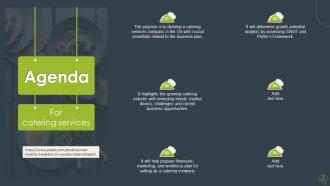
Slide 2: This slide states Agenda of the presentation.
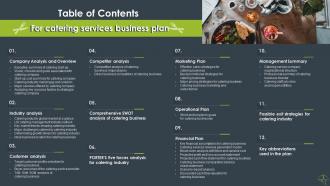
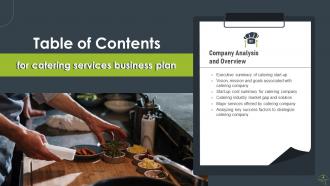
Slide 3: This slide shows Table of Content for the presentation.
Slide 4: This slide highlights title for topics that are to be covered next in the template.
Slide 5: This slide presents Executive summary of catering start-up.
Slide 6: This slide displays Vision, mission and goals associated with catering company.
Slide 7: This slide represents Start-up cost summary for catering company.
Slide 8: This slide showcases Catering industry market gap and solution.
Slide 9: This slide shows Major services offered by catering company.
Slide 10: This slide presents Analyzing key success factors to strategize catering company.
Slide 11: This slide highlights title for topics that are to be covered next in the template.
Slide 12: This slide displays Catering industry global market at a glance.
Slide 13: This slide represents US catering management industry outlook.
Slide 14: This slide showcases Key market trends shaping catering industry.
Slide 15: This slide shows Major challenges catered by catering industry.
Slide 16: This slide presents Determining growth drivers for catering industry.
Slide 17: This slide displays Ideal business location for catering business.
Slide 18: This slide highlights title for topics that are to be covered next in the template.
Slide 19: This slide represents Target customer profile selection for catering business.
Slide 20: This slide showcases Buyer personas of the catering service provider.
Slide 21: This slide shows TAM SAM SOM analysis of catering business.
Slide 22: This slide highlights title for topics that are to be covered next in the template.
Slide 23: This slide presents Competitive analysis of catering business major players.
Slide 24: This slide displays Direct business competitors of catering business.
Slide 25: This slide highlights title for topics that are to be covered next in the template.
Slide 26: This slide represents Comprehensive SWOT analysis of catering business.
Slide 27: This slide highlights title for topics that are to be covered next in the template.
Slide 28: This slide showcases PORTER’S five forces analysis for catering industry.
Slide 29: This slide highlights title for topics that are to be covered next in the template.
Slide 30: This slide shows Effective for catering business.
Slide 31: This slide presents Best promotional strategies for catering business.
Slide 32: This slide displays Major pricing strategies for catering business.
Slide 33: This slide represents Catering business marketing and sales funnel.
Slide 34: This slide highlights title for topics that are to be covered next in the template.
Slide 35: This slide showcases Short and long term goals for catering businesses.
Slide 36: This slide highlights title for topics that are to be covered next in the template.
Slide 37: This slide shows Key financial assumptions for catering business.
Slide 38: This slide presents Catering services revenue generation model.
Slide 39: This slide displays Break-even analysis with fixed and variable cost.
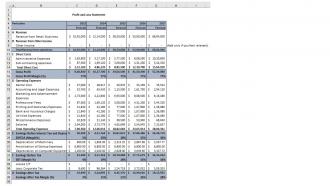
Slide 40: This slide represents Projected profit and loss account statement.
Slide 41: This is another slide continuing Projected profit and loss account statement.
Slide 42: This slide showcases Projected cash flow statement for catering business.
Slide 43: This is another slide continuing Projected cash flow statement for catering business.
Slide 44: This slide shows Catering business comparative balance sheet statement.
Slide 45: This slide presents Catering business comparative balance sheet statement.
Slide 46: This slide displays Scenario-based analysis with realistic, optimistic, and pessimistic cases.
Slide 47: This is another slide continuing Scenario analysis with realistic, optimistic, and pessimistic cases.
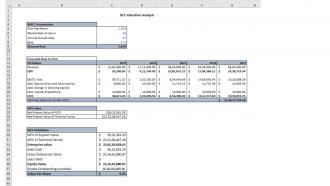
Slide 48: This slide represents Discounted cash flow valuation for catering business.
Slide 49: This slide highlights title for topics that are to be covered next in the template.
Slide 50: This slide showcases Catering service company organizational structure.
Slide 51: This slide shows Professional summary of catering business founder.
Slide 52: This slide presents Catering staff job roles and responsibilities.
Slide 53: This is another slide continuing Catering staff job roles and responsibilities.
Slide 54: This slide highlights title for topics that are to be covered next in the template.
Slide 55: This slide displays Possible exit strategies for catering industry.
Slide 56: This slide highlights title for topics that are to be covered next in the template.
Slide 57: This slide represents Key abbreviations used in the plan.
Slide 58: This slide contains all the icons used in this presentation.
Slide 59: This slide is titled as Additional Slides for moving forward.
Slide 60: This is About Us slide to show company specifications etc.
Slide 61: This slide provides Clustered Column chart with two products comparison.
Slide 62: This is a Comparison slide to state comparison between commodities, entities etc.
Slide 63: This slide depicts Venn diagram with text boxes.
Slide 64: This is Our Mission slide with related imagery and text.
Slide 65: This slide presents Roadmap with additional textboxes.
Slide 66: This is a Financial slide. Show your finance related stuff here.
Slide 67: This is an Idea Generation slide to state a new idea or highlight information, specifications etc.
Slide 68: This slide contains Puzzle with related icons and text.
Slide 69: This is a Timeline slide. Show data related to time intervals here.
Slide 70: This is a Thank You slide with address, contact numbers and email address.
Catering Business Plan Powerpoint Presentation Slides with all 75 slides:
Use our Catering Business Plan Powerpoint Presentation Slides to effectively help you save your valuable time. They are readymade to fit into any presentation structure.







FAQs for Catering Business Plan
So you'll need the basics - local market research, who you're targeting (weddings are gold mines btw), and what makes you different. Financial stuff is where people mess up big time, so nail down startup costs and realistic pricing. Operations covers your menu, kitchen space, staff, and how you'll actually get food there without everything falling apart. Oh and competitive analysis plus marketing strategy. I'd honestly spend most of your time on the money side - those projections need to be bulletproof or you're screwed.
Look, market research shows you who actually wants your food and what they'll pay. Figure out which events are big in your area, what food styles people are into, competitor pricing - all that jazz. Honestly saves you from epic fails like targeting the wrong crowd or pricing too high. Short sentences work. You might find there's literally no good Mexican catering downtown even though it's packed with offices. That's your opening right there. Use everything you learn to build your menu and set prices that actually make sense from the start.
Honestly, I'd start by figuring out your niche first - weddings, corporate stuff, food trucks, whatever clicks with you. Scope out the competition and see who they're missing. Social media's clutch for this - check what local event planners and venues are posting about. Survey people you already know too! I literally just walk around business areas sometimes and chat with folks about their catering headaches. Oh, and networking events are goldmines for this kind of intel. The trick is getting super specific about budgets and event types instead of that whole "everyone eats" mindset.
Map out your direct competitors first - other caterers obviously. But don't forget indirect ones like restaurants doing catering or even grocery stores. Check their pricing, menus, who they target. Honestly, just order from a few of them - sounds weird but it's the best way to see what you're up against. Look for gaps they're missing... maybe they suck at dietary restrictions or only do weddings when you could focus on corporate stuff. Figure out what makes you different and actually write it down. Oh and update this thing every few months because everything changes so fast in food service.
Honestly, cash flow projections are gonna be your lifesaver - catering has this weird thing where people pay deposits months early but you're buying all the food like two days before. You'll need sales forecasts broken down by event type, startup costs, break-even analysis, and P&L statements too. Corporate events vs weddings have totally different margins, so separate those out. Don't forget your pricing strategy - food costs versus labor can make or break you. Start conservative with your numbers, then do best/worst case scenarios. Investors eat that stuff up.
Honestly, the catering game is pretty crowded, but here's the thing - you gotta pick your lane and own it completely. Are you the vegan queen? The taco truck that actually shows up on time? Whatever makes you different from boring wedding chicken needs to be crystal clear. I'd say focus on one specialty instead of trying to be everything to everyone. Like, maybe you're incredible at Korean fusion or you do those interactive cooking stations people love posting about. The goal is when someone thinks of [your thing], they immediately think of you. Oh and don't try to compete with everyone - just be undeniably good at your specific niche.
For the operational section, map out your kitchen setup and what equipment you'll actually need. Staffing is huge - figure out how many people for different event sizes. I'd also nail down your supplier relationships early since good vendors can save your butt later. Delivery and setup processes matter more than you think. Oh, and don't get so caught up in the fun menu planning that you skip the boring stuff like food safety protocols and licensing. That'll bite you if ignored. Be honest about capacity limits too. Better to turn down orders than crash and burn in those crazy first few months when everything's new.
You definitely need a solid marketing strategy in your business plan. Investors want to see you actually know who your customers are and how you'll find them. Word-of-mouth is great but won't pay the bills when you're starting out - learned that the hard way! Include digital stuff like social media, but don't forget local networking since catering's still about relationships. It also helps you figure out what you'll spend on marketing upfront. Oh, and make sure you explain what makes you different from every other caterer in town.
Honestly, your menu is like the backbone of your whole catering business. It drives your food costs, what staff you'll need, equipment, pricing - basically everything. Think about it - you can't serve fancy plated dinners from a food truck, you know? Your menu also shapes who your customers are and how you market yourself. Even affects your kitchen setup and seasonal planning. I learned this the hard way when I first started thinking about catering (totally underestimated the domino effect). Focus on what you can actually pull off consistently and profitably. Then build everything else around that foundation.
Honestly, just do a simple "good, better, best" setup - people eat that stuff up. Calculate your food costs, labor, overhead, and profit margin first, then bundle everything into clear per-person rates. Different service levels, you know? Oh and definitely spell out what's included vs. what costs extra upfront. Nobody wants to get hit with random fees later. I'd throw in some sample menus with pricing too so they can actually picture what they're paying for. Makes the whole thing way less confusing for everyone.
Okay so first things first - call your local health department, they'll basically walk you through everything you need. Food service license and permits are obviously mandatory. Business registration and tax ID are pretty standard stuff. Get liability insurance though, seriously don't cheap out on that one. Most places want you to have ServSafe certification too. If you're hiring people, brush up on labor laws. Oh and zoning can be tricky if you're working from home - learned that the hard way with my cousin's bakery thing. Some areas need special permits for off-site catering or serving alcohol. It's honestly not as scary as it sounds once you get started.
Ok so first thing - grab some event management software to handle all your bookings and client stuff in one spot. CaterTrax or Caterease are solid options. Mobile payments are basically mandatory now, people get weird if you can't take cards. Inventory software will save you from constantly running out of random ingredients (been there). I'd honestly start with just one good catering platform, then add scheduling apps and maybe some social media automation once you figure out what's driving you the most crazy day-to-day.
Start with the obvious stuff - food poisoning scares, equipment dying mid-event, not having enough staff when you're slammed. Money's tricky too since demand's all over the place seasonally. Clients paying late will kill your cash flow, plus food costs keep jumping around. Oh, and bridezillas who change everything last second? Total nightmare. Weather can destroy outdoor gigs in minutes. One nasty online review spreads fast. The competition's brutal - established places plus all these trendy food trucks popping up everywhere. Definitely stash away 6 months of expenses and have backup plans ready.
Don't just slap sustainability onto the end - work it into everything from the start. Go local with your suppliers and seasonal ingredients when you can. Set actual waste reduction goals, like composting and ditching disposables for reusable stuff. Budget for the upfront costs though - compostable containers aren't cheap. Track everything with real numbers so you can brag about it later. Honestly, more clients care about this now than they used to, so it's worth the effort. Plus you'll feel better about not adding to landfills every event.
Honestly, focus on the money stuff first - revenue per event, profit margins, and what it costs to get new customers. Track your booking conversion rates too because that's where you'll spot problems early. Food waste is killer - I learned that the hard way when I was throwing away like 20% of my prep. Customer satisfaction scores matter more than you'd think since everyone finds caterers through referrals anyway. Also watch your repeat customer percentage and average order values. Setup times are worth tracking once you get busier. Don't overcomplicate it though - just use a simple spreadsheet you can check weekly.
-
Thanks to SlideTeam, we have an ideal template to present all the info we need to cover. Their slides give our numbers and projections a more clear and enchanting look.
-
I downloaded some of the presentations for work. They were simple to modify and saved me a lot of time and effort.