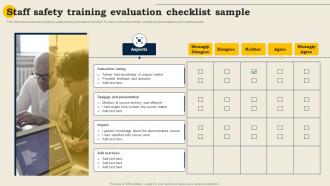
Staff Safety Training Evaluation Checklist Sample
Try Before you Buy Download Free Sample Product
Audience
Editable
of Time
The slide showcases an employee safety training evaluation checklist. It covers instruction ratings, design and presentation and impact aspects.
People who downloaded this PowerPoint presentation also viewed the following :
Staff Safety Training Evaluation Checklist Sample with all 6 slides:
Use our Staff Safety Training Evaluation Checklist Sample to effectively help you save your valuable time. They are readymade to fit into any presentation structure.
FAQs for Staff Safety Training
Key objectives of staff safety training programs include hazard identification, emergency response protocols, compliance with regulatory standards, accident prevention techniques, and fostering a proactive safety culture. These programs enhance workplace safety by reducing incidents, ensuring regulatory compliance, and building employee confidence, with organizations across manufacturing, healthcare, and construction finding that comprehensive training ultimately delivers lower insurance costs and improved operational efficiency.
Safety training evaluations should be conducted quarterly for high-risk environments, annually for standard operations, and immediately following incidents or regulatory changes. Many organizations find that this tiered approach enables continuous compliance monitoring, identifies knowledge gaps before they become issues, and ensures staff maintain current safety protocols, ultimately delivering reduced workplace incidents and stronger regulatory standing.
Safety protocols in training checklists should include emergency evacuation procedures, hazard identification and reporting, personal protective equipment usage, incident response protocols, and workplace-specific safety measures. These comprehensive protocols streamline safety compliance by establishing clear procedures, reducing workplace accidents, and ensuring regulatory adherence, with many organizations finding that structured safety training ultimately delivers enhanced employee confidence and significantly lower insurance costs.
Safety training effectiveness can be measured through pre/post assessments, incident rate tracking, behavioral observations, employee feedback surveys, and compliance audit scores. These evaluation methods enable organizations to identify knowledge gaps, monitor workplace behavior changes, and demonstrate ROI through reduced accidents and insurance costs, with many companies finding that systematic measurement approaches ultimately enhance both employee confidence and operational safety outcomes.
Metrics for assessing employee engagement during safety training include participation rates, quiz scores, interactive question responses, time spent on modules, and completion rates. These measurements enable organizations to identify knowledge gaps, optimize training delivery, and enhance retention, with many companies finding that engaged employees demonstrate significantly better safety compliance and fewer workplace incidents.
Ensuring safety training relevance requires conducting thorough role-based risk assessments, customizing content for specific job functions, incorporating department-specific scenarios, and regularly updating materials based on workplace changes and staff feedback. Manufacturing teams, healthcare workers, and office personnel each face distinct hazards, so training modules should address role-specific risks while maintaining core safety principles, ultimately delivering targeted protection and enhanced compliance across all organizational levels.
Methods for gathering post-training feedback include surveys and questionnaires, focus groups, one-on-one interviews, digital feedback platforms, and anonymous suggestion boxes. These approaches enable organizations to assess training effectiveness, identify knowledge gaps, and measure behavioral changes, with many companies finding that combining multiple feedback methods delivers more comprehensive insights and ultimately enhances workplace safety outcomes.
Real-life scenarios can be integrated through simulation exercises, case study analysis, role-playing activities, incident recreation walkthroughs, and workplace hazard identification tasks. These methods enhance training effectiveness by allowing employees to practice decision-making in controlled environments that mirror actual workplace situations, ultimately delivering better preparedness and improved safety outcomes across organizations.
Documentation should include training certificates, attendance records, assessment scores, training content summaries, and renewal dates. These records enable organizations to demonstrate regulatory compliance, track employee skill development, and identify training gaps across departments, while many companies find that comprehensive documentation systems streamline audit processes and enhance workplace safety accountability.
Technology enhances safety training evaluation through virtual reality simulations, AI-powered assessment analytics, mobile learning platforms, real-time performance tracking, and automated compliance reporting. These digital solutions streamline data collection, provide immersive scenario-based testing, and deliver instant feedback, with many organizations finding that technology-driven evaluations significantly improve training effectiveness while reducing administrative overhead and ensuring consistent safety standards.
Natural behaviors to observe include consistent use of personal protective equipment, proactive hazard identification and reporting, adherence to safety protocols without supervision, spontaneous peer corrections, and immediate response to safety incidents. These behavioral changes demonstrate genuine safety culture integration rather than mere compliance, with organizations finding that employees naturally mentor newcomers and consistently follow procedures even under time pressure, ultimately delivering sustained workplace safety improvements.
Aligning safety training goals with organizational regulations requires comprehensive policy mapping, regular compliance audits, and systematic gap analysis to ensure all training modules meet current regulatory standards. Organizations achieve this through structured evaluation frameworks that integrate OSHA requirements, industry-specific guidelines, and internal safety protocols, ultimately delivering consistent compliance while enhancing workplace safety culture and reducing liability risks.
Leadership drives staff safety training evaluation success by setting clear expectations, allocating adequate resources, demonstrating visible commitment to safety protocols, and ensuring systematic follow-through on identified improvements. Through consistent messaging and accountability measures, leaders create cultures where safety training becomes strategic priority rather than compliance exercise, with organizations finding that engaged leadership correlates directly with improved safety outcomes and reduced workplace incidents.
**INPUT**: How can we identify knowledge gaps in staff safety awareness after training? **OUTPUT**: Organizations can identify safety knowledge gaps through post-training assessments, practical simulations, spot observations, incident analysis, and regular feedback sessions with supervisors. These evaluation methods enable companies across manufacturing, healthcare, and construction sectors to pinpoint specific weaknesses, customize follow-up training, and ultimately enhance workplace safety compliance while reducing accident rates.
Follow-up procedures include regular refresher sessions, periodic skills assessments, safety huddles reviewing recent incidents, peer mentoring programs, and quarterly competency evaluations. These approaches reinforce learning by maintaining continuous engagement, identifying knowledge gaps through practical scenarios, and creating accountability systems, with many organizations finding that structured follow-up programs significantly reduce workplace incidents while enhancing overall safety culture.
-
Love the template collection they have! I have prepared for my meetings much faster without worrying about designing a whole presentation from scratch.
-
Superb! The innovative and inspiring template designs provide an edge to the presentation.