


Health And Safety Training Matrix For Workplace Safety Management Framework




Try Before you Buy Download Free Sample Product
 Impress Your
 Audience
 100%
100% Editable
 Save Hours
 of Time


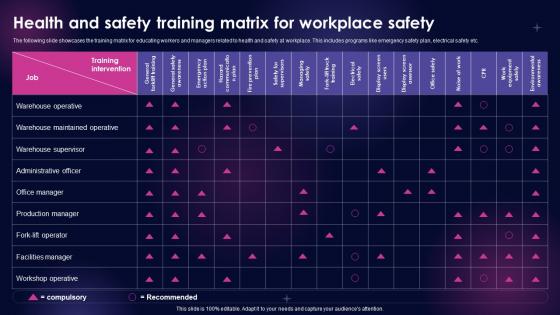
The following slide showcases the training matrix for educating workers and managers related to health and safety at workplace. This includes programs like emergency safety plan, electrical safety etc.
People who downloaded this PowerPoint presentation also viewed the following :
Health And Safety Training Matrix For Workplace Safety Management Framework with all 6 slides:
Use our Health And Safety Training Matrix For Workplace Safety Management Framework to effectively help you save your valuable time. They are readymade to fit into any presentation structure.





FAQs for Health And Safety Training Matrix For Workplace
So basically you're mapping out who needs which training and when. Put job roles down one side, then all your required courses across the top - fire safety, first aid, equipment training, whatever applies to your workplace. Track completion dates and renewal requirements for everyone. The tricky part is staying on top of expiry dates because nobody wants to deal with expired certifications during an audit (been there!). Set reminders maybe 30 days before renewals. Some people add competency levels too but honestly that's probably overkill unless you really need it. Sounds complicated but it's pretty straightforward once you get going.
Okay so training matrices are actually pretty clutch - they show you exactly who needs what training and when. No more digging through random files when auditors show up! You can spot gaps super fast, track when stuff expires, and prove everyone's legit trained. Honestly saves my butt during inspections. Plus you'll notice patterns, like how marketing always waits till the last minute (why though?). Set up alerts based on the matrix so nothing gets missed. Way better than panicking when you realize someone's cert expired three months ago.
Start with a spreadsheet mapping jobs to hazards and what regulations you need to hit. New hires obviously need way more hand-holding than your veterans. Think about who needs refreshers when, plus any hard deadlines you can't blow. Seasonal workers are tricky - they're gone before you know it. Budget matters too. Some stuff works fine online, but honestly? High-risk activities need real demos. Oh, and don't forget specialized equipment training - that's usually where people mess up. Once you've got everything mapped out, the gaps become super obvious and you can tackle the scary stuff first.
So basically you map out everyone's certs and expiration dates in one spot. Makes it crazy easy to catch who's missing what - like if your forklift guys need safety refreshers or new people haven't done their required stuff yet. Honestly changed my life lol, wish I'd started using one years ago. The cool thing is you can see patterns too, like when your whole night crew needs the same training. Just start with what everyone currently has and boom, the gaps become super obvious. Way better than digging through spreadsheets constantly.
Honestly, you can't run training matrices without good tech these days. Get an LMS that connects to your HR system - when people switch jobs, their training updates automatically. No more Excel hell (seriously, I've been there). Most platforms let you assign courses by role and spit out compliance reports pretty easily. The mobile thing is huge too since people can knock out training wherever they are. I'd start by figuring out your budget first, then find software that matches your complexity. It'll save you tons of time each week once it's set up.
Honestly? Every 6 months if you can manage it, but at minimum once a year. Regulations shift constantly, plus you've got new equipment, staff changes, all that stuff. I'd set a quarterly reminder just to do a quick scan - even if it's literally 10 minutes checking who needs refresher training soon. Trust me, you don't want to be that company suddenly realizing everyone's CPR certs expired three months ago. Been there, it's not fun. The scrambling is real when an audit hits and half your people are technically unqualified.
Honestly, the best way is tracking your incident rates before and after - that's where you'll see real results. Post-training quizzes are obvious but they work for checking if people actually retained stuff. I'd also do competency evaluations where you watch them apply what they learned in actual scenarios. Getting feedback from trainees is huge too, like was the content even relevant to their job? Oh and refresher sessions are great because they show you what people forgot. Start small with whatever method fits your budget, then add more as you figure out what clicks with your team.
Honestly, these training matrices are game-changers for onboarding. Instead of frantically trying to remember what safety courses your new hires need, everything's laid out by role. You'll see exactly what training they need and when it's due. I learned this the hard way after almost missing a critical certification deadline - not fun explaining that to management! Progress tracking becomes super easy too. New employees actually appreciate having a clear roadmap instead of wondering what's next. Oh, and definitely set up those automated reminders because deadlines sneak up fast.
So you've got tons of options for your training matrix. Classroom stuff, online modules, hands-on workshops, video training - the usual suspects. Some places throw in mentoring or toolbox talks too. VR's becoming a thing if your budget allows it. Here's the deal though - match your format to what you're actually teaching. Fire extinguisher training? You can't just watch a video and call it good. People need to actually grab the thing and use it. I'd map out which skills need real practice first, then figure out what can be done through reading or videos. Oh, and don't make everything online just because it's cheaper - some stuff really needs that face-to-face component.
Honestly, tracking training is a game-changer because it shows people that safety isn't just talk. When everyone can see who's current on their certs and who's falling behind, it creates this natural peer pressure that actually works. Nobody wants to be the slacker with expired training on the team dashboard - trust me on this one. You'll spot knowledge gaps way before they become real problems too. The key is making those completion rates visible to managers and checking them monthly. Sounds boring but it totally drives better participation across the board.
Honestly, just be super upfront about the whole thing when you send it out. Walk them through why certain people need specific training - like, actually connect it to what they do day-to-day. I made the mistake once of just emailing a spreadsheet and people were so confused lol. Set clear deadlines and make the training stuff easy to find. Pick someone to handle questions because trust me, there will be questions. Frame it as keeping everyone safe rather than just more paperwork to deal with. Maybe do a quick team huddle to go over it together? Regular check-ins help catch anyone who's falling behind too.
Honestly, the worst part is always time and money - you can't train people without pulling them off actual work, which managers hate. Been there, done that argument. Getting buy-in is brutal when everyone sees training as wasted hours. Oh and keeping everything updated? Nightmare fuel when regulations change constantly. Don't even get me started on tracking who's done what - spreadsheets will destroy your sanity. My take? Focus on your riskiest roles first and bite the bullet on decent tracking software from day one. Trust me on this one.
Dude, getting feedback from your team is seriously the best way to fix your training stuff. They'll spot holes you totally missed - like real situations they deal with that aren't covered, or old processes that don't even apply anymore. I always send a quick survey after sessions (nothing fancy), then actually look at the responses every few months to update things. Short sentences work better than long ones, trust me. People get way more into it when they know you're listening. Focus on what they say needs more detail and cut the boring parts that waste everyone's time.
Oh man, training matrices are lifesavers when shit hits the fan during investigations. You can instantly see who got trained on what and when their last refresher was. Missing qualifications? Boom, it's right there. Shows you whether someone screwed up because they didn't know better or if your training program sucks. Honestly, regulators eat this stuff up too - proves you're actually tracking who knows what. Just keep it updated or it's useless when you really need it. Like, what's the point of having stale data when you're trying to figure out what went wrong?
Ugh, regulatory changes are such a pain. You basically have to rebuild your whole training setup when new stuff comes out. New OSHA rules? Gotta add mandatory courses. Industry shifts? Time to update everything or scrap old requirements entirely. I swear it's like they coordinate to make your life harder - multiple agencies will drop updates at the same time. Sometimes you're creating brand new tracks for specific roles or extending how long certs last. Pro tip: join industry associations so you get a heads up instead of panicking at the last second to get compliant.
-
This design is not only aesthetically pleasing but it has many uses making the cost worthwhile. The graphics look stunning, and you can edit them as per your needs.
-
Great designs, really helpful.