

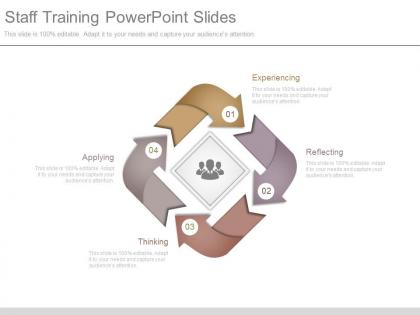
Staff training powerpoint slides




Try Before you Buy Download Free Sample Product
 Impress Your
Audience
 100%
Editable
 Save Hours
of Time


Focus on analysis with our Staff Training Powerpoint Slides. They draw your attention to critical aspects.
People who downloaded this PowerPoint presentation also viewed the following :
Staff training powerpoint slides with all 7 slides:
Engage the group with our Staff Training Powerpoint Slides. Get them all eager to contribute.


FAQs for Staff
Effective staff training programs include clear learning objectives, role-specific skill development, hands-on practice opportunities, regular assessments, and ongoing support systems. These components work together by ensuring knowledge retention, improving job performance, and reducing onboarding time, with many organizations finding that comprehensive programs ultimately deliver higher employee engagement and measurable productivity gains.
Organizations measure training success through multiple metrics including employee performance assessments, skill competency evaluations, productivity measurements, retention rates, and return on investment calculations. These comprehensive approaches enable companies across sectors like healthcare, manufacturing, and financial services to track knowledge retention, behavioral changes, and business impact, ultimately delivering improved operational efficiency and competitive advantage while ensuring training investments translate into measurable organizational growth.
Technology transforms modern staff training through virtual reality simulations, AI-powered personalized learning paths, mobile learning platforms, interactive video modules, and real-time performance analytics. These digital tools streamline training delivery by reducing costs, accelerating skill development, and enabling remote accessibility, with organizations across healthcare, retail, and manufacturing finding that technology-enhanced programs deliver faster competency development and measurable performance improvements.
Staff training accommodates diverse learning styles through visual presentations, hands-on workshops, audio content, interactive simulations, and mentoring programs. Organizations increasingly combine multiple delivery methods, with many companies finding that personalized learning paths enhance knowledge retention, accelerate skill development, and ultimately improve employee performance while reducing training costs.
Best practices for onboarding new employees include structured orientation sessions, role-specific skill development, mentorship programs, interactive learning modules, and regular progress assessments. These approaches streamline integration by establishing clear expectations, accelerating competency development, and fostering workplace relationships, with many organizations finding that comprehensive onboarding programs enhance employee retention and productivity while reducing time-to-performance.
**INPUT**: How can feedback from trainees be incorporated to improve future training sessions? **OUTPUT**: Trainee feedback can be incorporated through post-session surveys, focus groups, performance assessments, and regular one-on-one discussions to identify content gaps and delivery improvements. These insights enable organizations to refine training materials, adjust pacing, and enhance engagement methods, ultimately delivering more effective programs and better learning outcomes across departments.
Remote training challenges include technology barriers, reduced engagement, limited hands-on practice, communication difficulties, and maintaining consistent quality across distributed teams. Organizations overcome these through interactive platforms, virtual simulations, regular check-ins, and blended learning approaches, with many companies finding that strategic use of breakout sessions, gamification, and peer collaboration ultimately delivers effective skill development and stronger team connections.
Training budgets directly influence development quality through resource allocation for expert instructors, advanced materials, and comprehensive programs, while frequency depends on sustained funding for regular sessions. Organizations with strategic training investments typically deliver enhanced employee skills, improved performance metrics, and higher retention rates, with many companies finding that consistent development funding ultimately creates competitive advantages through better-equipped teams.
Mentorship enhances formal training programs by providing personalized guidance, real-world context, and ongoing support that bridges theoretical knowledge with practical application. Through one-on-one relationships, mentors help accelerate skill development, reinforce learning objectives, and offer industry-specific insights, with many organizations finding that mentorship significantly improves knowledge retention and employee engagement.
Training programs promote continuous learning culture by incorporating microlearning modules, peer-to-peer knowledge sharing, mentorship opportunities, regular skill assessments, and adaptive learning pathways. These approaches streamline professional development while enhancing employee engagement, with many organizations finding that strategic combinations of formal training and collaborative learning ultimately deliver higher retention rates, improved performance metrics, and sustained competitive advantage.
Today's workforce training prioritizes digital literacy, communication skills, adaptability, problem-solving capabilities, and emotional intelligence. These competencies enable organizations to navigate increasingly complex business environments, with many companies finding that employees equipped with these versatile skills deliver enhanced collaboration, faster innovation, and ultimately stronger competitive advantage across diverse operational challenges.
Organizations leverage gamification to increase training engagement through points systems, leaderboards, achievement badges, interactive challenges, and progress tracking that transform learning into competitive, rewarding experiences. Companies like Deloitte and McDonald's find that gamified training improves knowledge retention by up to 75%, while reducing completion times and costs, ultimately delivering higher employee satisfaction and better skill development outcomes.
Legal considerations for staff training programs include compliance with employment law, anti-discrimination regulations, workplace safety requirements, data privacy standards, and industry-specific mandates. These frameworks ensure training delivers consistent documentation, protects against liability risks, and meets regulatory obligations, with many organizations finding that comprehensive legal alignment ultimately enhances employee protection and operational credibility.
Soft skills training integrates effectively into technical programs through scenario-based learning, collaborative project work, peer mentoring sessions, and real-world case studies that combine technical problem-solving with communication challenges. This strategic combination enables professionals to develop both technical expertise and interpersonal capabilities simultaneously, with many organizations finding that integrated approaches deliver stronger team collaboration, enhanced client interactions, and ultimately more well-rounded technical professionals.
Assessments play a crucial role by identifying skill gaps, measuring learning progress, and evaluating training effectiveness through pre-training evaluations, ongoing quizzes, and post-program assessments. These tools enable organizations to customize content delivery, track employee development, and demonstrate ROI, with many companies finding that structured assessment frameworks enhance retention rates and ultimately deliver measurable improvements in workplace performance.
-
Visually stunning presentation, love the content.
-
Enough space for editing and adding your own content.