


Strategic Roadmap Checklist For Product Development





Try Before you Buy Download Free Sample Product
 Impress Your
 Audience
 100%
100% Editable
 Save Hours
 of Time


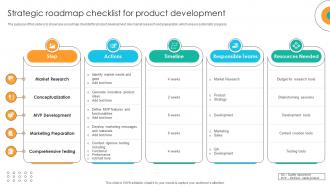
The purpose of this slide is to showcase a roadmap checklist for product development, like market research and preparation, which ensure systematic progress.
People who downloaded this PowerPoint presentation also viewed the following :
Strategic Roadmap Checklist For Product Development with all 9 slides:
Use our Strategic Roadmap Checklist For Product Development to effectively help you save your valuable time. They are readymade to fit into any presentation structure.








FAQs for Strategic Roadmap Checklist
Key components of an effective strategic roadmap include clear vision statements, measurable objectives, timeline milestones, resource allocation plans, and performance metrics. These elements work together by aligning organizational priorities, tracking progress systematically, and enabling adaptive planning, with many companies finding that well-structured roadmaps deliver enhanced operational efficiency and sustained competitive advantage.
Aligning a strategic roadmap with organizational goals involves mapping specific initiatives to broader objectives, establishing clear timelines and milestones, and ensuring resource allocation supports priority outcomes. This strategic combination enables organizations to maintain focus, track progress systematically, and adapt tactics while preserving overall direction, with many leadership teams finding that regular alignment reviews ultimately deliver enhanced operational efficiency and measurable progress toward long-term vision.
Stakeholder engagement ensures strategic roadmaps reflect diverse perspectives, organizational realities, and cross-functional requirements through collaborative input gathering, priority alignment, and buy-in development. This inclusive approach enhances roadmap accuracy and implementation success, with many organizations finding that early stakeholder involvement reduces resistance, accelerates decision-making, and ultimately delivers more achievable strategic outcomes.
A strategic roadmap helps prioritize projects by aligning initiatives with long-term business objectives, resource availability, and market opportunities, while providing clear timelines and dependencies for decision-making. Through visual mapping and milestone tracking, organizations can streamline resource allocation, minimize conflicting priorities, and accelerate high-impact initiatives, ultimately delivering enhanced operational efficiency and competitive advantage.
Strategic roadmap success metrics include revenue growth targets, customer acquisition rates, operational efficiency indicators, market share expansion, and timeline adherence percentages. These measurements enable organizations to track progress across financial, operational, and strategic dimensions, with many companies finding that balanced scorecards combining quantitative targets with qualitative milestones ultimately deliver clearer accountability and competitive advantage.
Strategic roadmaps should be reviewed quarterly and updated annually, with major revisions triggered by significant market shifts, competitive changes, or organizational pivots. Many organizations find that quarterly check-ins enable rapid adaptation to emerging opportunities while annual comprehensive updates ensure long-term strategic alignment, ultimately delivering enhanced agility and sustained competitive advantage.
Strategic roadmap tools include Roadmunk, ProductPlan, Aha!, Microsoft Visio, and specialized PowerPoint templates with timeline features. These platforms streamline planning by enabling collaborative input, real-time updates, and visual clarity, with many organizations finding that integrated dashboards enhance stakeholder alignment and accelerate decision-making processes across departments.
Effectively communicating strategic roadmaps requires tailoring messaging to each team's priorities, using visual presentations with clear timelines, milestones, and departmental responsibilities. Through regular cross-functional meetings, interactive dashboards, and role-specific documentation, organizations enhance alignment and accountability, with many finding that consistent communication cadences and feedback loops ultimately deliver better execution, reduced silos, and stronger strategic outcomes.
Common pitfalls include setting unrealistic timelines, lacking stakeholder input, insufficient resource planning, poor communication strategies, and neglecting regular progress reviews. These challenges often derail implementation across organizations, with many companies finding that overambitious goals without proper milestone tracking ultimately compromise strategic outcomes, while inadequate cross-functional alignment prevents seamless execution and sustainable competitive advantage.
Integrating market trends and competitive analysis involves conducting regular market research, monitoring competitor strategies, analyzing industry shifts, and identifying emerging opportunities or threats. Through systematic evaluation, organizations streamline decision-making processes, anticipate market changes, and adjust strategic priorities accordingly, while ensuring their roadmap remains agile and responsive to evolving competitive landscapes.
A strategic roadmap focuses on long-term vision, goals, and major initiatives across multiple timeframes, while a project timeline details specific tasks, dependencies, and deadlines for individual projects. Strategic roadmaps guide organizational direction and resource allocation over months or years, whereas project timelines manage tactical execution and deliverables, with many companies finding that roadmaps inform multiple underlying project timelines simultaneously.
Visual elements enhance strategic roadmap understanding by transforming complex data into digestible formats through charts, timelines, color coding, icons, and progress indicators. These design components streamline information processing, highlight critical milestones and dependencies, and enable stakeholders across departments to quickly grasp strategic priorities, ultimately delivering improved alignment and faster decision-making in organizational planning.
Stakeholder interviews, surveys, workshops, focus groups, and collaborative planning sessions can gather comprehensive input during roadmap development. These methods enable organizations to capture diverse perspectives from executives, team members, and customers, while ensuring strategic alignment and buy-in across departments, ultimately delivering more robust roadmaps that reflect real operational needs and market opportunities.
**INPUT**: How do you ensure flexibility and adaptability within a strategic roadmap? **OUTPUT**: Strategic roadmaps maintain flexibility through regular review cycles, scenario planning, milestone checkpoints, and modular framework designs that accommodate changing market conditions. Organizations increasingly build in contingency pathways and quarterly reassessment processes, enabling them to pivot strategies while maintaining core objectives, ultimately delivering sustained competitive advantage in dynamic business environments. **Word count: 51 words**
Best practices for documenting strategic roadmaps include creating visual timelines with clear milestones, defining measurable objectives, establishing regular review cycles, and ensuring stakeholder alignment through collaborative platforms. These approaches streamline communication by providing centralized access, maintaining version control, and enabling real-time updates, with many organizations finding that consistent documentation ultimately delivers enhanced transparency and accelerated strategic execution.
-
This PowerPoint layout is very helpful from a business point of view, and it's visually stunning too! I'm so happy with this product because it has helped me understand and deliver great presentations.
-
No second thoughts when I’m looking for excellent templates. SlideTeam is definitely my go-to website for well-designed slides.