


Strategic Sourcing In Supply Chain Management Strategy CD V




Try Before you Buy Download Free Sample Product
 Impress Your
 Audience
 100%
100% Editable
 Save Hours
 of Time


A procurement strategy is a plan that outlines how an organization will acquire the goods and services it needs to meet its goals and objectives. Grab our Strategic sourcing in supply chain management template. It defines the approach, processes, methods, and techniques to identify, select, and engage suppliers, negotiate contracts, manage risk, and ensure that the procurement process supports the overall business strategy. Procurement strategy may consider factors such as cost, quality, delivery, sustainability, and innovation. Our Supplier Management deck includes an overview of procurement strategy, its benefits, best practices, markers, and importance. It also covers the purchase order, supplier defect rate, and procurement ROI challenges faced by an organization to acquire goods. Additionally, our Strategic Sourcing PPT exhibits the procurement strategy types like cost reduction, risk management, supplier management, vendor development, etc. It further covers the steps for creating an effective procurement strategy and the positive impact of implementing the system. Lastly, our Category Management module covers the procurement dashboard and the cost incurred in executing the plan. Get instant access to our supply chain management ppt now.
People who downloaded this PowerPoint presentation also viewed the following :
Content of this Powerpoint Presentation
Slide 1: This slide introduces Strategic sourcing in supply chain management. Commence by stating Your Company Name.
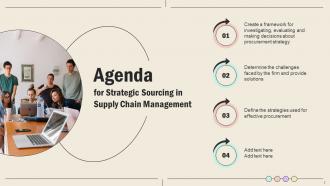
Slide 2: This slide depicts the Agenda of the presentation.
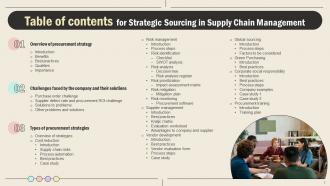
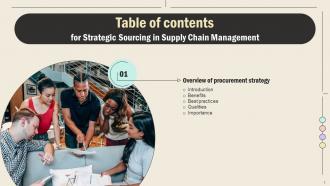
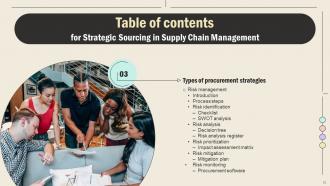
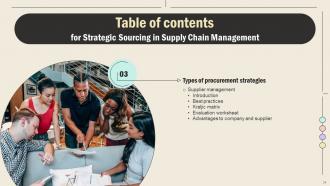
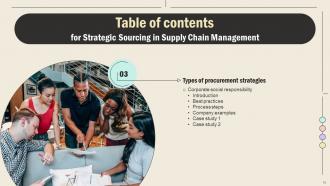
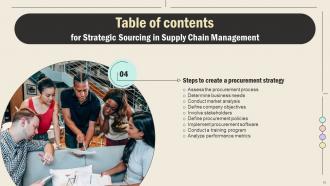
Slide 3: This slide incorporates the Table of contents.
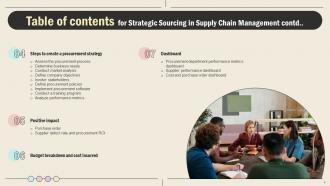
Slide 4: This is yet another slide continuing the Table of contents.
Slide 5: This slide highlights the Title for the Topics to be covered further.
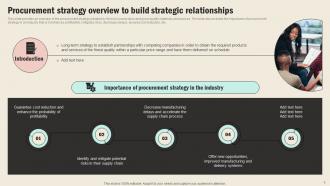
Slide 6: This slide states the Procurement strategy overview to build strategic relationships.
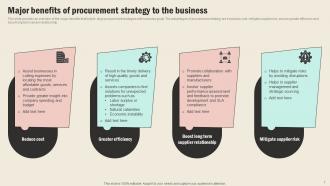
Slide 7: This slide displays the Major benefits of procurement strategy to the business.
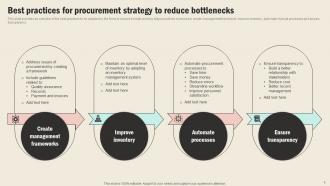
Slide 8: This slide exhibits the Best practices for procurement strategy to reduce bottlenecks.
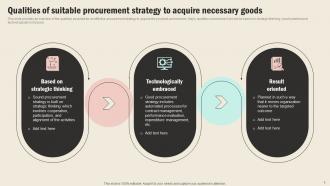
Slide 9: This slide shows the Qualities of suitable procurement strategy to acquire necessary goods.
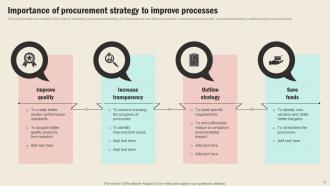
Slide 10: This slide depicts the Importance of procurement strategy to improve processes.
Slide 11: This slide indicates the Heading for the Contents to be discussed next.
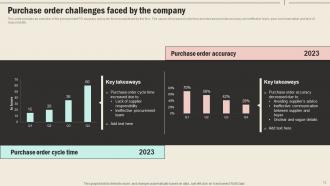
Slide 12: This slide provides an overview of the procurement PO accuracy and cycle time issues faced by the firm.
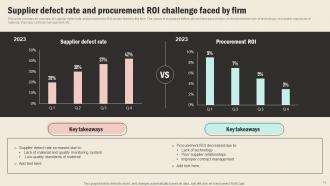
Slide 13: This slide portrays the supplier defect rate and procurement ROI issues faced by the firm.
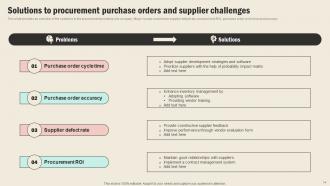
Slide 14: This slide mentions the Solutions to procurement purchase orders and supplier challenges.
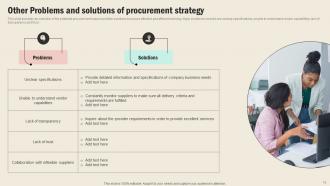
Slide 15: This slide states the Other problems and solutions of procurement strategy.
Slide 16: This slide highlights the Title for the Ideas to be covered in the following template.
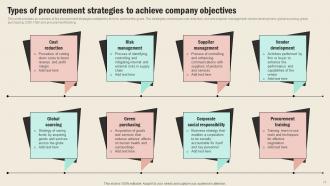
Slide 17: This slide shows the Types of procurement strategies to achieve company objectives.
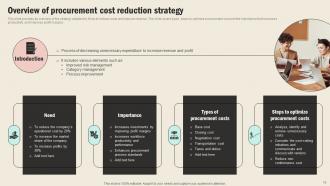
Slide 18: This slide provides an overview of the strategy adopted by firms to reduce costs and improve revenue.
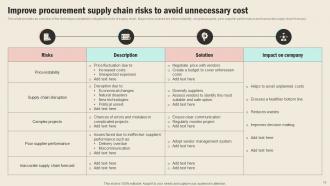
Slide 19: This slide presents the techniques adopted to mitigate the risks of supply chain.
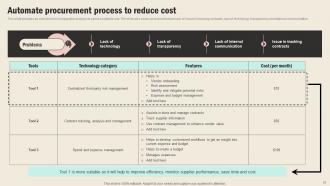
Slide 20: This slide provides an overview tool comparative analysis to select a suitable one.
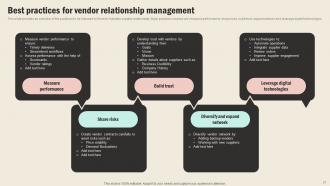
Slide 21: This slide exhibits the Best practices for vendor relationship management.
Slide 22: This slide provides an overview of a coffee house that faced difficulty to reduce costs.
Slide 23: This slide shows the Heading for the Ideas to be discussed further.
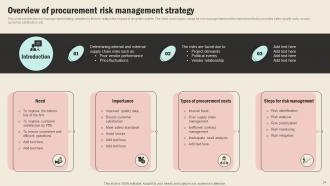
Slide 24: This slide exhibits the risk management strategy adopted by firms to reduce the impact of uncertain events.
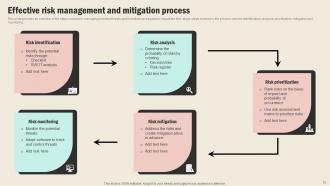
Slide 25: This slide portrays the Effective risk management and mitigation process.
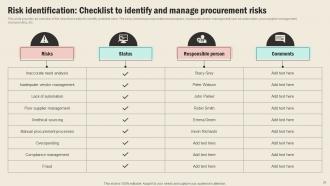
Slide 26: This slide provides an overview of the checklist created to identify potential risks.
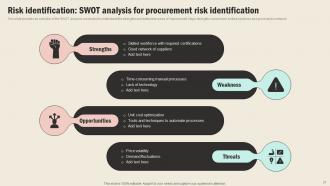
Slide 27: This slide portrays the SWOT analysis conducted to understand the strengths and determine areas of improvement.
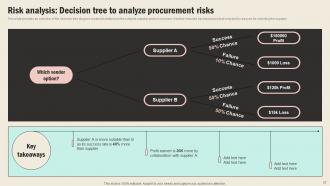
Slide 28: This slide shows the decision tree diagram created to determine the suitable supplier and risk involved.
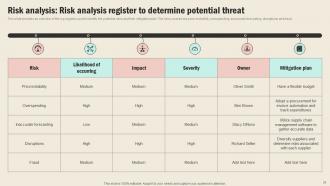
Slide 29: This slide illustrates the log register used to identify the potential risks and their mitigation plan.
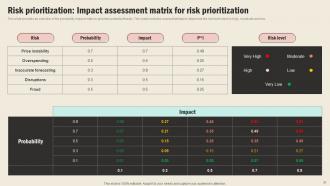
Slide 30: This slide provides an overview of the probability impact matrix to prioritize potential threats.
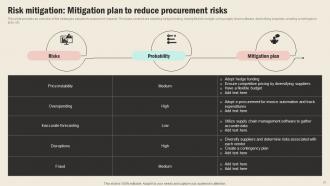
Slide 31: This slide shows the strategies adopted to reduce risk impacts.
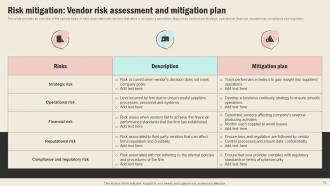
Slide 32: This slide provides an overview of the various types of risks associated with vendors that affect a company’s operations.
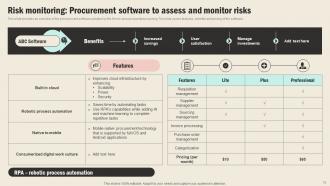
Slide 33: This slide portrays the procurement software adopted by the firm to ensure seamless working.
Slide 34: This slide includes the Title for the Contents to be discussed next.
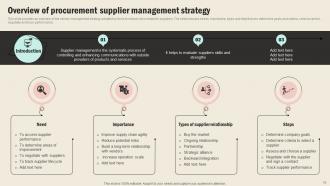
Slide 35: This slide shows an overview of the vendor management strategy adopted by firms to reduce risks related to suppliers.
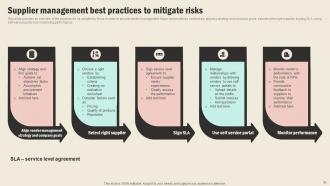
Slide 36: This slide deals with Supplier management best practices to mitigate risks.
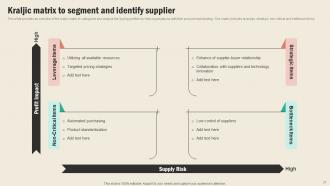
Slide 37: This slide illustrates the Kraljic matrix to segment and identify supplier.
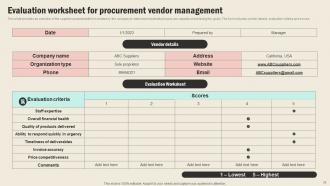
Slide 38: This slide displays the Evaluation worksheet for procurement vendor management.
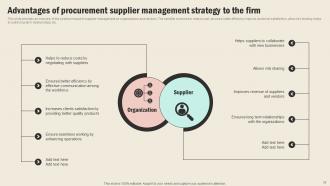
Slide 39: This slide contains the Advantages of procurement supplier management strategy to the firm.
Slide 40: This slide covers the Heading for the Topics to be covered further.
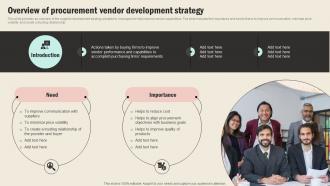
Slide 41: This slide provides an overview of the supplier development strategy adopted by managers to help improve vendor capabilities.
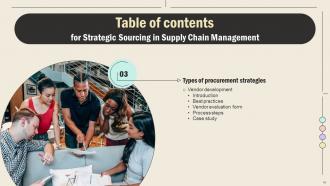
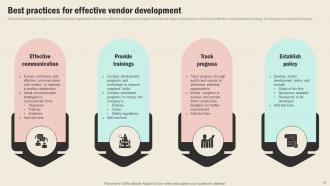
Slide 42: This slide exhibits the practices to be followed by organizations to ensure effective working and supplier development.
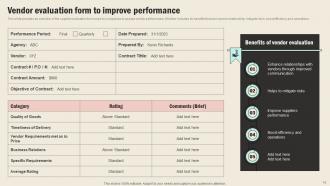
Slide 43: This slide displays the Vendor evaluation form to improve performance.
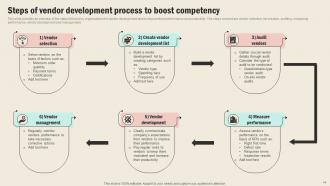
Slide 44: This slide states the Steps of vendor development process to boost competency.
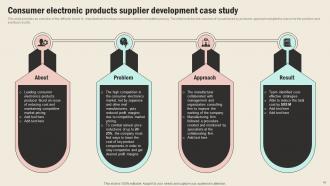
Slide 45: This slide depicts the Consumer electronic products supplier development case study.
Slide 46: This slide shows the Title for the Topics to be discussed in the following template.
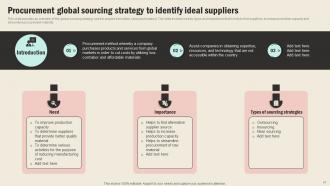
Slide 47: This slide portrays the Procurement global sourcing strategy to identify ideal suppliers.
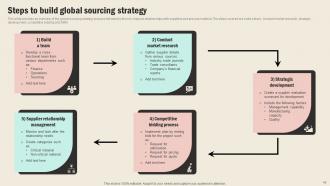
Slide 48: This slide states the Steps to build global sourcing strategy.
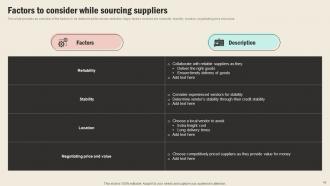
Slide 49: This slide depicts the Factors to consider while sourcing suppliers.
Slide 50: This slide presents the Heading for the Contents to be covered next.
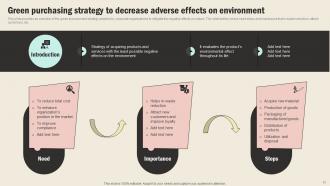
Slide 51: This slide talks about Green purchasing strategy to decrease adverse effects on environment.
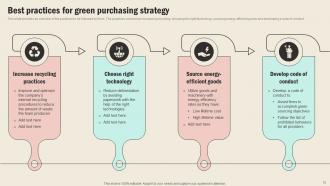
Slide 52: This slide highlights the Best practices for green purchasing strategy.
Slide 53: This slide mentions about the Title for the Ideas to be discussed in the upcoming template.
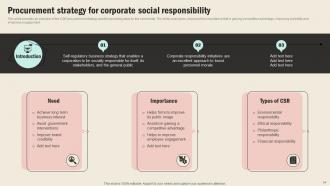
Slide 54: This slide indicates the Procurement strategy for corporate social responsibility.
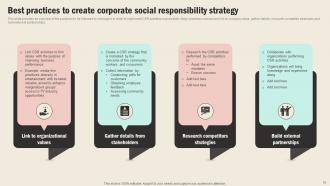
Slide 55: This slide exhibits the Best practices to create corporate social responsibility strategy.
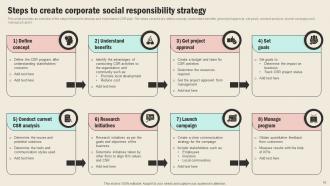
Slide 56: This slide displays the Steps to create corporate social responsibility strategy.
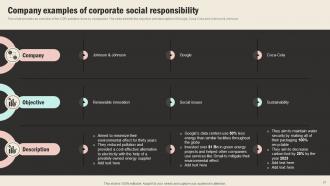
Slide 57: This slide reveals the Company examples of corporate social responsibility.
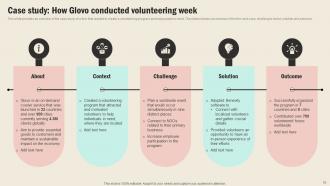
Slide 58: This slide provides an overview of the case study of a firm that wanted to create a volunteering program.
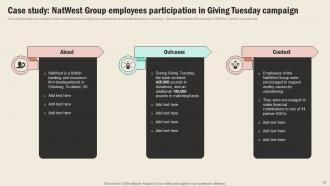
Slide 59: This slide shows the company whose employees volunteered and donated funds for a campaign.
Slide 60: This slide presents the Heading for the Ideas to be covered in the following template.
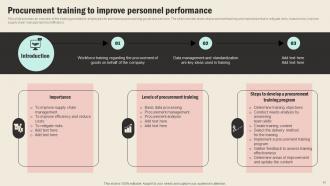
Slide 61: This slide indicates the Procurement training to improve personnel performance.
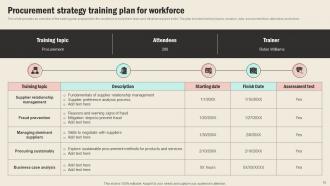
Slide 62: This slide shows the Procurement strategy training plan for workforce.
Slide 63: This slide incorporates the Title for the Contents to be discussed next.
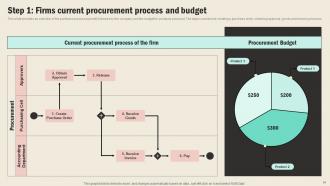
Slide 64: This slide presents the purchase process currently followed by the company and the budget for products procured.
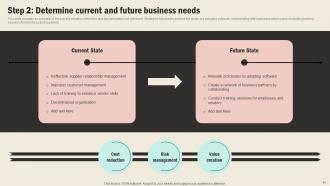
Slide 65: This slide provides an overview of the current situation of the firm and desired state to be achieved.
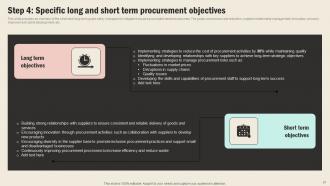
Slide 67: This slide highlights the short and long-term goals set by managers to mitigate risks and accomplish desired outcomes.
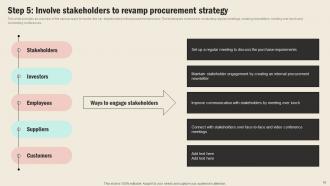
Slide 68: This slide provides an overview of the various ways to involve the key stakeholders in the procurement process.
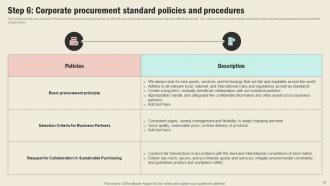
Slide 69: This slide shows the purchasing and sourcing policies of a firm to ensure goods are acquired in a fair and efficient manner.
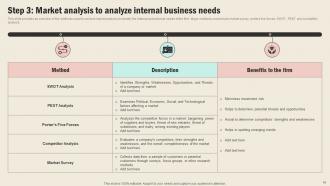
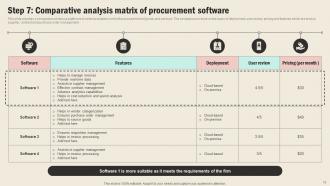
Slide 70: This slide indicates a comparison of various platforms to select a suitable one for the procurement of goods and services.
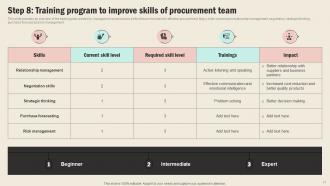
Slide 71: This slide portrays the training plan created by managers to boost various skills of team members for effective procurement.
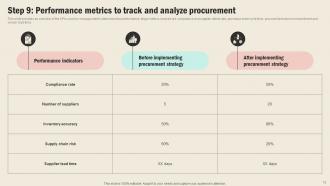
Slide 72: This slide provides an overview of the KPIs used by management to determine the performance.
Slide 73: This slide contains the Heading for the Topics to be covered next.
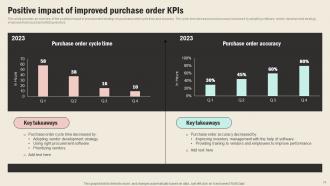
Slide 74: This slide reveals the Positive impact of improved purchase order KPIs.
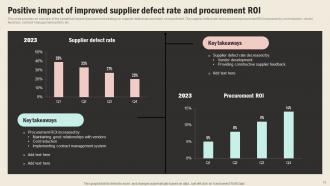
Slide 75: This slide highlights the Positive impact of improved supplier defect rate and procurement ROI.
Slide 76: This slide incorporates the Title for the Topics to be discussed further.
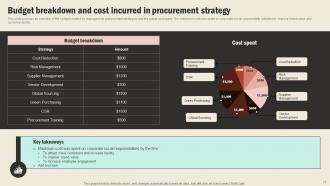
Slide 77: This slide provides an overview of the budget created by managers for procurement strategies and the actual cost spent.
Slide 78: This slide includes the Heading for the Contents to be covered in the next template.
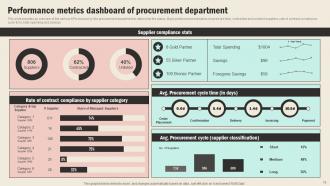
Slide 79: This slide displays the Performance metrics dashboard of procurement department.
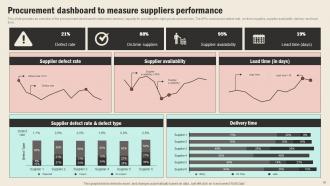
Slide 80: This slide presents the Procurement dashboard to measure suppliers performance.
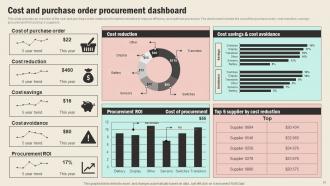
Slide 81: This slide showcases the Cost and purchase order procurement dashboard.
Slide 82: This is the Icons slide containing all the Icons used in the plan.
Slide 83: This slide is used for depicting some Additional information.
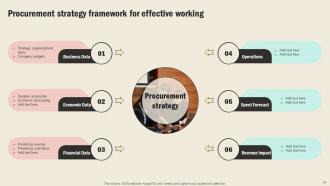
Slide 84: This slide represents the Procurement strategy framework for effective working.
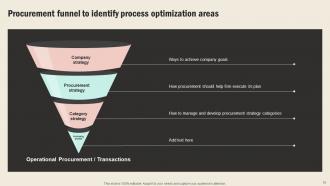
Slide 85: This slide showcases the Procurement funnel to identify process optimization areas.
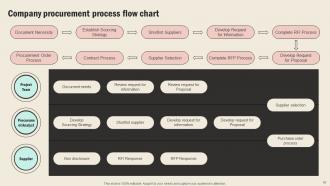
Slide 86: This slide illustrates the Company procurement process flow chart.
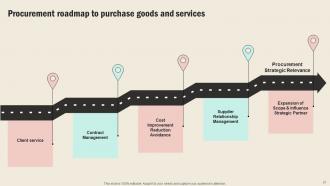
Slide 87: This slide highlights the Procurement roadmap to purchase goods and services.
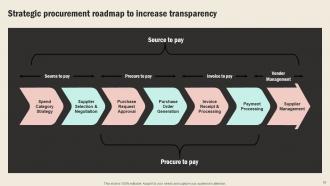
Slide 88: This slide presents the Strategic procurement roadmap to increase transparency.
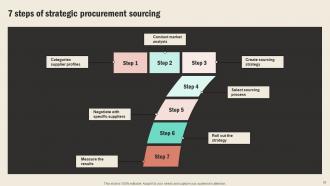
Slide 89: This slide states the 7 steps of strategic procurement sourcing.
Slide 90: This is the Idea generation slide for encouraging fresh ideas.
Slide 91: This slide contains the Post it notes for reminders and deadlines.
Slide 92: This is the 30,60,90 days plan slide for effective planning.
Slide 93: This is the Venn diagram slide.
Slide 94: This is the Puzzle slide with related imagery.
Slide 95: This is the Thank You slide for acknowledgement.
Strategic Sourcing In Supply Chain Management Strategy CD V with all 103 slides:
Use our Strategic Sourcing In Supply Chain Management Strategy CD V to effectively help you save your valuable time. They are readymade to fit into any presentation structure.














FAQs for Strategic Sourcing In Supply Chain Management
Key components of a successful strategic sourcing process include spend analysis, supplier market research, sourcing strategy development, competitive bidding, supplier evaluation, and contract negotiation. These elements work together by identifying cost reduction opportunities, optimizing supplier relationships, and ensuring competitive pricing, with organizations across manufacturing, healthcare, and retail finding that systematic implementation delivers 10-20% procurement savings while enhancing operational efficiency.
Organizations can effectively assess supplier performance through comprehensive scorecards evaluating quality metrics, delivery reliability, cost competitiveness, financial stability, and compliance standards. Through regular audits, performance reviews, and data analytics, companies in manufacturing, healthcare, and retail can identify top-performing partners, mitigate risks, and negotiate better terms, ultimately delivering enhanced operational efficiency and competitive advantage.
Technology revolutionizes strategic sourcing through AI-powered supplier analytics, automated procurement platforms, blockchain transparency, cloud-based collaboration tools, and predictive market intelligence systems. These technologies streamline vendor evaluation, contract management, and risk assessment processes, with organizations in manufacturing and retail finding significantly reduced costs, enhanced supplier relationships, and improved operational efficiency.
Strategic sourcing contributes to cost savings and efficiency by consolidating supplier relationships, leveraging volume discounts, and implementing data-driven vendor selection processes. Through comprehensive market analysis and competitive bidding, organizations streamline procurement cycles, reduce administrative overhead, and negotiate better contract terms, with many manufacturing and retail companies finding that strategic partnerships ultimately deliver 15-30% cost reductions while enhancing supply chain reliability.
Common strategic sourcing implementation challenges include supplier resistance to change, internal stakeholder alignment issues, inadequate data quality and systems integration, procurement team skill gaps, and organizational change management difficulties. These obstacles often emerge when companies transition from traditional purchasing to strategic sourcing, with many organizations finding that addressing cultural resistance and investing in proper training ultimately delivers sustainable procurement transformation and competitive advantage.
Supplier relationship management in strategic sourcing focuses on long-term partnerships, collaborative innovation, and mutual value creation rather than transactional interactions. Through strategic sourcing, organizations develop deeper supplier partnerships that enable joint problem-solving, shared risk management, and continuous improvement initiatives, ultimately delivering enhanced innovation, reduced costs, and competitive advantage across supply chains.
Effective strategic sourcing metrics include cost savings percentage, supplier performance scores, procurement cycle time reduction, contract compliance rates, and total cost of ownership improvements. These measurements enable organizations to track operational efficiency, supplier relationship quality, and strategic value delivery, with many companies finding that combining financial metrics with supplier scorecards ultimately delivers comprehensive visibility into sourcing success and competitive advantage.
Companies ensure sustainability and ethical sourcing through comprehensive supplier assessments, clear environmental and labor standards, regular audits, and long-term partnership development with values-aligned vendors. Through strategic supplier scorecards and certification requirements, organizations streamline compliance monitoring, enhance supply chain transparency, and minimize reputational risks, while many manufacturing and retail companies find that sustainable sourcing ultimately delivers cost savings and competitive advantage.
Global supply chain disruptions force strategic sourcing strategies to prioritize diversification, resilience planning, and supplier relationship management over cost-focused approaches. Organizations increasingly adopt multi-sourcing frameworks, nearshoring initiatives, and advanced analytics to minimize risk exposure, while many companies find that building strategic supplier partnerships and maintaining contingency inventory delivers greater operational stability and competitive advantage in volatile markets.
Businesses align strategic sourcing objectives with corporate goals by establishing clear procurement KPIs that support financial targets, integrating sourcing decisions into strategic planning processes, and ensuring supplier selections advance sustainability and innovation priorities. Through cross-functional collaboration between procurement, finance, and operations teams, organizations streamline cost management, enhance supply chain resilience, and accelerate growth initiatives, ultimately delivering competitive advantage and shareholder value.
Strategic sourcing market analysis best practices include supplier landscape mapping, spend category analysis, total cost of ownership evaluation, risk assessment, and competitive benchmarking. These approaches enable procurement teams to identify cost reduction opportunities, assess supplier capabilities, and negotiate better contracts, with many organizations finding that comprehensive market intelligence ultimately delivers 15-20% cost savings and enhanced supplier performance.
Organizations foster cross-functional collaboration in strategic sourcing through integrated planning sessions, shared performance metrics, and unified communication platforms that align procurement, finance, operations, and stakeholders. These approaches streamline decision-making by establishing clear roles, creating transparent evaluation criteria, and implementing regular touchpoints, ultimately delivering faster sourcing cycles and enhanced supplier relationships across departments.
Digital transformation, sustainability requirements, AI-powered analytics, supplier ecosystem integration, and risk diversification are reshaping strategic sourcing practices. These trends enable organizations to automate vendor evaluation, enhance supply chain transparency, and build resilient partnerships, with many companies finding that strategic sourcing delivers competitive advantage through cost optimization and operational agility.
Risk management drives strategic sourcing decisions by evaluating supplier financial stability, geopolitical factors, quality standards, and supply chain vulnerabilities before contract commitments. Organizations increasingly use risk assessment frameworks, diversified supplier portfolios, and contingency planning to minimize disruptions, with many finding that proactive risk evaluation ultimately delivers greater supply chain resilience and competitive advantage.
Strategic sourcing professionals require analytical skills, negotiation expertise, market research capabilities, supplier relationship management, and risk assessment abilities. These competencies enable sourcing teams to evaluate supplier performance, negotiate favorable contracts, and identify cost-saving opportunities across procurement categories, with many organizations finding that skilled professionals deliver significant supply chain optimization and competitive advantage.
-
I joined SlideTeam last month and there’s no doubt that I tend to find our bond only strengthening over time. Best place to find world-class themes, templates, and icons.
-
Graphics are very appealing to eyes.