


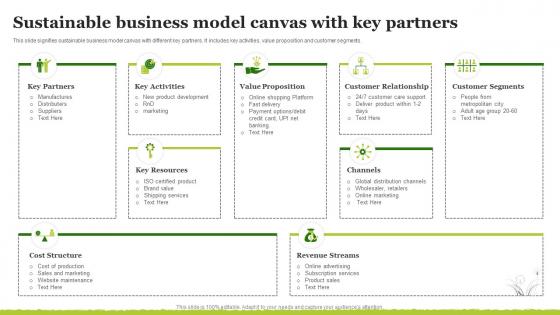
Sustainable Business Model Canvas With Key Partners




Try Before you Buy Download Free Sample Product
 Impress Your
 Audience
 100%
100% Editable
 Save Hours
 of Time


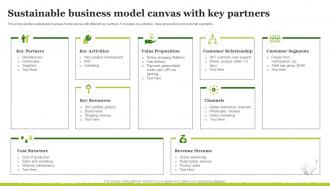
This slide signifies sustainable business model canvas with different key partners. It includes key activities, value proposition and customer segments .
People who downloaded this PowerPoint presentation also viewed the following :
Sustainable Business Model Canvas With Key Partners with all 6 slides:
Use our Sustainable Business Model Canvas With Key Partners to effectively help you save your valuable time. They are readymade to fit into any presentation structure.





FAQs for Sustainable Business Model Canvas
So the sustainable version adds three extra pieces to the regular nine blocks: environmental benefits, social benefits, and governance stuff. Instead of just thinking about your value prop and revenue, you're also figuring out how your business helps the planet, tackles social problems, and stays ethical. It's like the triple bottom line but built into your actual planning process. What's neat is these sustainability parts often show you new ways to make money or cut costs that you totally missed before. I'd just take your current canvas and add these three layers on top - you'll probably spot some interesting gaps.
Just weave the KPIs right into each canvas section - like adding carbon footprint stuff to your value props, social impact to customer relationships, etc. Way better than trying to track sustainability separately. Start small though, maybe 2-3 indicators per block? You can always add more later. Track waste reduction in your activities section, supplier sustainability under partnerships - honestly it makes the whole thing hang together better. Oh and don't forget community benefits in your revenue streams part. I thought it'd be annoying extra work at first, but it actually makes everything cleaner.
Okay so first thing - figure out who actually matters for your business. Customers obviously, but also employees, suppliers, investors, community people, even those annoying regulators. Set up different ways to hear from them: surveys, workshops, focus groups, whatever works. Honestly, I've watched companies completely bomb because they only listened to shareholders. Big mistake. Different groups care about totally different sustainability stuff, so you need that mix of voices. Be upfront about how you'll actually use their input - people hate feeling ignored. Oh, and don't just do this once. Keep checking back with them as you're building things out. Way better than treating it like some checkbox exercise.
Look, sustainability totally changes your pitch. Instead of just fixing problems, you're fixing them the *right* way. Patagonia literally tells customers "don't buy this jacket unless you need it" - which is honestly genius but also kinda crazy from a business perspective. Your customers start picking you because they like HOW you do things, not just what you're selling. The trick is making your green practices actually improve their experience. Nobody wants to feel like they're sacrificing quality just to save the planet, you know?
Tech basically makes sustainability way easier to track and scale up. IoT sensors can monitor your resource usage constantly, while AI optimizes supply chains to cut waste. Blockchain's good for transparent sourcing, though I still think it's kinda overhyped tbh. The real win is automating stuff that'd cost too much to do by hand. Cloud platforms let you share data with stakeholders easily. Predictive analytics spots problems before they get expensive - that's huge. My advice? Pick your worst sustainability headache first, then find tech that tackles that specific issue. Don't try digitizing everything right away.
Honestly, I'd break this into three main risk areas - operational stuff like supply chain issues, financial risks (those upfront costs can be brutal), and reputational damage. The greenwashing backlash is real right now. Get your stakeholders to call out your blind spots early. Classic risk matrix works here - just plot impact vs likelihood. My advice? Start small with pilots so you don't blow up spectacularly. Build extra time and budget into everything, find multiple sustainable suppliers, and be super transparent about your progress. Oh, and don't oversell your green efforts - people will catch you.
Yeah, Patagonia's the classic example - they basically built their whole thing around environmental responsibility being part of how they make money. Interface Inc. did something similar with carpet manufacturing, went carbon negative which is pretty wild. Unilever restructured their brands around sustainable living too. Tesla's obvious but honestly they got it right by making sustainability the main selling point, not some afterthought. My advice? Don't try to tackle your entire business at once. Pick one product line and map that out first - way less overwhelming and you can actually see what's working before going bigger.
Honestly, map out your whole supply chain first - see where you can cut waste AND costs. I'd audit your suppliers for sustainability practices, then focus on local sourcing to slash transportation emissions. This used to feel like busy work, but it genuinely saves cash over time. Find suppliers who actually care about waste reduction and fair labor. Build these standards into vendor selection upfront instead of scrambling later. Oh, and don't overwhelm yourself - just tackle your top 3 suppliers initially. Way more manageable that way.
Track your usual business stuff like revenue and margins, obviously. But honestly, the impact metrics are where it gets interesting - carbon footprint, waste reduction, how engaged your employees actually are. Customer retention is massive since people stick with sustainable brands way more than regular ones. Social outcomes matter too, plus stakeholder satisfaction scores. My advice? Build a dashboard mixing traditional KPIs with your sustainability goals. Check it monthly to catch trends early. Oh, and make sure it's not just pretty numbers that look good on paper - you want real impact data.
Honestly, just grab 2-3 boxes from the canvas that actually matter right now - like your value proposition or key partnerships. Don't try fixing everything at once (I've watched too many businesses crash and burn that way). Pick one sustainable thing each quarter. Maybe it's cutting waste, buying local, whatever fits your vibe. You're probably already doing more sustainable stuff than you realize - seriously, map it out first. The canvas thing is pretty flexible, so you can tweak it as you figure things out. Then just test one concrete change for 30 days and see what happens.
Customer education is huge for this stuff. Most people genuinely want to make better choices but honestly don't know where to start or what actually makes a difference. When you explain your sustainable practices clearly, you're not just building trust - you're helping customers feel good about spending more money with you. Educated customers become your biggest cheerleaders too. I'd start by figuring out what myths people believe about sustainability in your space, then create content that breaks those down. It's way more effective than just saying "we're eco-friendly" and hoping people get it.
Honestly, partnerships are where you can really multiply your sustainability impact instead of going it alone. Split those R&D costs for green tech. Share resources on circular economy stuff. Look at Patagonia and Fair Trade - way stronger as a team than solo acts. Map out who could actually help with your specific goals, whether that's cutting waste or switching to renewables. Sometimes the best partners aren't obvious at first. Your canvas should call out these key allies who complement what you're already doing. Don't overthink it - just find people who get excited about the same environmental problems you're trying to solve.
Honestly, the hardest part is getting people on board - teams hate changing stuff they're already good at. Measuring impact is a nightmare too since you can't track environmental stuff as easily as revenue (learned this the hard way). The timing thing kills me though - you're spending money now for benefits that won't show up until way later, which makes convincing stakeholders brutal when they only care about this quarter's numbers. Oh and everything feels massive at first. Best move? Start with tiny pilot programs to show it actually works before trying to change the whole company.
So basically, going sustainable gives you a bunch of competitive edges. Your costs drop when you become more efficient with resources. Plus customers are way more drawn to brands that actually care about this stuff - it's kinda wild how much people prioritize it now. Some industries won't even take you seriously without it. The cool thing is your business becomes way more resilient too. Supply chain issues? Regulatory changes? You're already ahead of the game since you've been thinking long-term. I'd pick one sustainable thing that saves money AND sets you apart from competitors to start.
So here's what I'd do - look at what you're already throwing away first. That waste could literally be money sitting there. Instead of selling products outright, try leasing them out as a service. Customers love it because they get ongoing support, plus you keep control over the whole lifecycle which is honestly pretty smart business-wise. You can also make money from take-back programs and selling carbon credits. Oh, and don't sleep on partnering with other sustainable companies - there's decent fees in that supply chain work. The circular economy stuff is where the real creative revenue lives though.
-
Their templates are super easy to edit and use even for the one like me who is not familiar with PowerPoint. Great customer support.
-
SlideTeam is my go-to resource for professional PPT templates. They have an exhaustive library, giving you the option to download the best slide!