


Swot Analysis For Global Automotive Industry Analyzing Vehicle Manufacturing Market Globally




Try Before you Buy Download Free Sample Product
 Impress Your
 Audience
 100%
100% Editable
 Save Hours
 of Time


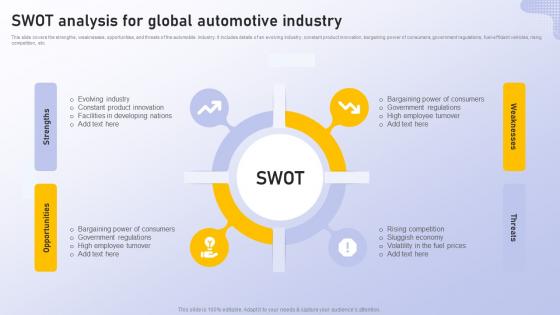
This slide covers the strengths, weaknesses, opportunities, and threats of the automobile industry. It includes details of an evolving industry, constant product innovation, bargaining power of consumers, government regulations, fuel-efficient vehicles, rising competition, etc.
People who downloaded this PowerPoint presentation also viewed the following :
Swot Analysis For Global Automotive Industry Analyzing Vehicle Manufacturing Market Globally with all 6 slides:
Use our Swot Analysis For Global Automotive Industry Analyzing Vehicle Manufacturing Market Globally to effectively help you save your valuable time. They are readymade to fit into any presentation structure.





FAQs for Swot Analysis For Global Automotive Industry Analyzing Vehicle
SWOT analysis comprises Strengths, Weaknesses, Opportunities, and Threats, with internal factors (strengths and weaknesses) evaluated against external market conditions (opportunities and threats). These components interrelate strategically, with organizations leveraging strengths to capitalize on opportunities, addressing weaknesses before pursuing growth, and using competitive advantages to mitigate threats, ultimately delivering comprehensive strategic insights. **Word count: 58 words**
Businesses effectively gather SWOT data through customer surveys, competitor analysis, financial audits, employee feedback, and market research studies. Strategic combinations of internal assessments, like performance metrics and resource evaluations, with external intelligence from industry reports and stakeholder interviews enable comprehensive analysis, with many organizations finding that cross-departmental collaboration ultimately delivers more accurate strategic insights.
Team collaboration is essential for comprehensive SWOT analysis, bringing diverse perspectives, departmental insights, cross-functional expertise, and objective viewpoints that individual assessments often miss. Through collaborative sessions, organizations uncover hidden strengths, identify blind spots in weaknesses, recognize emerging opportunities, and anticipate threats more accurately, ultimately delivering more strategic decision-making and competitive advantage.
Companies should update their SWOT analysis quarterly or semi-annually, with additional reviews triggered by significant market shifts, competitive changes, or internal developments like product launches or leadership transitions. Many organizations find that regular updates enable them to identify emerging opportunities, address evolving threats more effectively, and maintain strategic agility in an increasingly dynamic business environment.
SWOT analysis effectively applies to individual career planning by evaluating personal strengths, weaknesses, industry opportunities, and potential threats to career advancement. Through strategic self-assessment, professionals can identify skill gaps, leverage core competencies, and navigate market changes, with many finding that this structured approach enables targeted skill development, strategic career pivots, and ultimately delivers competitive positioning in increasingly dynamic job markets.
Common SWOT pitfalls include being overly optimistic about strengths, ignoring internal weaknesses, treating threats as purely external factors, focusing on obvious opportunities while missing strategic ones, and failing to prioritize findings. These missteps undermine strategic planning by creating incomplete assessments, with many organizations finding that rushed or surface-level analysis delivers flawed insights rather than competitive advantage. **Word count: 58**
SWOT analysis enables startups to make informed strategic decisions by systematically evaluating internal strengths and weaknesses alongside external opportunities and threats. This framework helps entrepreneurs identify competitive advantages, allocate limited resources effectively, and anticipate market challenges, with many early-stage companies finding that structured analysis ultimately delivers clearer strategic direction and improved investor confidence.
SWOT analysis integrates seamlessly with strategic planning tools like Porter's Five Forces, balanced scorecards, scenario planning, and PESTLE analysis to create comprehensive frameworks. These strategic combinations enhance decision-making by cross-referencing internal capabilities with external market forces, ultimately delivering deeper insights and more robust strategic roadmaps for sustainable competitive advantage.
Cultural differences significantly impact SWOT interpretation through varying risk tolerance levels, communication styles, competitive perspectives, and decision-making approaches across team members. While Western teams might emphasize individual strengths and direct threat assessment, Asian teams often focus on collective capabilities and long-term relationship considerations, with many multinational organizations finding that structured cultural awareness training and standardized frameworks help align diverse interpretations for more effective strategic planning.
Best practices for presenting SWOT analysis to stakeholders include using clear visual frameworks, prioritizing findings by strategic impact, providing specific data-backed examples, creating actionable recommendations, and maintaining balanced perspectives across all quadrants. These approaches enhance stakeholder engagement by transforming analytical insights into compelling narratives, with many organizations finding that structured presentations drive faster decision-making and stronger strategic alignment.
Businesses can leverage SWOT-identified strengths by aligning them with market opportunities, differentiating their competitive positioning, and scaling successful operations across new markets or product lines. Companies like Amazon have transformed their logistics strengths into competitive advantages, while financial institutions use their regulatory expertise to expand services, ultimately delivering enhanced customer experiences and increased market share.
Technological advancements significantly reshape SWOT opportunities by enabling digital transformation, automation, and enhanced customer experiences, while simultaneously creating threats through market disruption and competitive pressure. Organizations increasingly find that emerging technologies like AI, cloud computing, and data analytics can transform internal weaknesses into competitive strengths, ultimately delivering operational efficiency and strategic advantage in rapidly evolving markets.
Nonprofits can benefit from SWOT analysis by identifying internal strengths like volunteer networks and community trust, recognizing weaknesses in funding or staffing, spotting opportunities for partnerships and grants, and addressing threats such as donor fatigue. This strategic assessment enables organizations to optimize resource allocation, strengthen fundraising strategies, and enhance program effectiveness, ultimately delivering greater community impact and sustainable growth.
Several methodologies can enhance SWOT analysis effectiveness, including stakeholder workshops, data triangulation, scenario planning, weighted scoring systems, and cross-functional team integration. These approaches streamline strategic planning by incorporating diverse perspectives, validating insights through multiple data sources, and prioritizing strategic initiatives, with many organizations finding that combining quantitative metrics with qualitative insights ultimately delivers more actionable and comprehensive strategic frameworks.
SWOT analysis adapts to rapidly changing industries through frequent reassessment cycles, real-time data integration, and scenario-based planning that accounts for emerging technologies and regulatory shifts. Tech companies and healthcare organizations increasingly conduct quarterly SWOT reviews, incorporate predictive analytics for threat identification, and use cross-functional teams to capture diverse perspectives, ultimately enabling faster strategic pivots and competitive positioning.
-
It’s really cool, and you can find pretty much everything you could need for your work or school.
-
Professionally designed slides with color coordinated themes and icons. Perfect for enhancing the style of the presentations.