

SWOT Analysis Of JP Morgan Powerpoint Ppt Template Bundles





Try Before you Buy Download Free Sample Product
 Impress Your
 Audience
 100%
100% Editable
 Save Hours
 of Time


Our SWOT Analysis Of JP Morgan Powerpoint Ppt Template Bundles are topically designed to provide an attractive backdrop to any subject. Use them to look like a presentation pro.
People who downloaded this PowerPoint presentation also viewed the following :
Content of this Powerpoint Presentation
Slide 1: This slide introduces SWOT analysis of JP Morgan. State your company name and begin.
Slide 2: This slide provides a concise overview of Strengths, Weakness, Opportunities, Threats of the brand HP Inc operating in the footwear industry.
Slide 3: This slide highlights the strengths of JP Morgan such as strong financial position, diversified product portfolio, renowned brand and CSR activities in detail which helps the brand.
Slide 4: This slide mentions weaknesses of JP Morgan such as reputation vulnerabilities, high operational cost and legal & regulatory issues in detail that hinder growth of the brand.
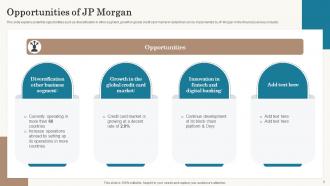
Slide 5: This slide explains potential opportunities such as diversification in other segment, growth in global credit card market in detail that can be implemented by JP Morgan.
Slide 6: This slide mentions potential threats such global recession, tough competition and Cybersecurity risks in detail that can be encountered by JP Morgan operating in the financial services.
Slide 7: This is a Thank You slide with address, contact numbers and email address.
SWOT Analysis Of JP Morgan Powerpoint Ppt Template Bundles with all 15 slides:
Use our SWOT Analysis Of JP Morgan Powerpoint Ppt Template Bundles to effectively help you save your valuable time. They are readymade to fit into any presentation structure.












FAQs for SWOT Analysis Of JP Morgan Powerpoint
So SWOT has four parts - strengths and weaknesses are stuff you control internally, while opportunities and threats come from outside forces. The cool part is connecting them together. Match your strengths with good opportunities to win big. Also figure out where your weak spots might get you burned by external threats. Honestly, most people just make four separate lists and call it done, but that's missing the point. You gotta look for patterns between all the boxes - that's where the real insights hide. Don't overthink it though, just focus on the relationships.
Start by asking your team what makes you different - they'll give you the real answer, not corporate fluff. Skip the obvious stuff like "great customer service" because literally everyone claims that. Dig into your actual wins instead. What keeps customers coming back? Maybe it's how fast you turn projects around, or that one person on your team who's just weirdly good at solving problems others can't. Go through your best projects and look for patterns. Customer feedback is gold too - what do they actually compliment you on? The goal isn't finding what sounds impressive, it's finding what genuinely gives you an edge that competitors can't easily copy.
Honestly, start with internal audits and employee surveys - people know where the problems are. Customer complaints are pure gold for this stuff. Look at your financial metrics too, they don't lie. I'd set up anonymous feedback because otherwise nobody's gonna tell you the real issues. Performance reviews help if you're actually being honest about them. Oh, and check out what competitors are doing better than you (painful but worth it). Create some kind of safe space so your team won't worry about getting blamed. Maybe tackle one department first instead of trying to fix everything at once?
Market trends are where you'll find your best opportunities. Look for shifts in how people behave, new tech popping up, regulation changes, or economic stuff that could help your business. Remote work totally transformed video conferencing companies - they saw it coming and crushed it. The trick is catching these movements before everyone else does because that's where the money is. Industry reports are gold for this, plus actually listening to what customers are saying. Honestly, most companies are terrible at spotting trends early, so if you're paying attention you've already got an edge.
So competitor analysis is huge for the O and T parts of your SWOT. You've gotta see what they're crushing (threat to you) and where they suck (your opportunity). Plus it helps you reality-check your own stuff - I thought our pricing was competitive until I actually looked around, yikes. Without checking what's out there, you're basically just guessing about your position. Start by mapping out maybe 3-5 main competitors before diving into the SWOT. Trust me, it'll make the whole thing way more accurate.
Honestly, SWOT analysis is just a fancy way to get real about your business situation. It makes goal-setting so much simpler when you know what you're actually good at and what might bite you later. You can play up your strong points when good opportunities come around, fix weak spots before they blow up, and stay ready for whatever curveballs get thrown your way. I probably do mine every few months because things shift pretty quickly - what worked in January might be totally off by April. The main thing is it stops you from setting goals that look amazing but completely ignore what's actually happening in your market.
So basically, you're still doing SWOT but thinking about mission impact instead of just money stuff. Strengths could be your volunteer base or community connections. Weaknesses - probably the usual suspects like shaky funding or being understaffed (honestly, when is a nonprofit NOT dealing with that?). Look for opportunities in new grants, partnerships, or social issues you could tackle. Threats might be other orgs competing for the same donors or new regulations messing with your operations. Oh, and definitely get input from everyone - staff, board, the people you actually serve. They'll catch things you miss.
Honestly, the worst thing you can do is be super vague - like writing "good team" without explaining what makes them actually good. Most people totally ignore what's happening in the market too, which is kinda dumb. Don't just throw ideas at the wall randomly! Be real about your weaknesses instead of trying to sneak in fake humble-brags. I see this all the time - people spend hours making these fancy SWOT charts then never look at them again. Tie your points to actual numbers when you can. Short, specific bullets work way better than fluffy nonsense.
Dude, visual SWOT analyses are so much better than those boring bullet point slides that make everyone zone out. I'd use colorful quadrant templates or throw in some icons - makes it way easier for people to actually see what matters most. Like which strengths are your biggest wins or what threats you need to tackle first, you know? Canva and Miro have decent templates if you don't want to start from scratch. Even just color coding your current format helps tons. Trust me, your audience will actually pay attention instead of checking their phones the whole time.
Honestly? Every 6 months works best for most people. I used to do it yearly but things move way too fast now - like, your biggest strength last January might be totally irrelevant by summer. Markets shift, new competitors show up out of nowhere, regulations change. If you're in tech or something super volatile, maybe quarterly makes sense. But don't overthink it - the main thing is just picking a schedule and actually sticking to it. Oh, and set that calendar reminder now before you forget (speaking from experience here lol).
Honestly, most SWOT analyses just collect dust after the meeting ends - that's your first red flag. Track whether you're actually doing the action items from each section. Are you capitalizing on those strengths? Fixing the weaknesses? Simple stuff, but it matters. Look at concrete metrics: revenue bumps, risks you avoided, new opportunities you grabbed. Also check if people were genuinely engaged during the process. The real winner though? When your SWOT becomes something you reference during quarterly planning sessions. If you're pulling it out three months later to guide decisions, you've nailed it.
Mix up your team big time - grab people from different departments and levels, not just your usual crew. I've watched so many SWOT sessions become total echo chambers when it's the same voices every time. Have everyone brainstorm solo first, then break into small groups before the big presentation. Stops groupthink cold and lets the quiet ones actually speak up. Ask pointed questions like "What are customers really saying?" or "What's happening on the front lines that we're missing?" Honestly, the best insights come when your finance guy starts going head-to-head with marketing about what actually counts as a strength.
So Netflix nailed this when they ditched DVDs for streaming - they used their data skills as a strength, cut those crazy shipping costs, jumped on streaming early, and beat Redbox at their own game. Starbucks did the same thing going global. They knew their brand was solid but had to tweak stuff for different countries (green tea frappuccinos in Asia - genius or weird? You decide). Toyota's whole improvement thing? It's basically them doing SWOT checks constantly. Here's the thing though - you can't just do it once and forget about it. Make it a regular thing your team actually uses.
Honestly, data makes SWOT analysis so much better than just guessing. You can actually pull real numbers from social media sentiment, competitor tools, all that stuff. I used to just wing it and - yeah, terrible results. Short sentences work better sometimes. Now I'll run sentiment analysis to see what people actually think about my brand, or use predictive tools to spot threats early. The trick is mixing different data sources to back up each point. Saves you from those blind spots when you're too deep in your own business to see clearly.
SWOT's like your starting point - it maps out what you're good/bad at internally, plus what's happening outside your company. Once you've got that big picture, you can dive deeper with other tools. Porter's Five Forces might focus on competitive pressure, while balanced scorecards track specific metrics. Honestly, I think too many people skip SWOT and jump straight to the fancy frameworks. Bad move. You need that foundation first to understand where you actually stand. Then tools like PESTLE can drill into political/economic factors, or you'll do competitive analysis on specific rivals. Get your bearings with SWOT, then layer on whatever specialized analysis makes sense.
-
They had the topic I was looking for in a readymade presentation…helped me meet my deadline.
-
The templates are handy and I can personalize them as per my needs. Glad to be your subscriber!