

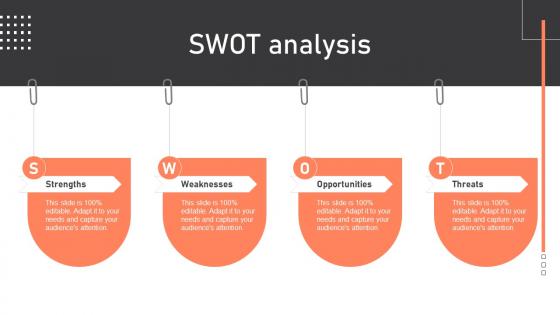
SWOT Analysis Warehouse Management Strategies To Reduce Inventory Wastage




Try Before you Buy Download Free Sample Product
 Impress Your
Audience
 100%
Editable
 Save Hours
of Time


Our SWOT Analysis Warehouse Management Strategies To Reduce Inventory Wastage are topically designed to provide an attractive backdrop to any subject. Use them to look like a presentation pro.
People who downloaded this PowerPoint presentation also viewed the following :
SWOT Analysis Warehouse Management Strategies To Reduce Inventory Wastage with all 6 slides:
Use our SWOT Analysis Warehouse Management Strategies To Reduce Inventory Wastage to effectively help you save your valuable time. They are readymade to fit into any presentation structure.






FAQs for SWOT Analysis Warehouse Management Strategies To
So SWOT is basically four boxes - your strengths and weaknesses (internal stuff), plus opportunities and threats (what's happening outside your control). Most people just make lists and think they're done, which honestly drives me crazy. The real value comes from mixing and matching between the quadrants. Like, can you use a strength to grab an opportunity? Or what happens if that weakness gets hit by a threat you saw coming? I usually pair them up systematically - each strength with an opportunity, weaknesses against threats. That's where you find your actual strategic moves instead of just... lists.
Start by asking your people what they think you're actually good at - they see stuff management totally misses. Look at your wins from the past year and figure out what made them happen. Customer feedback is gold too, but don't just say "we have great service." What makes it great exactly? I'd also peek at what competitors are doing (or failing at). Honestly, most companies list super vague strengths that mean nothing. Be brutally specific about your real advantages - maybe it's your crazy-fast turnaround times or that one team that never drops the ball. Numbers help prove it too.
Don't be vague - saying "good customer service" means nothing without specifics. I see this all the time. You'll miss the mark if you ignore what's actually happening in your market too. Back everything up with real data, not just what feels right. Most people treat this like a one-time thing when you should revisit it regularly. Here's the thing though - start with your weaknesses first. Be brutally honest about them. That's usually where the good stuff is hiding, and honestly, it's way more useful than listing obvious strengths.
Run your SWOT early in planning - that's when it actually matters. Map each section to real actions you can take. Strengths + opportunities = where you want to double down. Weaknesses that make threats worse? Fix those first. Honestly, the opportunities vs threats part always surprises me the most. Don't just make the SWOT and forget about it (everyone does this). Keep referring back to it when you're deciding what projects get funding. It should guide which stuff you prioritize. Otherwise you'll just end up with another useless framework sitting in a drawer somewhere.
Dude, you can't just wing SWOT opportunities by sitting around guessing. Market research is where the good stuff lives - it shows you actual trends, what's pissing customers off, and holes your competitors aren't filling. I'd start with surveying your current customers about what they wish existed. Then dig into industry reports to see where things are headed. Without real data you're basically throwing darts blindfolded. Customer complaints are goldmines too - they're literally telling you what to build next. Trust me, the conference room brainstorm thing never works.
So basically, internal stuff is what you can actually control - your team, budget, how things work around your office, that kind of thing. Those become your strengths and weaknesses. External factors? That's everything outside your company walls. Market changes, competitors doing weird stuff, new regulations, the economy being... well, the economy. You can't really control those directly - they're your opportunities and threats. Here's the thing though: you can fix internal problems by throwing strategy and money at them. With external stuff, you're mostly just trying to roll with the punches and adapt quickly.
SWOT works totally different depending on where your company's at. Startups are basically just trying not to die - you're hunting for opportunities and dodging threats that could wipe you out before you even find product-market fit. Established companies? They're using it more for strategic moves since they actually know their strengths and weaknesses already. The thing is, startups have way too many unknowns which makes SWOT kinda unreliable, but still worth doing. I mean, at least it helps you reality-check your assumptions. Startups need to move fast on whatever they learn, while bigger companies can sit on insights longer. Just don't create the damn thing and then forget about it - actually use it for planning your next few months.
Look, I'd do it quarterly if you can swing it. Most companies say once a year but that's honestly too slow these days. Big stuff happens - new competitors pop up, markets shift, your team changes. Don't wait around for your annual review if something major hits. I've watched businesses get totally caught off guard because they were working off old assumptions. Tech moves especially fast, but really any industry now. Set those quarterly reminders and maybe have someone keep an eye out for curveballs between reviews. Better safe than sorry, you know?
SWOT works way better when you combine it with other stuff. Porter's Five Forces really helps you dig into those competitive threats. PESTLE analysis is great for understanding what's happening externally - like政策 changes or economic shifts that could hit your opportunities. Business Model Canvas is probably my favorite pairing though. It connects your SWOT findings to actual strategic moves you can make. Stakeholder mapping's useful too since different people see your strengths totally differently. Don't try all of these at once or you'll just get stuck analyzing forever. Pick one complementary tool first.
Honestly, templates are a game changer for SWOT presentations. Nobody wants to stare at endless bullet points - your audience will zone out instantly. Quadrant layouts with color coding make everything way easier to digest. Plus when space is limited, you're forced to cut the fluff and focus on what actually matters. I always throw in some icons or visual hierarchy to make the critical stuff pop. Makes the whole thing look more professional too, not just some random brainstorming session. Trust me, people remember visual stuff way better than walls of text.
Apple's probably the best example - back in the late 90s they realized their product line was a mess and streamlined everything. That's when they became, well, Apple. Amazon figured out their book shipping setup could work for literally anything else, so they expanded from there. McDonald's saw people freaking out about health stuff and added salads (though honestly, who orders those?). Nike keeps doing SWOT analyses to spot new opportunities and stay on top. The key thing is these companies didn't just do the analysis and call it a day. They actually changed their strategies based on what they found.
Here's the thing - you need everyone actually talking, not just nodding along while the boss dominates the whole thing. I'd start with silent brainstorming first, then share out loud. Way better than letting the loudest person steamroll everyone else. Get someone neutral to facilitate who can redirect when things go sideways. Anonymous feedback works great for the tough stuff, especially weaknesses (nobody wants to call out their manager's blind spots publicly, right?). Oh, and set ground rules upfront - stick to facts, keep it constructive. Skip the blame game completely. Trust me, I've watched too many of these turn into total disasters otherwise.
So you'll want to tie specific metrics to each part of your SWOT. Track market share or customer retention for strengths. Weaknesses? Look at efficiency scores or complaint drops. Most people totally blow this part - they finish the analysis and never check back. Revenue from new projects shows if you're hitting opportunities. For threats, measure stuff like response times or how much you depend on risky suppliers. Oh, and definitely grab baseline numbers before you start making changes. Then check quarterly to see what's actually moving the needle.
Okay so here's the thing - your SWOT means nothing without context. Like, rapid changes might be amazing in tech but absolutely terrible in something like pharmaceuticals where you need FDA approval for everything. I found this out the hard way when our American team thought fast expansion was brilliant, but our Japanese colleagues were like "whoa, slow down." Your team's cultural background totally changes how they see risks vs opportunities. Also industry standards matter - what seems competitive to you might just be basic expectations everyone has. Bottom line: don't make any big moves until you've filtered your SWOT through your specific market reality first.
Honestly, skip the boring quadrant-by-quadrant walkthrough and hit them with your big insights first. Nobody wants to sit through strengths, weaknesses, opportunities, threats just to hear what you actually think they should do. The magic happens when you connect the dots - like how your team's expertise could nail that new market opportunity, or where your gaps might bite you later. Keep the visuals clean (messy SWOT charts are the worst). Oh, and this is crucial - wrap up with actual next steps and put names on them. Otherwise it's just another deck that'll collect digital dust.
-
Making a presentation has never been this easy for me. Thank you SlideTeam for offering a splendid template library.
-
Innovative and attractive designs.