

Warehouse Management Strategies To Improve Revenue And Profits Powerpoint Presentation Slides





Try Before you Buy Download Free Sample Product
 Impress Your
Audience
 100%
Editable
 Save Hours
of Time


Warehouse management plays a crucial role in optimizing operations and maximizing profitability. Our Warehouse Management Strategies to Improve Revenue and Profits template is designed to help organizations effectively manage their warehouse operations and reduce operational costs. The Inventory Management section focuses on streamlining processes and optimizing resources to minimize costs. It includes strategies for storage optimization, improving inventory visibility, and reducing overstocking. The Warehouse Automation presentation explores inventory management techniques such as ABC analysis, LIFO FIFO method, and HML analysis. It also addresses warehouse theft and provides techniques to identify and mitigate the risk. The Warehouse Stock Management module emphasizes inventory-picking optimization techniques to minimize expenses and reduce errors. It also highlights warehouse automation technologies that can enhance efficiency and reduce operational costs. Additionally, the Warehouse Shipment Presentation introduces key performance indicators KPIs for tracking warehouse expenses and their impact on direct, indirect, and fixed costs. The presentation concludes with a dashboard that enables tracking of warehouse shipments and payments. Gain access to this valuable resource to improve your warehouse management and increase revenue and profits.
People who downloaded this PowerPoint presentation also viewed the following :
Content of this Powerpoint Presentation
Slide 1: This slide introduces Warehouse Management Strategies to Improve Revenue and Profits. State your company name and begin.
Slide 2: This slide depicts the Agenda of the presentation.
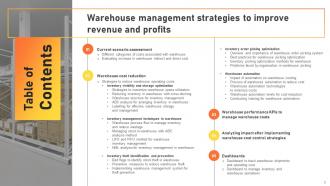
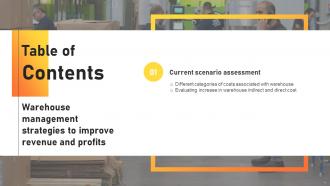
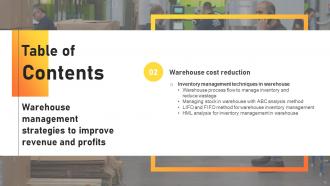
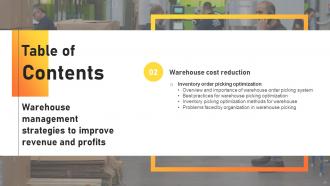
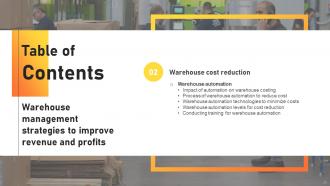
Slide 3: This slide incorporates the Table of Contents.
Slide 4: This slide highlights the Title for the Topics to be discussed further.
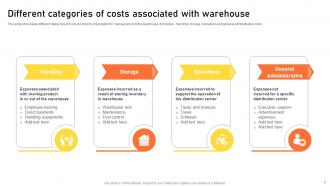
Slide 5: This slide showcases different categories of costs incurred by organization to manage and run the warehouse.
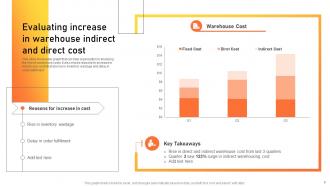
Slide 6: This slide focuses on Evaluating increase in warehouse indirect and direct cost.
Slide 7: This slide reveals the Heading for the Components to be discussed next.
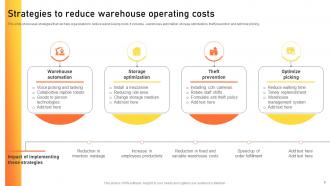
Slide 8: This slide showcases strategies that can help organization to reduce warehousing costs.
Slide 9: This slide mentions the Title for the Ideas to be covered further.
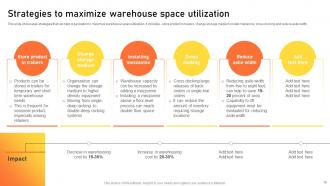
Slide 10: This slide deals with the Strategies to maximize warehouse space utilization.
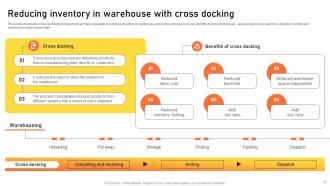
Slide 11: This slide showcases cross docking technique that can help organization to reduce inventory in warehouse and reduce storage cost.
Slide 12: This slide outlines the Warehouse Structure for Inventory Management.
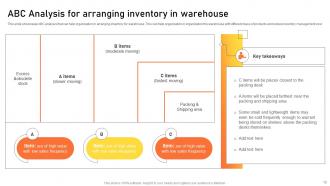
Slide 13: This slide portrays ABC analysis that can help organization in arranging inventory for warehouse.
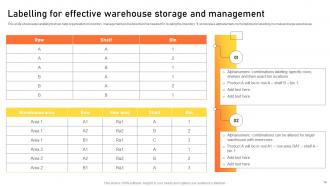
Slide 14: This slide emphasizes on Labelling for effective warehouse storage and management.
Slide 15: This slide indicates the Heading for the Ideas to be covered further.
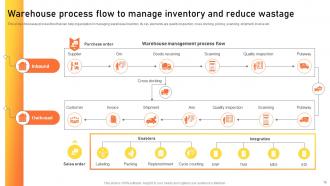
Slide 16: This slide showcases process flow that can help organization in managing warehouse inventory.
Slide 17: This slide represents ABC analysis method that can help organization in inventory management.
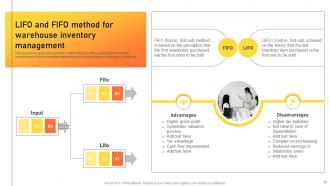
Slide 18: This slide talks about LIFO and FIFO method for warehouse inventory management.
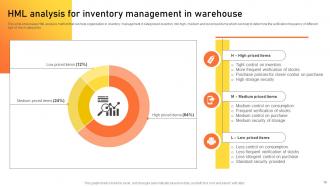
Slide 19: This slide displays the HML analysis for inventory management in warehouse.
Slide 20: This slide depicts the Title for the Components to be discussed further.
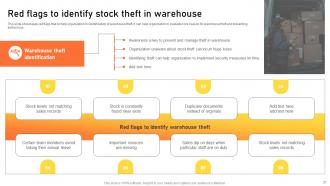
Slide 21: This slide focuses on the Red flags to identify stock theft in warehouse.
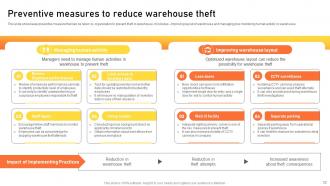
Slide 22: This slide highlights the Preventive measures to reduce warehouse theft.
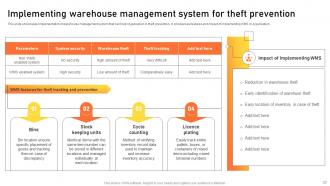
Slide 23: This slide showcases implementation of warehouse management system that can help organization in theft prevention.
Slide 24: This slide mentions the Heading for the Topics to be covered in the upcoming slide.
Slide 25: This slide elucidates the Overview and importance of warehouse order picking system.
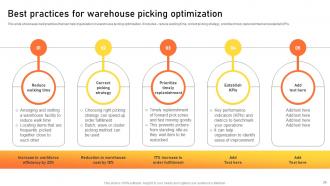
Slide 26: This slide highlights the Best practices for warehouse picking optimization.
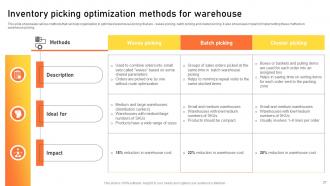
Slide 27: This slide deals with Inventory picking optimization methods for warehouse.
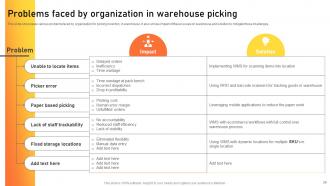
Slide 28: This slide lists the Problems faced by organization in warehouse picking.
Slide 29: This slide indicates the Title for the Topics to be covered further.
Slide 30: This slide showcases impact of implementing automation technologies on warehouse costing.
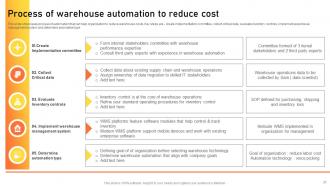
Slide 31: This slide illustrates the Process of warehouse automation to reduce cost.
Slide 32: This slide emphasizes on the Warehouse automation technologies to minimize costs.
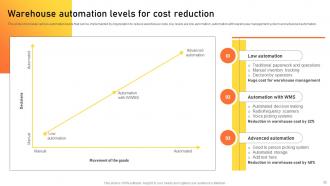
Slide 33: This slide reveals the Warehouse automation levels for cost reduction.
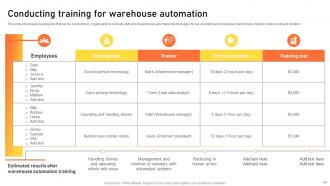
Slide 34: This slide displays the Conducting training for warehouse automation.
Slide 35: This slide incorporates the Heading for the Componnets to be discussed further.
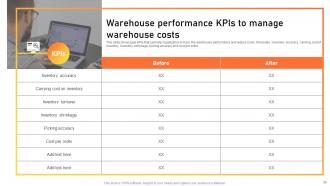
Slide 36: This slide shows the KPIs that can help organization to track the warehouse performance and reduce costs.
Slide 37: This slide contains the Title for the Ideas to be covered in the following template.
Slide 38: This slide deals with Analysing impact after implementing warehouse cost control strategies.
Slide 39: This slide reveals the Heading for the Ideas to be discussed next.
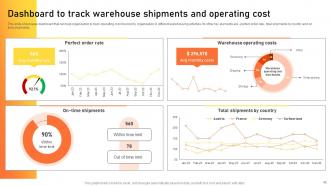
Slide 40: This slide illustrates the Dashboard to track warehouse shipments and operating cost.
Slide 41: This slide represents the Dashboard to manage inventory and warehouse operations.
Slide 42: This slide contains all the icons used in this presentation.
Slide 43: This slide is titled as Additional Slides for moving forward.
Slide 44: This is About Us slide to show company specifications etc.
Slide 45: This is Our Team slide with names and designation.
Slide 46: This is Our Mission slide with related imagery and text.
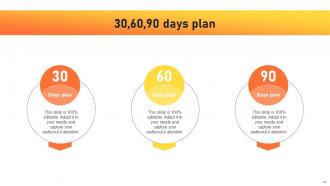
Slide 47: This slide provides 30 60 90 Days Plan with text boxes.
Slide 48: This slide shows SWOT describing- Strength, Weakness, Opportunity, and Threat.
Slide 49: This is an Idea Generation slide to state a new idea or highlight information, specifications etc.
Slide 50: This slide shows Post It Notes. Post your important notes here.
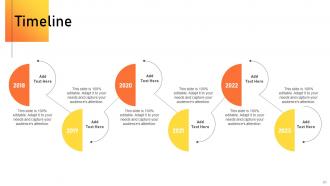
Slide 51: This is a Timeline slide. Show data related to time intervals here.
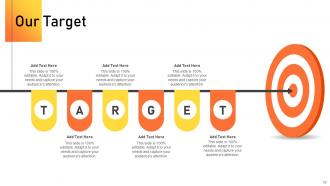
Slide 52: This is Our Target slide. State your targets here.
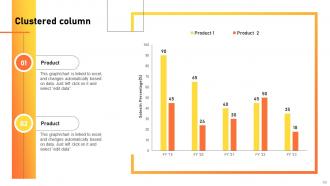
Slide 53: This slide provides Clustered Column chart with two products comparison.
Slide 54: This slide contains Puzzle with related icons and text.
Slide 55: This slide depicts Venn diagram with text boxes.
Slide 56: This is a Quotes slide to convey message, beliefs etc.
Slide 57: This slide presents Roadmap with additional textboxes.
Slide 58: This is a Thank You slide with address, contact numbers and email address.
Warehouse Management Strategies To Improve Revenue And Profits Powerpoint Presentation Slides with all 63 slides:
Use our Warehouse Management Strategies To Improve Revenue And Profits Powerpoint Presentation Slides to effectively help you save your valuable time. They are readymade to fit into any presentation structure.





















FAQs for Warehouse Management Strategies To Improve Revenue And Profits
Focus on five main things: inventory management, layout optimization, workforce planning, tech integration, and tracking your metrics. Most places totally botch the layout - it's like Tetris with forklifts and way more stress. Real-time inventory tracking is crucial. Design your space so it flows smoothly from receiving to shipping. Give your team processes that actually make sense to follow. WMS software pulls everything together nicely. I'd start by mapping out your current setup and finding your biggest bottleneck. That's usually where you'll see results fastest.
Honestly, automation is a game-changer for warehouse speed. Those repetitive tasks? Machines crush them way faster than people ever could. I'd focus on automated picking systems and conveyor belts first - the ROI is pretty solid on those. Your workers get to do actual problem-solving instead of just scanning barcodes all day, which they'll probably appreciate. Machines don't need coffee breaks either, so you're looking at 24/7 operations with way fewer mistakes. Oh, and definitely start small with whatever's eating up most of your time right now. Build momentum from there.
Honestly, inventory management is like the foundation everything else gets built on. Get that right and your whole warehouse just runs smoother. You'll figure out which products are flying off the shelves so you can put them in easy-to-reach spots. Slow movers become obvious too. It cuts down on those annoying moments when you're hunting everywhere for something or telling customers you're out of stock. Labor costs drop because your team isn't running around like crazy. Try cycle counting first - maybe ABC analysis too if you're feeling ambitious. Those two will show you what's really going on.
So real-time analytics basically shows you what's happening in your warehouse right now instead of last week's data. You'll catch bottlenecks forming, see which picking routes are slowing people down, spot inventory issues before they blow up. Game changer honestly. Quick adjustments to staffing become possible. Reroute workflows on the spot. Even optimize storage locations as you go - though that part can get pretty complex depending on your setup. My advice? Start simple with one metric like order fulfillment times. Track that in real-time first, then expand from there.
Man, the big issues you'll hit are inventory being totally off, wasted space, and your team being inefficient as hell. Spreadsheets are basically useless at this point - you need real-time tracking or you're screwed. I'd start with getting your inventory numbers right first because everything else falls apart without that. Get a decent WMS with barcode scanning, then rearrange stuff based on what moves fast. Cross-train people too so they're not just standing around when one section gets crazy busy. Trust me, fix the tracking thing before anything else.
Look, your warehouse layout is basically everything when it comes to speed. If your team's walking miles between picking and packing, you're bleeding time and money every single day. The trick is putting your fastest-moving stuff where people can actually reach it without a ladder or hiking boots. Map out where everyone's currently walking - I bet you'll find some ridiculous patterns where they're zigzagging all over the place for no reason. Set things up so the flow makes sense: receiving flows to storage, storage flows to picking, picking flows straight to shipping. Honestly, most warehouses I've seen could cut their pick times in half just by fixing the layout. Clear paths matter too.
Honestly, start with AI forecasting and robotics for warehouse picking - those are making the biggest impact right now. IoT sensors give you live inventory data which is pretty sweet. Cloud-based warehouse systems beat the old clunky ones hands down. Digital twins sound fancy but they're basically just virtual copies of your warehouse that help optimize everything. Voice picking's getting popular too since workers don't have to look at screens constantly. But here's the thing - figure out what's actually broken in your operation first. Don't just buy shiny new tech because everyone else is doing it.
Look, your warehouse lives or dies by how you manage your people. Good training and clear metrics make all the difference - teams work faster and screw up less. I've literally watched places turn around overnight once they fix their labor stuff. Fair scheduling matters too, obviously. Better retention saves you crazy money on hiring. Oh, and definitely track your pick rates first - that's where you'll spot the biggest problems. Your costs will thank you later, trust me.
Honestly, start by tracking what you're doing now - you can't fix what you don't measure. Move your popular stuff closer to where you pack orders. Zone picking is a game changer - have different people work separate areas at the same time instead of one person running around like crazy. A decent WMS will batch orders together and create smarter routes. Cross-docking works if you can swing it, basically shipping stuff out without storing it first. The warehouse layout thing might seem obvious but most people overlook it.
Working with suppliers gives you actual visibility into what's coming - when, how much, potential delays. You can plan your receiving instead of scrambling when trucks show up randomly. They'll help with better packaging, consolidated shipments, sometimes even drop-ship direct to customers. Most warehouses still don't do this for some reason - it's kinda crazy honestly. I'd start simple: grab your top 3 suppliers and set up regular calls about upcoming orders. Then brainstorm what's inefficient and fix it together. Way easier than you'd think.
Dude, green warehousing is actually a smart move right now. Start with an energy audit - it'll show you where you're bleeding money. LED lights and smart HVAC systems sound boring but they slash your bills fast. I've seen companies save thousands just switching to renewables. Also look into better packaging (less waste = less cost) and find suppliers with green certs. Oh, and recycling programs are pretty easy wins. Some places even go for LEED certification if they're feeling fancy. Honestly though, just focus on energy efficiency first - that's where the real savings are.
Track the stuff that actually moves your business forward. Order accuracy and inventory turnover are obvious ones. Picking speed matters too - plus how well you're using your warehouse space. I'd definitely watch labor productivity like picks per hour and what you're spending on labor vs revenue. Customer satisfaction scores are pretty critical since happy customers keep coming back. Honestly, way too many companies obsess over metrics that look impressive but don't really help day-to-day operations. Pick maybe 3-5 that match your biggest headaches and check them weekly.
Start with safety training - that's non-negotiable. Then get everyone certified on forklifts and warehouse equipment. Your inventory management system training is clutch too. Cross-training saves your butt when half the team calls out during flu season, trust me on that one. Make sure people know the warehouse software and basic troubleshooting. Proper lifting techniques matter more than you'd think. Skip the marathon training sessions - regular short refreshers work way better. Don't forget leadership development for supervisors since they're dealing with all the chaos. Do a skills gap analysis first to figure out what you're actually missing.
So basically start by cutting out all the waste - unnecessary walking around, waiting, too much inventory sitting there. Do the 5S thing first to get organized, then map your processes to find where stuff gets stuck. Trust me, once you actually walk the floor you'll be amazed at how much time people waste just because of bad layout. Get your team involved since they know what's broken better than anyone. Just-in-time receiving helps if you can swing it, and fix your picking routes to flow better. Oh and don't try to change everything at once - pick one process and nail that first.
Honestly, just weave safety into what you're already doing instead of treating it like some separate thing. Set up safety zones that actually match how your warehouse is laid out. When people are doing their picking routes, throw in safety checkpoints along the way. During shift changes, have everyone do quick equipment checks - kills two birds with one stone. Your WMS should ping you about safety issues the same way it does for inventory problems. Cross-train your team so they know both the job and safety stuff - that way everyone's got each other's backs. Oh, and run safety audits when you're doing inventory counts. Makes the whole process way less painful.
-
“Easy to use. I always wanted to have a quick search for products and SlideTeam has helped me have it.”
-
I didn’t expect such a good service for the money I am paying. But, they exceed my expectations. Great work SlideTeam.