


Implementing Strategies For Inventory Management And Control Powerpoint Presentation Slides




Try Before you Buy Download Free Sample Product
 Impress Your
 Audience
 100%
100% Editable
 Save Hours
 of Time


Efficient stock procurement and management are crucial for organizations to track inventory in real time and procure goods from suppliers. Our Implementing Strategies for Inventory Management and Control template is designed to provide insights on decreasing operational costs and minimizing inventory wastage. The presentation outlines the processes for maintaining an optimum stock level by purchasing accurate quantities of merchandise from suppliers. It also covers demand forecasting methods, such as economic order quantity and reorder point, based on historical sales data. Our Stock Inventory Procurement PPT also showcases various warehouse optimization strategies, including ABC analysis and warehouse automation, to help reduce inventory waste. It includes an automated tracking system to minimize stock wastage and determine the ideal time to order inventory. The presentation highlights strategies for accurate order fulfillment and preventing stock outs, along with the costs incurred and challenges organizations face in managing inventory. The deck also contains dashboards and KPIs to track warehouse operations and inventory. Get access now to streamline your inventory management and control strategies.
People who downloaded this PowerPoint presentation also viewed the following :
Content of this Powerpoint Presentation
Slide 1: This slide introduces Implementing Strategies for Inventory Management and Control. State your company name and begin.
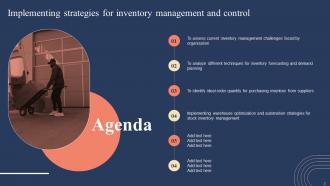
Slide 2: This slide depicts the Agenda of the presentation.
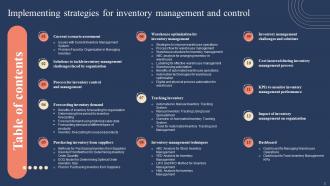
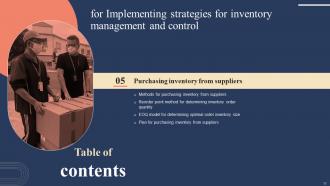
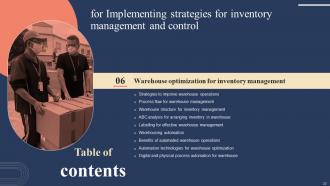
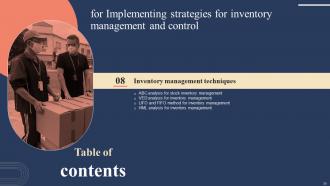
Slide 3: This slide elucidates the Table of contents.
Slide 4: This slide highlights the Title for the Topics to be covered further.
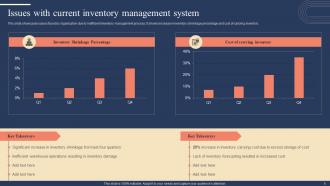
Slide 5: This slide showcases issues faced by organization due to inefficient inventory management process.
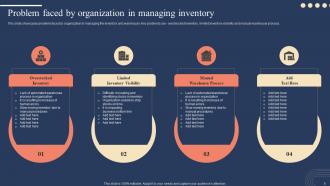
Slide 6: This slide presents the problems faced by organization in managing the inventory and warehouse.
Slide 7: This slide elucidates the Heading for the Contents to be covered further.
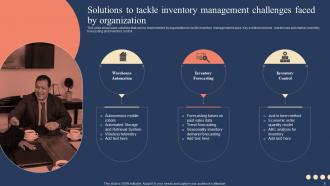
Slide 8: This slide showcases solutions that can be implemented by organization to tackle inventory management issues.
Slide 9: This slide mentions the Title for the Ideas to be discussed next.
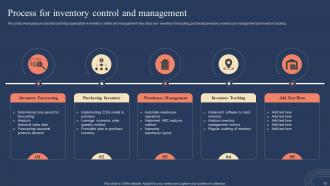
Slide 10: This slide reveals process that can help organization in inventory control and management.
Slide 11: This slide mentions the Heading for the Ideas to be covered in the upcoming template.
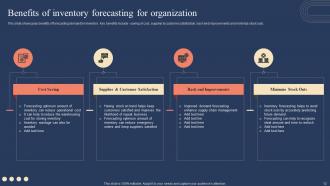
Slide 12: This slide highlights the benefits of forecasting demand for inventory.
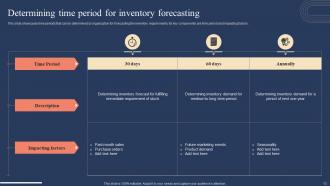
Slide 13: This slide deals with the time periods that can be determined by organization for forecasting the inventory requirements.
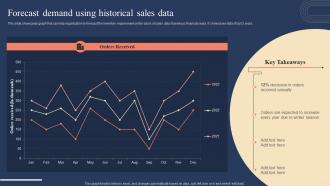
Slide 14: This slide provides information about the Forecast demand using historical sales data.
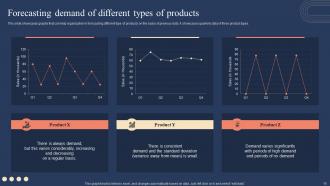
Slide 15: This slide indicates the Forecasting demand of different types of products.
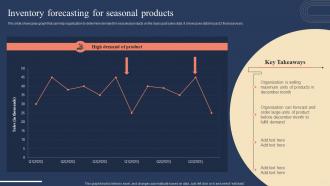
Slide 16: This slide focuses on the Inventory forecasting for seasonal products.
Slide 17: This slide depicts the Title for the Components to be discussed next.
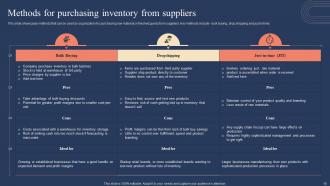
Slide 18: This slide elucidates the Methods for purchasing inventory from suppliers.
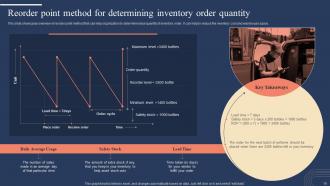
Slide 19: This slide presents the overview of reorder point method that can help organization to determine ideal quantity of inventory order.
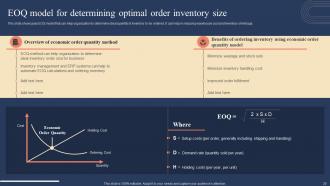
Slide 20: This slide exhibits the EOQ method can help organization to determine ideal inventory order size for business.
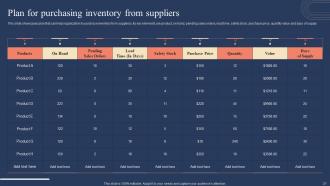
Slide 21: This slide outlines the plan that can help organization to purchase inventory from suppliers.
Slide 22: This slide presents the Heading for the Topics to be discussed next.
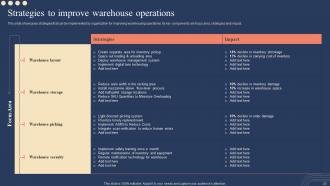
Slide 23: This slide reveals the Strategies to improve warehouse operations.
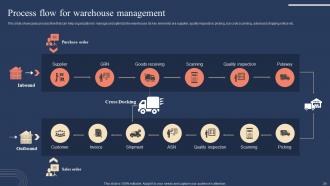
Slide 24: This slide showcases process flow that can help organization to manage and optimize the warehouse.
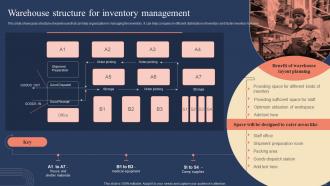
Slide 25: This slide portrays the Warehouse structure for inventory management.
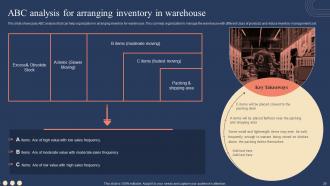
Slide 26: This slide displays the ABC analysis that can help organization in arranging inventory for warehouse.
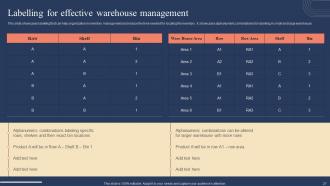
Slide 27: This slide illustrates Labelling for effective warehouse management.
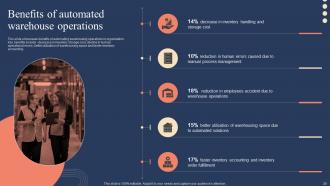
Slide 28: This slide portrays the benefits of automating warehousing operations in organization.
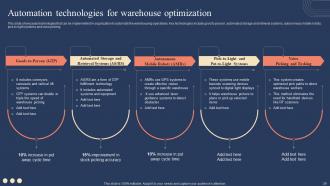
Slide 29: This slide depicts the technologies that can be implemented in organization to automate the warehousing operations.
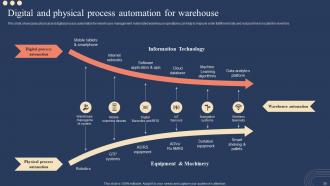
Slide 30: This slide focuses on the Digital and physical process automation for warehouse.
Slide 31: This slide incorporates the Title for the Topics to be discussed further.
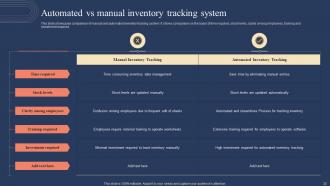
Slide 32: This slide showcases comparison of manual and automated inventory tracking system.
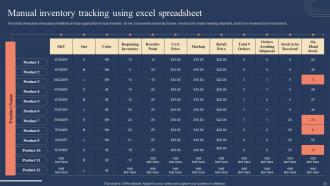
Slide 33: This slide reveals the Manual inventory tracking using excel spreadsheet.
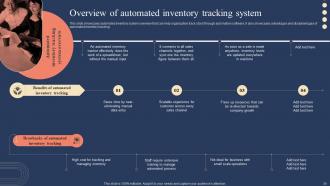
Slide 34: This slide exhibits automated inventory system overview that can help organization track stock through automation software.
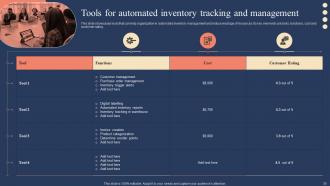
Slide 35: This slide contains the tools that can help organization in automated inventory management and reduce wastage of resources.
Slide 36: This slide elucidates the Heading for the Contents to be covered in the forth-coming template.
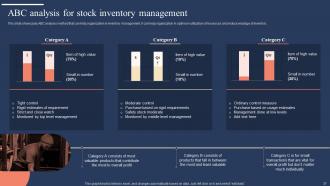
Slide 37: This slide represents the ABC analysis method that can help organization in inventory management.
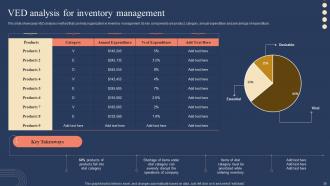
Slide 38: This slide showcases VED analysis method that can help organization in inventory management.
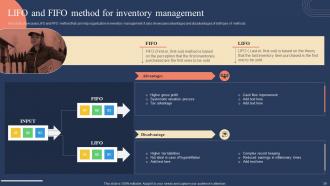
Slide 39: This slide reveals the LIFO and FIFO method for inventory management.
Slide 40: This slide depicts the Title for the Topics to be covered further.
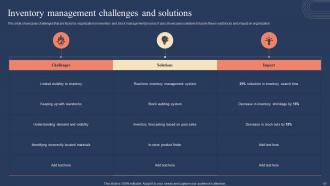
Slide 41: This slide focuses on the Inventory management challenges and solutions.
Slide 42: This slide elucidates the Heading for the Components to be discussed next.
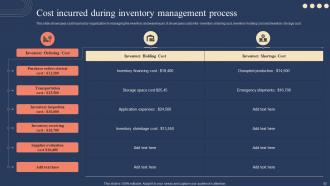
Slide 43: This slide shows the cost incurred by organization in managing the inventory and warehouse.
Slide 44: This slide mentions the Title for the Components to be covered in the following template.
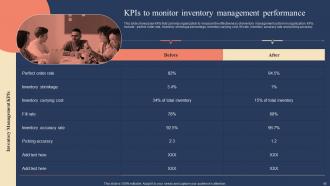
Slide 45: This slide illustrates the KPIs to monitor inventory management performance.
Slide 46: This slide incorporates the Heading for the Topics to be discussed further.
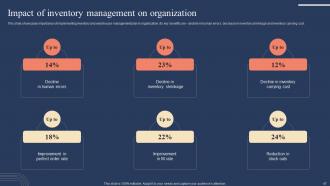
Slide 47: This slide deals with the Impact of inventory management on organization.
Slide 48: This slide reveals the Title for the Topics to be discussed next.
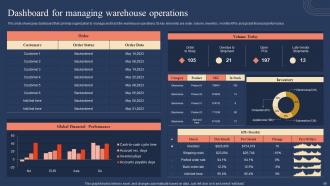
Slide 49: This slide exhibits the Dashboard for managing warehouse operations.
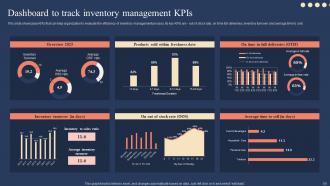
Slide 50: This slide depicts the Dashboard to track inventory management KPIs.
Slide 51: This slide contains all the icons used in this presentation.
Slide 52: This slide is titled as Additional Slides for moving forward.
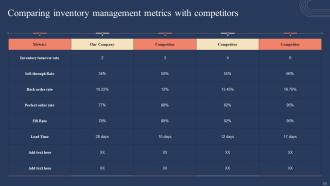
Slide 53: This slide presents Comparing inventory management metrics with competitors.
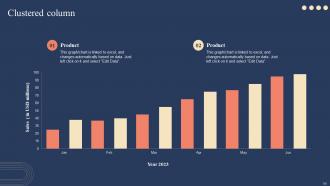
Slide 54: This slide provides Clustered Column chart with two products comparison.
Slide 55: This is an Idea Generation slide to state a new idea or highlight information, specifications etc.
Slide 56: This is Our Mission slide with related imagery and text.
Slide 57: This is a Comparison slide to state comparison between commodities, entities etc.
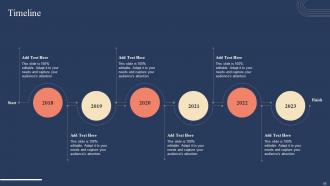
Slide 58: This is a Timeline slide. Show data related to time intervals here.
Slide 59: This is Our Team slide with names and designation.
Slide 60: This slide presents Roadmap with additional textboxes.
Slide 61: This is a Thank You slide with address, contact numbers and email address.
Implementing Strategies For Inventory Management And Control Powerpoint Presentation Slides with all 66 slides:
Use our Implementing Strategies For Inventory Management And Control Powerpoint Presentation Slides to effectively help you save your valuable time. They are readymade to fit into any presentation structure.












FAQs for Implementing Strategies For Inventory Management And Control
Don't overthink it - balance stock levels without drowning in cash. Use real data for demand forecasting instead of guessing. ABC analysis works great here - watch your expensive stuff like a hawk, let the cheap items coast. Reorder points are clutch for each product. Safety stock too, but honestly most people make this way harder than it needs to be. Skip the yearly inventory nightmare and just do regular cycle counts instead. Oh, and track your turnover ratio religiously. That's what'll tell you which products actually move versus the ones just taking up space.
First thing - map out your demand patterns and get tight with your suppliers. That's honestly where most people mess up. Pick items with predictable cycles to start with. You're basically betting everything shows up right on time (kinda nerve-wracking tbh). Get real-time tracking set up and work on shrinking those lead times. Quality has to be spot-on since there's no backup inventory if something goes wrong. Oh, and definitely test this with just one product line first. Don't go all-in until you know your system actually works.
Honestly, tech completely changed the inventory game. Automated tracking and AI forecasting make those old Excel nightmares look ancient - thank god we're past that mess. Your software can predict demand and auto-reorder before you're scrambling for stock. Barcode scanning cuts out most human mistakes too. The real win? You see everything in real-time across your whole supply chain. Spot problems early instead of firefighting later. I'd start by looking at what tech you're already using and figuring out the obvious gaps first.
Dude, you'll love this stuff. Real-time stock tracking means no more guessing what's left on shelves. When you're running low, it sends alerts automatically - no more surprise stockouts. The counting errors disappear since everything's tracked digitally instead of manually. Reports actually make sense too, showing you which products are duds and helping predict what you'll need next month. Honestly saves a ton on storage costs. My cousin switched last year and swears by it now. I'd write down your worst inventory problems first, then test drive a couple platforms to see what clicks.
Honestly, you need both your historical data AND what's happening right now. Pull your last 12-18 months of sales - seasonal stuff, weird spikes, all of it. But here's the thing: don't just copy last year's numbers like most people do. That's how you get burned. Layer in current signals too - customer orders coming in, any marketing pushes you're doing, economic weirdness. Track how accurate your forecasts actually are over time so you can fix what's not working. If you're just starting out, simple moving averages work fine. You can get fancy later once you've got the hang of it.
Ugh, been there with the inventory nightmare! First thing - get your demand forecasting sorted using past sales data and what's happening in your market. Just-in-time ordering is a lifesaver so you're not drowning in stock that sits there forever. Set up automatic reorder points based on what you actually use, not what you think you might need. For the dead stock? Bundle it, discount it, or donate it for the tax write-off. Honestly, tracking your turnover ratio monthly is probably the most boring but useful thing you can do - catches problems before they snowball.
Honestly, start with inventory turnover ratio - that's the big one that shows how fast you're moving stuff. Track your carrying costs and how often you're out of stock too. Gross margin by product category is super helpful. Oh, and don't sleep on days sales outstanding, most people forget about that one but it matters. Fill rate and order accuracy are must-haves since pissed off customers aren't coming back. Once you've got those basics locked down, then you can dive into the fancier stuff like ABC analysis and safety stock calculations.
So basically ABC analysis sorts your inventory into three buckets - A items are your money makers (like 20% of stuff bringing in 80% of cash), B is middle tier, C is the cheap stuff. Makes total sense when you think about it. You'd watch your A items like a hawk with constant check-ins, but C items? Just set up basic reorder points and forget about it. Way better than obsessing over every single thing equally - I learned that the hard way lol. Start by looking at what you've got now and see where everything lands value-wise.
Dude, you're basically locking up your cash whenever you buy too much inventory. Overstocking means money just sits there doing nothing instead of going toward ads or new hires. But running out of stuff is arguably worse - customers get pissed and you lose sales. I learned this the hard way last year, honestly. Track your inventory turnover ratio to see how fast things move. For non-seasonal products, try ordering just enough to meet demand without stockpiling. It's all about keeping cash moving while having enough product on hand.
So you've got to connect your suppliers directly to your inventory system - that's where the magic happens. Share your demand forecasts with them so they can actually plan ahead. Give them access to see your current stock levels too. Trust me, this stops you from being stuck with tons of crap nobody wants while you're completely out of the stuff flying off shelves. Set up automatic reorder points based on real sales data, not just guessing. Also try consignment deals where they keep stock at your place. Honestly, I'd start with just one supplier and test it out first.
Honestly, the inventory thing is a nightmare when you're selling everywhere at once. Stock counts get messy fast - like something sells on your website but doesn't update your store system right away, then boom, you're oversold. Each channel has totally different buying patterns too, which makes predicting demand tricky. Oh, and figuring out how much inventory to save for each platform? That's its own headache. You really need one of those systems that keeps everything synced up automatically across all your channels. Trust me, trying to manage it manually will drive you crazy.
Honestly, data analytics is a game changer for inventory - it stops you from just guessing what you need. Look at your sales patterns and seasonal stuff to actually predict demand. The algorithms are pretty good at catching things we'd totally miss. You'll nail better reorder points and dodge those annoying stockouts that piss customers off. Plus you can spot slow movers before they become dead inventory taking up space. My advice? Start with just one product category first, get some basic forecasting tools, then see how much better your accuracy gets over a few months. Way less stressful than winging it.
Cycle counting is your best friend here - way better than those brutal annual shutdowns that nobody wants to deal with. Focus on your high-value stuff first with ABC analysis, then hit your fast-movers monthly since that's where things get messy. Always double-check that what's physically there matches your system records. When you find discrepancies, jump on them right away - don't let them pile up. Having someone else verify counts helps too. Oh, and document everything you find, even the weird stuff. Trust me, doing small chunks regularly beats cramming it all into one hellish week.
Honestly, just dig into last year's sales data first - that'll show you when things get crazy busy versus dead. Stock up before your peak seasons but don't blow all your cash on inventory that might sit there forever. Try negotiating flexible deals with suppliers so you can order more when needed. Drop-shipping saved my butt a few times during unexpected rushes, just saying. The trick is having enough stuff without your money tied up in products gathering dust. Oh, and run new forecasts every quarter - things change fast and you don't want to get caught off guard.
Safety stock is just extra inventory you keep around to avoid running out when things go sideways. Demand suddenly jumps? Supplier's running late again? That's when it saves you. I mean, nobody wants angry customers because you're out of stock. You'll need to look at your past sales data and see how reliable your suppliers actually are - some are way worse than others. The math can get messy with all these formulas, but honestly the concept is straightforward. It's your backup plan. Figure out how much cushion you need based on how unpredictable your business really is.
-
Nothing beats the well-formatted and professionally designed templates offered. Kudos to SlideTeam for their amazing collection of PPT slides.
-
“I really like the convenient operation and professionalism I saw on the SlideTeam website. I want to express my regards and appreciation to the team.”