


Warehouse Inventory Management Stock Summary Report




Try Before you Buy Download Free Sample Product
 Impress Your
 Audience
 100%
100% Editable
 Save Hours
 of Time


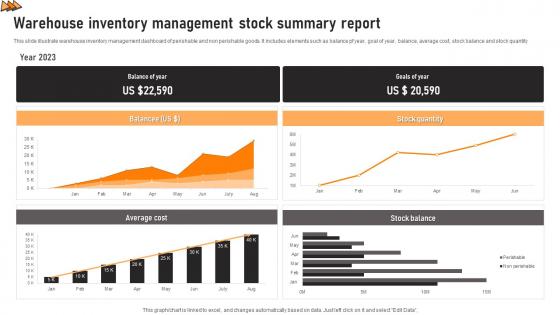
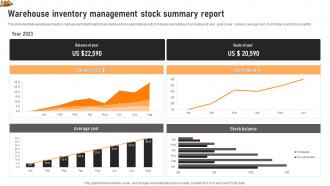
This slide illustrate warehouse inventory management dashboard of perishable and non perishable goods. It includes elements such as balance pf year, goal of year, balance, average cost, stock balance and stock quantity.
People who downloaded this PowerPoint presentation also viewed the following :
Warehouse Inventory Management Stock Summary Report with all 7 slides:
Use our Warehouse Inventory Management Stock Summary Report to effectively help you save your valuable time. They are readymade to fit into any presentation structure.





FAQs for Warehouse Inventory Management
Effective warehouse inventory management systems include real-time tracking technology, automated inventory controls, demand forecasting analytics, strategic storage optimization, and integrated reporting dashboards. These components streamline operations by minimizing stockouts, reducing carrying costs, and enhancing order accuracy, with many distribution centers finding that this strategic combination ultimately delivers faster fulfillment and improved customer satisfaction.
RFID and barcode scanning enhance inventory accuracy by providing real-time tracking, automating data capture, and eliminating manual counting errors that plague traditional systems. These technologies enable warehouses to achieve 99%+ accuracy rates through instant location updates, automated stock movements, and seamless integration with management systems, ultimately delivering faster order fulfillment and reduced operational costs.
Businesses should track inventory turnover ratio, carrying costs, stockout frequency, order fulfillment accuracy, and lead time variability to evaluate inventory management efficiency. These metrics enable organizations to optimize stock levels, reduce storage expenses, and improve customer satisfaction, with many retailers and manufacturers finding that consistent monitoring of these indicators delivers significant cost savings and operational improvements.
JIT inventory management significantly transforms warehouse operations by minimizing storage costs, reducing waste, and streamlining workflows through precise demand forecasting and supplier coordination. This approach enables organizations, particularly in manufacturing and retail sectors, to maintain leaner facilities while enhancing cash flow and operational efficiency, ultimately delivering faster response times and competitive advantage.
Optimizing warehouse storage space involves implementing vertical storage solutions, zone-based organization, ABC inventory classification, dynamic slotting strategies, and cross-docking capabilities. These approaches streamline operations by maximizing cubic space utilization, reducing picking times, and improving inventory turnover, with many distribution centers finding that strategic space optimization delivers up to 30% increased capacity and enhanced operational efficiency.
Businesses forecast demand through historical data analysis, seasonal trend evaluation, market research insights, and predictive analytics tools to maintain optimal inventory levels. These strategic approaches enable companies to anticipate customer needs, minimize carrying costs, and reduce stockouts, with many retailers and manufacturers finding that accurate forecasting delivers improved cash flow and enhanced customer satisfaction.
Workforce training enhances warehouse inventory management by improving accuracy in stock counting, optimizing picking processes, and reducing handling errors through proper equipment usage and safety protocols. Well-trained teams in retail and manufacturing environments streamline operations, minimize costly mistakes, and accelerate order fulfillment, ultimately delivering improved customer satisfaction and operational efficiency.
Lean inventory principles reduce waste by implementing just-in-time ordering, eliminating overstock situations, streamlining supplier relationships, and optimizing storage layouts for faster retrieval. These approaches enable warehouses to minimize carrying costs, reduce expired inventory, and accelerate order fulfillment, with many distribution centers finding that strategic lean implementation delivers significantly improved turnover rates and operational efficiency.
Common warehouse inventory management challenges include inaccurate stock levels, inefficient picking processes, poor demand forecasting, limited visibility across locations, and manual tracking errors. These obstacles can be overcome by implementing automated inventory systems, utilizing barcode or RFID technology, and adopting real-time tracking solutions, with many distribution centers finding that strategic integration of these technologies ultimately delivers enhanced operational efficiency and reduced carrying costs.
Integrating inventory management with supply chain operations enhances business performance by synchronizing demand forecasting, optimizing stock levels, and streamlining procurement processes across all touchpoints. This strategic combination enables companies to reduce carrying costs, minimize stockouts, and accelerate order fulfillment, with many retailers and manufacturers finding that seamless integration delivers improved cash flow and enhanced customer satisfaction.
Effective strategies include demand forecasting using historical data, flexible storage solutions, strategic supplier partnerships, safety stock optimization, and cross-docking capabilities. These approaches enable warehouses to anticipate seasonal peaks, adjust capacity dynamically, and maintain optimal inventory levels, with many retail and e-commerce operations finding that proactive planning reduces carrying costs while ensuring product availability during critical periods.
Data analysis and reporting tools enhance inventory decisions by providing real-time visibility into stock levels, demand patterns, supplier performance, and seasonal trends. Through predictive analytics and automated reporting, warehouses can optimize reorder points, reduce carrying costs, and minimize stockouts, with many distribution centers finding that data-driven insights ultimately deliver 20-30% improved inventory efficiency.
**Benefits include reduced operational costs, access to advanced technology, scalability, and expertise in logistics optimization, while drawbacks involve less direct control, potential communication gaps, and dependency on external providers. Many manufacturers and retailers find that strategic 3PL partnerships ultimately deliver enhanced efficiency and competitive advantage, though successful implementation requires careful vendor selection and clear performance agreements.**
Inventory visibility directly enhances customer satisfaction by enabling accurate order promising, reducing stockouts, and providing real-time delivery updates throughout the fulfillment process. Through advanced tracking systems, warehouses streamline order accuracy, minimize shipping delays, and deliver transparent communication, with many retailers finding that enhanced visibility ultimately reduces customer complaints while accelerating order processing times.
Current innovations include AI-powered demand forecasting, IoT sensors for real-time tracking, automated guided vehicles, robotic picking systems, and blockchain for supply chain transparency. These technologies streamline operations by reducing manual errors, accelerating fulfillment processes, and optimizing storage efficiency, with many logistics companies finding that strategic automation ultimately delivers faster customer service and significant cost reductions.
-
Excellent template with unique design.
-
Awesome presentation, really professional and easy to edit.