

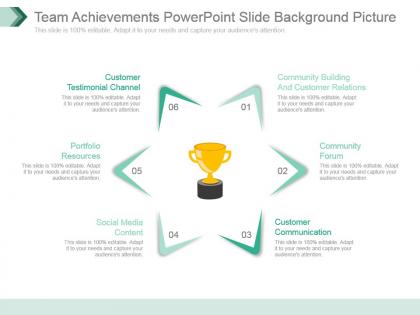
Team achievements powerpoint slide background picture




Try Before you Buy Download Free Sample Product
 Impress Your
 Audience
 100%
100% Editable
 Save Hours
 of Time


Your ideas will create benchmarks. Add to your credentials with our Team Achievements Powerpoint Slide Background Picture.
People who downloaded this PowerPoint presentation also viewed the following :
Team achievements powerpoint slide background picture with all 7 slides:
Immediately establish a decisive edge with our Team Achievements Powerpoint Slide Background Picture. Be able to jockey for the edge.







FAQs for Team achievements powerpoint
Key factors contributing to team milestone success include clear goal alignment, effective communication protocols, defined role accountability, strategic resource allocation, and consistent performance tracking. These elements work together by fostering collaboration, minimizing project delays, and enhancing decision-making processes, with many organizations finding that teams combining structured frameworks with adaptive leadership ultimately deliver faster project completion and sustained competitive advantage.
Team achievements can be effectively communicated through visual dashboards, milestone reports, success metrics presentations, stakeholder newsletters, and executive briefings that highlight quantifiable results. These approaches streamline communication by showcasing measurable outcomes, celebrating key wins, and demonstrating ROI impact, with many organizations finding that regular, data-driven updates enhance stakeholder confidence and strategic alignment.
Team achievements significantly influence company culture by fostering collaboration, recognition, and shared purpose, while boosting morale through collective pride and motivation. These successes create positive feedback loops where celebrated wins encourage innovation, strengthen team bonds, and establish performance standards, with many organizations finding that highlighted achievements drive employee engagement, reduce turnover, and ultimately enhance overall productivity and workplace satisfaction.
Leadership drives team achievements by setting clear vision, fostering collaboration, providing necessary resources, and creating accountability frameworks that align individual efforts with organizational goals. Effective leaders in sectors like technology and healthcare enhance team performance through strategic guidance, skill development, and recognition systems, ultimately delivering improved productivity and competitive advantage.
Diversity enhances team achievements by bringing varied perspectives, experiences, and problem-solving approaches that drive innovation and creativity. Teams with diverse backgrounds, skills, and viewpoints generate more comprehensive solutions, make better decisions through reduced groupthink, and adapt more effectively to complex challenges, ultimately delivering stronger performance and competitive advantage in increasingly global markets.
Effective team achievement metrics include project completion rates, quality scores, customer satisfaction ratings, revenue impact, and goal attainment percentages. These measurements work together by tracking both quantitative outcomes and qualitative performance indicators, with many organizations finding that combining productivity metrics with team collaboration assessments delivers comprehensive insights into overall effectiveness and strategic value.
Individual contributions impact team achievements by combining diverse skills, expertise, and perspectives to create comprehensive solutions, enhanced innovation, and stronger collective performance. Through strategic collaboration, organizations find that leveraging each member's unique strengths accelerates project timelines, improves decision-making quality, and ultimately delivers superior outcomes that exceed what isolated efforts could accomplish alone.
Teams can overcome challenges and achieve goals through clear communication, collaborative problem-solving, defined roles and responsibilities, regular progress monitoring, and adaptive planning strategies. These approaches enable organizations across sectors like healthcare, manufacturing, and financial services to streamline operations, enhance productivity, and deliver consistent results, ultimately building competitive advantage through stronger team performance and organizational resilience.
Celebrating team achievements fosters collaboration by building trust, reinforcing shared goals, and creating positive momentum that encourages collective problem-solving and knowledge sharing. When organizations recognize collaborative successes, team members become more willing to support each other's initiatives, share resources across departments, and pursue ambitious projects together, ultimately delivering stronger business outcomes and enhanced workplace culture.
Common pitfalls include poor communication, unclear goal setting, lack of accountability, insufficient resource allocation, and misaligned priorities. These challenges often stem from inadequate planning and coordination, with many organizations finding that addressing communication gaps and establishing clear ownership structures significantly enhances team performance and goal attainment rates.
Technology streamlines achievement tracking through performance analytics platforms, automated reporting systems, real-time dashboards, project management tools, and AI-driven insights. These solutions enhance team performance by identifying productivity patterns, measuring goal completion rates, and providing actionable feedback, ultimately delivering improved collaboration and competitive advantage across organizations.
Unsuccessful team efforts reveal critical lessons including poor communication protocols, unclear role definitions, inadequate resource allocation, misaligned objectives, and insufficient leadership oversight. These failures enable organizations to strengthen project management frameworks, enhance collaborative processes, and establish clearer accountability structures, with many companies finding that analyzing past shortcomings ultimately delivers improved team performance and strategic outcomes.
Recognition and reward are crucial for sustaining team morale, as they reinforce positive behaviors, validate contributions, and motivate continued high performance through acknowledgment and incentives. Strategic recognition programs enhance employee engagement, reduce turnover, and build momentum for future achievements, with many organizations finding that consistent appreciation ultimately delivers stronger team cohesion and competitive advantage.
Team achievements significantly accelerate career development by demonstrating collaborative skills, leadership potential, and measurable business impact to employers and stakeholders. These accomplishments enhance individual portfolios with quantifiable results, increase visibility within organizations, and create networking opportunities, with many professionals finding that documented team successes lead to promotions, expanded responsibilities, and enhanced market credibility.
Continuous improvement practices enhance future team achievements by fostering systematic feedback loops, data-driven decision making, regular process optimization, and adaptive learning frameworks. Through iterative assessment cycles, teams identify performance gaps, streamline workflows, and build knowledge repositories, ultimately delivering higher success rates and sustained competitive advantage across projects.
-
Great experience, I would definitely use your services further.
-
Unique research projects to present in meeting.