


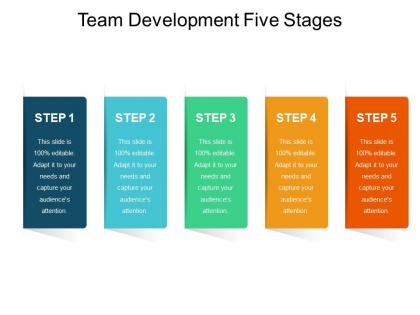
Team development five stages




Try Before you Buy Download Free Sample Product
 Impress Your
 Audience
 100%
100% Editable
 Save Hours
 of Time


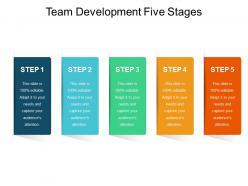
Create a concise and effective presentation by using our Team Development Five Stages PowerPoint template. Use this eye-catching team building model PPT theme to showcase the five stages of team growth. With this graphical PowerPoint slide, you can make the group enhancement action plan much simpler. Utilize this team development example PPT layout to define the five stages of morale boosting for better collaboration between your team members. By using this employee improvement PPT template, you can upskill your colleagues and prepare them for future challenges. With the assistance of this group advancement PPT layout, you can empower your coworkers to grow together as a unit. You can also use this visual preset to identify the key components of a positive work culture. This workforce building PPT slide will also help you devise effective teamwork activities. So download this employee formation PowerPoint template on five stages of team development and hit the ground running.
People who downloaded this PowerPoint presentation also viewed the following :
Team development five stages with all 5 slides:
Feel the difference with our Team Development Five Stages. Your thoughts will get that extra lift.
FAQs for Team
The Tuckman model includes forming (politeness, uncertainty, dependence on leadership), storming (conflict, competition, resistance to tasks), norming (cohesion, established roles, shared commitment), performing (high productivity, interdependence, problem-solving focus), and adjourning (task completion, emotional separation). These stages enable organizations to anticipate team dynamics, implement targeted interventions, and accelerate progression to high-performance states, with many finding that structured facilitation significantly reduces time spent in unproductive early phases.
Team leaders can effectively facilitate this transition by establishing clear communication protocols, setting explicit team norms and expectations, and creating safe spaces for open dialogue about emerging conflicts. Through structured team-building activities, regular check-ins, and proactive conflict resolution training, leaders help teams navigate interpersonal tensions while maintaining focus on shared objectives, ultimately accelerating progress toward higher performance stages.
Strategies include establishing clear communication protocols, implementing regular feedback sessions, creating collaborative decision-making processes, fostering open dialogue channels, and setting shared expectations for interaction styles. These approaches streamline team dynamics by building trust, reducing misunderstandings, and enhancing workflow coordination, with many organizations finding that structured communication frameworks during norming ultimately deliver stronger team cohesion and improved project outcomes.
In the performing stage, team roles become more fluid and interdependent, with members naturally adapting responsibilities based on expertise rather than formal assignments, while leadership shifts dynamically among team members depending on task requirements. Team dynamics evolve toward collaborative problem-solving, enhanced trust, and streamlined communication, with many high-performing organizations finding that these self-managing teams deliver faster project completion and improved innovation outcomes.
Common storming stage challenges include personality clashes, resistance to leadership, unclear role boundaries, communication breakdowns, and competing priorities among team members. These obstacles can be overcome through structured conflict resolution processes, clearly defined roles and responsibilities, regular team meetings for open dialogue, and strong facilitation from leaders who encourage respectful debate while maintaining focus on shared objectives.
Team development stages significantly impact productivity and morale through varying levels of collaboration, conflict resolution, and performance optimization. During forming and storming phases, productivity typically decreases while morale fluctuates, but teams progressing through norming to performing stages experience enhanced efficiency, stronger relationships, and sustained motivation, with many organizations finding that structured stage management accelerates overall team effectiveness and competitive advantage.
Feedback accelerates team progression by providing clarity during forming, addressing conflicts constructively in storming, establishing performance standards during norming, and optimizing excellence in performing. Through regular feedback loops, organizations enable continuous improvement, enhance communication effectiveness, and build psychological safety, with many teams finding that structured feedback processes significantly reduce development timelines while delivering stronger collaboration and measurable performance outcomes.
Tools supporting team development include collaboration platforms like Slack and Microsoft Teams, project management software such as Asana and Trello, assessment tools like StrengthsFinder, and communication frameworks including regular retrospectives and feedback sessions. These resources streamline team coordination, enhance transparency, and facilitate structured discussions, with many organizations finding that combining digital platforms with deliberate communication processes accelerates progression through development stages while building stronger collaborative foundations.
Team size significantly impacts development dynamics by affecting communication complexity, decision-making speed, and relationship formation at each stage. Smaller teams often navigate forming and storming more quickly with direct interactions, while larger teams face coordination challenges but benefit from diverse expertise during norming and performing stages, ultimately delivering enhanced problem-solving capabilities and strategic outcomes.
Leaders can recognize team stagnation through declining communication quality, increased conflicts over previously resolved issues, reduced accountability for individual contributions, and decreased innovation or creative problem-solving. Signs include team members reverting to formal interactions, avoiding challenging decisions, missing deadlines more frequently, and loss of collective ownership, with many organizations finding that regular pulse surveys and one-on-one feedback sessions help identify these regression patterns early.
The adjourning stage provides closure, knowledge transfer, and relationship preservation opportunities that enhance future team formations and organizational learning. Effective management involves structured reflection sessions, documentation of best practices, celebration of achievements, and maintaining professional networks, with many organizations finding that thoughtful adjournment processes significantly improve subsequent project outcomes and team member retention.
Understanding team development stages enables leaders to tailor conflict resolution approaches by recognizing that storming-phase disputes require different interventions than performing-phase disagreements, while norming-stage tensions need specific facilitation techniques. This knowledge helps managers anticipate typical conflict patterns, implement stage-appropriate mediation strategies, and guide teams through productive resolution processes, ultimately accelerating team maturation and enhancing collaborative effectiveness.
Cultural diversity enhances team dynamics by bringing varied perspectives, problem-solving approaches, and creative solutions throughout all development stages. While forming teams benefit from diverse viewpoints in establishing norms, and performing teams leverage different cultural strengths for innovation, organizations increasingly find that diverse teams deliver superior outcomes, enhanced decision-making, and competitive advantages in global markets.
Virtual teams experience team development stages with extended forming periods due to limited non-verbal cues, accelerated storming through digital miscommunications, and modified norming that relies heavily on established protocols and communication tools. These teams often develop stronger written communication skills, clearer documentation practices, and more structured decision-making processes, ultimately delivering enhanced flexibility and global collaboration capabilities for modern organizations.
Teams can leverage collective strengths by conducting skills assessments, assigning roles based on individual expertise, establishing mentorship pairs, and creating cross-functional collaboration opportunities. Through strategic talent mapping and peer-to-peer learning initiatives, organizations streamline progression from forming to performing stages, with many finding that structured strength-based approaches reduce development timelines while enhancing overall team cohesion and productivity.
-
Visually stunning presentation, love the content.
-
Presentation Design is very nice, good work with the content as well.