


Technology architecture powerpoint slide influencers






Try Before you Buy Download Free Sample Product
 Impress Your
 Audience
 100%
100% Editable
 Save Hours
 of Time


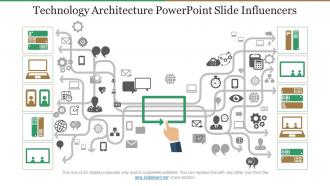
Represent your business technological model with our professionally crafted technology architecture PowerPoint slide design. It will help in defining the core values of your business technological system and also helps in representing the model effectively. Describe and define your company’s technology model through this information technology architecture Presentation diagram. You can use this PPT design to further describe the IT infrastructure of your business which is essentially required by any business to further support all the IT applications and the IT operations. In the same manner, you can represent the reporting requirements of the same with this technology framework PowerPoint slide template. It further helps in presenting your company’s technical profile with the values in front of your potential clients and customers. It also helps in attracting more business investors. Therefore, simply tap on the download option given below to start working over this professional organization technical framework PPT image diagram. Indulge in intelligent interaction with our Technology Architecture Powerpoint Slide Influencers. Generate a fruitful exchange of ideas.
People who downloaded this PowerPoint presentation also viewed the following :
Technology architecture powerpoint slide influencers with all 5 slides:
Stand at ease with our Technology Architecture Powerpoint Slide Influencers. Deliver your ideas in a relaxed atmosphere.



FAQs for Technology architecture
So you need three main layers - data (databases, storage), application (your business logic and APIs), and presentation (the UI stuff). Infrastructure is massive though: servers, networking, security, monitoring tools. Integration points matter way more than people think since everything connects now. Honestly, governance around data standards and security policies will save you headaches later. Each layer should scale on its own but still communicate smoothly. Map what you've got first, spot the gaps, then build from there. Don't just start coding random stuff.
Yeah, microservices are way better for scaling - you can just bump up the parts that actually need it instead of your whole app. Like if auth is getting slammed but payments are chilling, why scale everything? That's just burning money. Plus if one service crashes, it doesn't take down your entire system. The downside though? Deployment becomes a total pain and monitoring gets messy fast. Really depends on where your bottlenecks are - if it's only a couple components causing issues, the extra complexity might actually be worth it for your project.
Dude, cloud computing has totally changed how we build stuff. You can scale up or down without dealing with actual servers - which is honestly a lifesaver. Spinning up services across different regions? Way easier now. Microservices become less of a headache too. The pay-as-you-go thing is clutch because you're not stuck with expensive hardware just collecting dust. Disaster recovery gets simpler as well, though I still mess up configs sometimes lol. I'd say look at what you've got running now and figure out what could move to the cloud first. That's usually the smoothest way to start.
Here's the thing - good tech architecture basically gives you a roadmap for how data moves between all your systems. Instead of having everything connected in a chaotic mess (which honestly happens way too often), you get standardized APIs and shared data models that actually talk to each other properly. Governance rules keep your data clean as it flows around, plus you can monitor everything from one place instead of playing detective across multiple dashboards. I'd start by mapping out what data sources you currently have and figuring out which integrations are causing you the biggest headaches. That'll show you exactly where to focus first.
Honestly, security's gotta be baked in from the ground up - way easier than trying to patch holes later. Go with zero trust (basically don't trust anything by default, even internal stuff). Authentication and authorization are your best friends here. Encrypt everything - data moving around AND data sitting still. Give people the absolute minimum access they need to do their job, nothing more. Monitor everything too because you can't fix what you don't know is broken. Also have an incident response plan ready day one. Trust me on this one.
Your tech stack basically decides what you can build and how well it'll perform. Python's great for most stuff but terrible for high-frequency trading. JavaScript works everywhere except embedded systems - learned that the hard way once. Each language has its strengths, and frameworks lock you into certain patterns whether you like it or not. The trick is matching your choice to what you actually need: performance requirements, what your team knows, and honestly? What you'll be able to maintain later. Don't just pick whatever's hot on Twitter right now.
Focus on modularity first - build stuff so you can swap pieces without everything breaking. API-first design is clutch because new tech integrates way easier later. Cloud-native patterns give you tons of flexibility too. Honestly, don't fall in love with specific vendors (I got burned by this with an old system that became a nightmare). Keep your data architecture clean and documented. Oh, and audit your current dependencies - figure out which ones would totally screw you if they disappeared tomorrow. That exercise alone will show you where to start.
Honestly, figure out what problems you're actually trying to fix first - not what sounds cool. Make a simple scoring sheet with stuff like cost, whether it plays nice with your existing systems, and if your team can actually use it without losing their minds. Run a small test if you can. I've watched companies blow budgets on fancy tools that just collect digital dust because nobody bothered asking the people who'd use it daily. Oh, and check if the vendor support is decent - you'll need it. Your users should have the final say though, since they're stuck with whatever you pick.
Look, you want your tech choices to actually move the needle for your business. Pick tools that solve real problems, not just shiny ones that look impressive on your resume. Fast development and lower costs naturally follow when everything works together properly. I learned this the hard way after inheriting a Frankenstein stack once – total disaster. Audit your current setup regularly. Does each piece contribute to what you're trying to build? If not, ditch it. Technical debt piles up fast when you're running tools that don't serve a clear purpose.
Track the technical stuff first - uptime, response times, how it handles load spikes. Business metrics matter just as much though: cost savings, user satisfaction, faster deployments. I'm big on real-time dashboards plus those quarterly check-ins. Oh, and definitely survey your dev team - if they're constantly cursing at the system, that's data too lol. Set your baselines before you launch or you'll have nothing to compare against later. The worst thing is realizing six months in that you can't prove if anything actually improved.
Dude, the worst thing you can do is over-engineer everything when something simple would work just fine. Also don't get trapped by vendor lock-in - I've watched entire teams get completely screwed by that. Security stuff? Handle it from day one, not as an afterthought when you're scrambling to fix everything. Same with planning for scale. Technical debt will definitely come back to haunt you later if you're cutting too many corners now. Oh, and write down why you made certain decisions. Trust me on this one. Always think "what happens when we're way bigger?"
Honestly, DevOps is a game changer because it gets dev and ops teams actually talking to each other instead of throwing code over the fence. You'll catch bugs way earlier with automated testing built into your pipeline - saves so much headache later. Infrastructure-as-code keeps everything consistent across environments (no more "works on my machine" nonsense). The monitoring piece is clutch for spotting issues before users start complaining. My advice? Don't try to boil the ocean. Pick one service, get CI/CD working there first, then roll it out everywhere else.
Dude, APIs are what make all your different systems actually talk to each other instead of living in silos. Without them you'd be rebuilding everything constantly which sounds like hell. Documentation is huge - I can't stress this enough because you'll forget how your own stuff works in like 6 months. Version control keeps you from accidentally breaking things that already work. Rate limiting and auth are non-negotiable for security obviously. Start by figuring out what APIs you've got, document the critical ones first, then get some basic monitoring set up. Trust me, that monitoring will catch problems before your users start yelling at you.
Honestly, APIs and middleware are gonna save you here. They're perfect for getting legacy stuff to talk to your new systems without rebuilding everything from scratch. I'd map out what you've got first - figure out where the biggest headaches are. Service meshes are pretty hot right now too, worth looking into. Build some abstraction layers that can translate between your different data formats. Oh, and don't feel like you need to tackle everything at once - just start with your most critical legacy systems and work from there. Way less overwhelming that way.
Yeah, definitely let UX drive your architecture from the start. Fast page loads? You'll want CDNs and solid caching. Mobile users with bad connections? Go lightweight APIs and offline features. I've watched so many teams build these "amazing" architectures that users actually hate because they're sluggish or keep breaking. Your database picks, microservices setup, deployment stuff - it all needs to connect back to what users actually experience. Start with the UX requirements first. Then pick your tech stack around those needs, not the other way around.
-
Appreciate the research and its presentable format.
-
Excellent Designs.