


Technology development power point presentation examples




Try Before you Buy Download Free Sample Product
 Impress Your
 Audience
 100%
100% Editable
 Save Hours
 of Time


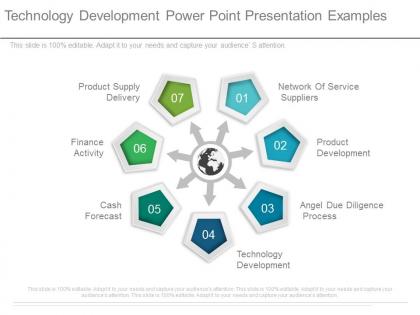
Browse through our technology development PowerPoint presentation. Our professional presentation designers has created this wonderful slide for your use. The technology presentation slides comes with different stages in the process such as network of service suppliers, product development, angel due diligence process, technology development, cash forecast, finance activity and product supply delivery. To display all these aspects you might have to create six or seven presentation slides whereas our technology presentation examples PPT design makes it possible for you to get all these in just one single slide. The design comes with globe in between that you can use it to show your technology development in international market. Those working in the technology industry can share the details about the new development with their clients and engage them in it. Our technology PowerPoint template will be your perfect partner when you are looking for some reliable source to let the world aware of your technology development. Our Technology Development Power Point Presentation Examples encourage forthright expression. Thoughts will flow with complete clarity.
People who downloaded this PowerPoint presentation also viewed the following :
Content of this Powerpoint Presentation
Description:
The image is a PowerPoint slide titled "Technology Development PowerPoint Presentation Examples." It's designed to outline a business process or strategy related to technology development. The central graphic is a grey circle with a stylized globe, around which seven hexagonal shapes are arranged in a circular pattern, each connected to the center with arrows, indicating a flow or cycle. Each hexagon is numbered and labeled with a different aspect of a business strategy:
1. Network of Service Suppliers
2. Product Development
3. Angel Due Diligence Process
4. Technology Development
5. Cash Forecast
6. Finance Activity
7. Product Supply Delivery
Use Cases:
This slide is a quintessential example of how to visually communicate complex business processes in technology presentations and can be used across various industries:
1. Venture Capital:
Use: Explaining the investment cycle.
Presenter: Investment Manager
Audience: Investors, entrepreneurs
2. Software Development:
Use: Outlining the software lifecycle.
Presenter: Software Engineering Lead
Audience: Development team, stakeholders
3. Manufacturing:
Use: Detailing the product manufacturing process.
Presenter: Operations Manager
Audience: Production team, supply chain partners
4. Biotechnology:
Use: Presenting R&D and commercialization stages.
Presenter: Chief Scientific Officer
Audience: R&D team, investors
5. E-commerce:
Use: Mapping the online product journey.
Presenter: E-commerce Strategist
Audience: Marketing team, logistics managers
6. Renewable Energy:
Use: Describing the development of new energy technologies.
Presenter: Project Developer
Audience: Engineers, environmental analysts
7. Automotive:
Use: Illustrating the process of vehicle design and assembly.
Presenter: Product Manager
Audience: Design team, engineers
This technology development slide offers a structured approach to presenting multifaceted processes, making it an exemplary tool for capturing the intricacies of technology presentation examples and development strategies.
Technology development power point presentation examples with all 4 slides:
Your audience will be delirious over our Technology Development Power Point Presentation Examples. Your ideas will have them jumping for joy.
FAQs for Technology development power
Honestly, AI integration is the big one right now - it's going into literally everything. Edge computing's getting huge too since nobody wants to wait for cloud processing anymore. Sustainability isn't optional anymore either, which is actually pretty cool to see. Quantum's finally leaving the labs (still wild to think about). 5G and IoT are creating insane amounts of data opportunities. Security's become this whole "build it in from day one" thing because of all the breaches. Oh, and privacy laws are basically forcing us to redesign how we approach products. I'd definitely get your team up to speed on AI tools and green development - those are gonna be essential no matter what you're building.
Honestly, it's wild how much AI and IoT are shaking things up everywhere. Manufacturing companies are putting sensors on machines to predict breakdowns before they happen. Banks use AI for fraud detection, customer service bots handle basic stuff. Healthcare might be the coolest though - wearables track patients constantly, and AI spots diseases faster than human doctors sometimes. Even farmers are flying drones around their fields now (which still feels futuristic to me). For your company, I'd say start with something boring and repetitive. Find one process that involves tons of data and test how these tools could make it smoother.
Honestly, UX can make or break your whole project. I've watched so many smart developers build amazing tech that nobody could actually figure out - such a waste! Don't wait until the end to think about how people will use it. Map out those user journeys before you even touch the code. Test early and often with real users, not just your coworkers who already get it. The feedback will surprise you every time. Build quick prototypes and iterate based on what people actually do, not what you think they'll do.
Honestly, just pick ONE thing that's actually driving you crazy right now - don't go overboard trying to fix everything. Your team needs to be part of this from day one or they'll just ignore whatever you roll out (learned that the hard way). Test it small first, see how it meshes with what you're already doing. Budget for training too, not just the tech itself. Here's the thing though - if it's not genuinely making life easier after a few weeks, ditch it. I've seen too many companies stick with crappy solutions just because they paid for them. Track whether it's actually helping or just creating more work.
So basically you've got three big things to worry about: privacy, bias, and how your tech impacts society. Data protection is huge obviously. But also - are your algorithms screwing over certain groups? That stuff gets messy fast. Transparency matters too - like, can people actually understand what your system's doing to them? Oh and there's job displacement, environmental costs, all that. Honestly the whole thing's way more complicated than you'd think going in. Don't save ethics discussions for the end though, that's a mistake. Build them right into your process from the start.
Yeah, regulations do slow things down - especially in healthcare, finance, and self-driving cars where approval processes take forever. But it's weird how sometimes they actually help. Like GDPR forced everyone to build way better privacy systems, which honestly was overdue. The trick is figuring out what rules you'll need to follow from day one and baking that into your plans. Way easier than trying to slap compliance on later. I've seen teams get totally blindsided by regulatory stuff they should've seen coming. Healthcare is probably the worst for this - those timelines are brutal.
Dude, security isn't just important - it's make-or-break stuff. You gotta build it in from the start, not slap it on later like some afterthought. Trust me on this one. Fixing vulnerabilities after launch costs like 10x more than doing it right initially. Users will bail if your app feels sketchy, and don't even get me started on compliance headaches. My buddy ignored this advice and basically had to rebuild his entire backend. Start with threat modeling early and build security checks into your regular dev cycle. Way easier than explaining a data breach to investors later.
Look, forget the flashy stuff for now. Find problems your competitors won't touch and go after those hard. I learned this the messy way - spent months on "cool" features nobody cared about. What actually works? Pick one thing that makes people's lives way easier, faster, or cheaper. Automate something they hate doing. Sometimes it's boring work, but that's where you win. Ship small first. Get that one core feature right before you build everything else. Users don't care if it's technically brilliant - they just want their problem solved. Focus there and you'll be ahead of most startups already.
Programming fundamentals are a must - Python, JavaScript, whatever fits your field. Frameworks change all the time though, so adaptability matters more than memorizing syntax. Problem-solving and critical thinking skills will carry you further than most people realize. Communication's key too since you're always working with different teams. Oh, and basic cloud/DevOps knowledge is pretty much expected now. My take? Go deep in one area but stay curious about the rest. Makes collaborating with other specialists way easier, and honestly, it keeps the work interesting.
Honestly, open-source is a game changer because developers don't have to reinvent the wheel constantly. Thousands of people can jump in and fix bugs or add features way faster than any single company could. Corporate barriers just... disappear, which is wild when you think about it. I've watched teams from rival companies actually collaborate on the same project without drama. You can build on existing tools, give back your own improvements, and tap into this huge community knowledge. Oh, and the cost savings are pretty nice too. Start by finding open-source versions of whatever software you're using now and see what's out there.
Honestly, the performance stuff will hit you first - your app just starts crawling when traffic spikes. Database scaling becomes a nightmare real quick. Architecture choices that worked fine with 100 users? They'll completely break with 10k. Load balancing gets tricky, caching becomes critical, and distributed systems are... well, they're a pain. Oh, and your AWS bill will make you cry. Here's the thing though - start building for scale early, even if it feels overkill. I learned this the hard way. Retrofitting scalability later is like trying to widen a highway while cars are still driving on it.
Dude, tech is totally changing the sustainability game right now. Smart grids are making energy way more efficient, and AI is cutting manufacturing waste like crazy. Farmers are using IoT sensors to save water - honestly didn't expect agriculture to get so high-tech but here we are. Solar's getting dirt cheap and battery storage actually works now. Even boring stuff like logistics software is slashing transport emissions. My advice? Find tech that's already built for your industry. There's probably something out there that'll help the environment AND your wallet.
Tech's actually getting pretty wild at fixing healthcare problems. Telemedicine lets people in the middle of nowhere video call specialists - game changer for rural folks. Those health apps track your blood pressure and stuff, catching issues before you end up in the ER. AI can spot diseases way faster than doctors sometimes, which is honestly a little freaky but also amazing. Blockchain keeps medical records secure and lets you take them anywhere. The tricky part though? Making sure this tech reaches people who really need it, not just folks who already have decent healthcare.
Dude, quantum computing is gonna break literally everything we use for encryption right now. Once these machines get powerful enough, all our current security becomes useless - they work with quantum bits instead of regular ones, so the math is completely different. Honestly, it's kinda scary how fast this could happen. But there's cool stuff too - drug discovery, financial modeling, all that optimization stuff will get insane upgrades. If you're doing anything security-related, you should probably start looking into post-quantum cryptography now. Better safe than scrambling later when everyone's freaking out about it.
Honestly, supply chains control everything in tech right now. COVID showed us how fast things can fall apart - one factory shuts down and suddenly you can't get the chips you need. Companies literally have to redesign entire products just because certain parts aren't available. It's wild how much power that gives suppliers. Most manufacturing happens in Asia, so when there's drama over there, it hits everyone. My advice? Don't wait until you're in crisis mode. Build backup plans into your timeline early, even if it feels like overkill at first.
-
Designs have enough space to add content.
-
Unique research projects to present in meeting.