

The problem solution ppt powerpoint presentation outline sample




Try Before you Buy Download Free Sample Product
 Impress Your
 Audience
 100%
100% Editable
 Save Hours
 of Time


Impress folks with your calm demeanor due to our The Problem Solution Ppt Powerpoint Presentation Outline Sample. It helps handle a cliff hanger.
People who downloaded this PowerPoint presentation also viewed the following :
Content of this Powerpoint Presentation
Description:
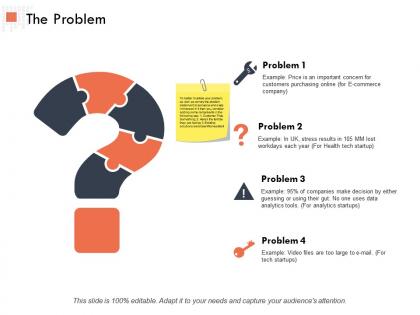
The image is of a PowerPoint slide titled "The Problem," designed for presenters to outline key issues that their product, service, or project aims to address. The slide visually represents the concept of problem-solving with a question mark composed of puzzle pieces, indicating that there are missing parts or unanswered questions to be addressed.
The slide has four distinct sections labeled Problem 1 through Problem 4, each with an example illustrating a specific issue:
Problem 1:
Concerns price sensitivity among online shoppers. This is a common issue for e-commerce businesses where customers are looking for the best deals.
Problem 2:
Highlights the impact of stress on workdays lost in the UK, pertinent for health tech startups focusing on wellness and productivity solutions in the workplace.
Problem 3:
Points out that many companies rely on gut feeling rather than data analytics for decision-making, which opens a market for analytics startups to provide data-driven solutions.
Problem 4:
Addresses the technical limitation of email systems to handle large video files, which is a challenge that tech startups could solve.
Each problem comes with an icon that emphasizes the nature of the issue: a price tag for cost concerns, a sticky note for additional details, an exclamation mark for critical problems, and a tool for technical issues.
Use Cases:
This slide format is versatile and can be adapted for use across multiple sectors:
1. E-Commerce:
Use: Outlining challenges in online customer retention
Presenter: Marketing Director
Audience: Marketing team, stakeholders
2. Public Health:
Use: Presenting societal health issues for policy advocacy
Presenter: Public Health Official
Audience: Policy makers, health professionals
3. Data Science:
Use: Emphasizing the importance of data in strategic decisions
Presenter: Data Scientist
Audience: Business leaders, IT professionals
4. Cybersecurity:
Use: Discussing risks and vulnerabilities in digital communication
Presenter: Cybersecurity Expert
Audience: Corporate IT departments, security personnel
5. Education Technology:
Use: Identifying gaps in educational software and hardware
Presenter: EdTech Innovator
Audience: Educators, tech investors
6. Digital Marketing:
Use: Highlighting the challenges in digital ad targeting and ROI
Presenter: Digital Strategist
Audience: Advertisers, marketing teams
7. Venture Capital:
Use: Evaluating pain points startups aim to solve for investment opportunities
Presenter: Venture Capitalist
Audience: Investors, entrepreneurs
The problem solution ppt powerpoint presentation outline sample with all 5 slides:
Global access gets enhanced with our The Problem Solution Ppt Powerpoint Presentation Outline Sample. Folks across the earth will open their doors.

FAQs for The problem solution ppt powerpoint
Key components include problem identification, impact analysis, proposed solution, implementation plan, and expected outcomes. These elements work together by establishing credibility through data-driven problem framing, presenting viable solutions with clear methodologies, and demonstrating ROI potential, with many organizations finding that structured problem-solution presentations significantly enhance stakeholder buy-in and project approval rates.
Visuals enhance problem-solution presentations by simplifying complex data through charts and infographics, illustrating cause-and-effect relationships with flowcharts, and demonstrating outcomes through before-and-after comparisons. These visual elements streamline audience comprehension, reduce cognitive load, and accelerate decision-making processes, with many organizations finding that strategic visual integration ultimately delivers more persuasive presentations and faster stakeholder buy-in.
Engagement techniques include interactive polling, compelling storytelling with real scenarios, visual demonstrations of problems, audience question segments, and case study walkthroughs. These approaches enhance audience participation by creating emotional connections, encouraging active involvement, and demonstrating tangible outcomes, with many presenters finding that combining multiple techniques significantly improves message retention and stakeholder buy-in.
Real-life case studies enhance problem-solution outlines by providing concrete evidence, building credibility through documented outcomes, and helping audiences visualize practical applications of proposed solutions. These case studies enable presenters to demonstrate measurable results, address potential objections with proven data, and create emotional connections through relatable scenarios, ultimately delivering stronger persuasion and increased stakeholder confidence in implementation strategies.
Storytelling transforms abstract problems into relatable scenarios by creating emotional connections, establishing context, and illustrating real-world consequences that resonate with audiences. Through narrative frameworks, presenters can guide audiences from problem awareness to solution acceptance, with many organizations finding that story-driven presentations increase stakeholder engagement and decision-making speed by up to 65%.
Presenters should prioritize problems based on audience impact, urgency, and strategic alignment with business objectives, focusing on issues that directly affect their stakeholders' operations, revenue, or competitive position. Through systematic evaluation of problem magnitude, implementation feasibility, and resource requirements, organizations can address high-impact challenges first, ultimately delivering measurable outcomes and sustainable competitive advantage.
**INPUT**: What strategies can be employed to ensure that solutions presented are actionable and realistic? **OUTPUT**: Effective strategies include conducting thorough feasibility analysis, defining clear implementation timelines, establishing measurable success metrics, identifying required resources, and validating solutions through stakeholder feedback. These approaches streamline decision-making by addressing practical constraints, budget considerations, and organizational capabilities, with many businesses finding that pilot testing and phased rollouts ultimately deliver higher success rates and stronger buy-in. [Word count: 58]
Data and statistics can be effectively integrated by embedding quantitative evidence in the problem section to establish scope and urgency, using benchmarking data to validate solution approaches, and presenting projected ROI metrics to demonstrate expected outcomes. Through strategic placement of compelling statistics, presenters enhance credibility while building a data-driven narrative, with many organizations finding that combining emotional storytelling with hard numbers ultimately delivers more persuasive proposals and stakeholder buy-in.
Common mistakes include vague problem definitions, lack of supporting data, oversimplified solutions, insufficient audience consideration, and weak calls-to-action. These pitfalls undermine credibility by failing to establish urgency, provide compelling evidence, or demonstrate feasibility, with many presenters finding that thorough preparation, stakeholder analysis, and clear implementation roadmaps ultimately deliver more persuasive outcomes and stronger audience buy-in.
Presenters can tailor their problem-solution outlines by adjusting technical depth, industry-specific terminology, relevant case studies, and stakeholder priorities based on audience expertise and sector needs. For example, healthcare presentations emphasize patient outcomes and compliance, while manufacturing focuses on operational efficiency and cost reduction, with successful presenters finding that audience-specific customization significantly enhances engagement and decision-making outcomes.
Effective problem-solution presentation conclusions include reinforcing the core problem's urgency, restating your solution's key benefits, providing clear next steps, and ending with a compelling call to action that emphasizes competitive advantage. These elements work together by creating memorable closure, driving immediate action, and demonstrating ROI potential, with many organizations finding that strong conclusions significantly improve stakeholder buy-in and project approval rates.
Feedback from previous presentations can significantly enhance new problem-solution outlines by identifying which pain points resonated most with audiences, revealing gaps in proposed solutions, and highlighting presentation flow issues. This insight enables presenters to refine problem statements, strengthen solution frameworks, and improve audience engagement strategies, with many organizations finding that iterative feedback incorporation leads to more compelling presentations and higher stakeholder buy-in rates.
**INPUT**: What are the ethical considerations to keep in mind when outlining problems and solutions? **OUTPUT**: Ethical considerations include accurate data representation, balanced stakeholder impact assessment, transparent methodology disclosure, cultural sensitivity awareness, and unbiased solution evaluation. These principles enhance credibility by ensuring fair problem framing, inclusive solution development, and responsible implementation strategies, with many organizations finding that ethical frameworks ultimately deliver stronger stakeholder trust and sustainable outcomes.
Presenters can effectively manage solution-focused questions by establishing clear discussion frameworks, preparing for common objections, addressing concerns with specific data and examples, and maintaining structured dialogue throughout the session. By anticipating stakeholder questions about implementation timelines, resource requirements, and potential challenges, presenters demonstrate thorough preparation while guiding conversations toward actionable outcomes, ultimately building confidence and securing buy-in for their proposed solutions.
Tools that streamline problem-solution presentation creation include PowerPoint's Designer feature, Canva's business templates, Prezi's interactive frameworks, Google Slides' collaboration capabilities, and specialized platforms like Beautiful.AI. These technologies enhance productivity by automating design elements, providing structured templates, and enabling real-time collaboration, with many organizations finding that strategic template usage significantly reduces preparation time while delivering more polished, professional presentations.
No Reviews