

Timeline For Evolution Of Wireless Telecommunication 1G To 5G Technology




Try Before you Buy Download Free Sample Product
 Impress Your
 Audience
 100%
100% Editable
 Save Hours
 of Time


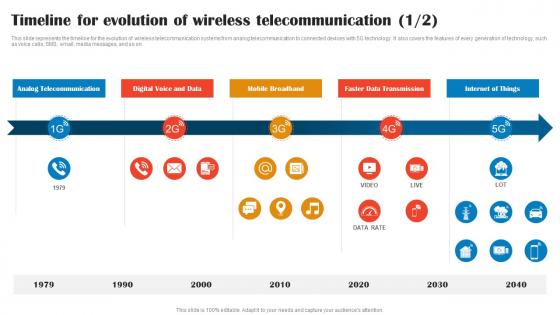
This slide represents the timeline for the evolution of wireless telecommunication systems from analog telecommunication to connected devices with 5G technology. It also covers the features of every generation of technology, such as voice calls, SMS, email, media messages, and so on.
People who downloaded this PowerPoint presentation also viewed the following :
Timeline For Evolution Of Wireless Telecommunication 1G To 5G Technology with all 7 slides:
Use our Timeline For Evolution Of Wireless Telecommunication 1G To 5G Technology to effectively help you save your valuable time. They are readymade to fit into any presentation structure.





FAQs for Timeline For Evolution Of Wireless Telecommunication 1G
Key technological advancements include radio wave transmission, antenna systems, signal modulation techniques, frequency management protocols, and digital encoding methods. These technologies revolutionized communication by enabling voice transmission without physical connections, supporting mobile networks across vast distances, and ultimately delivering seamless connectivity, with telecommunications companies finding that wireless infrastructure significantly reduces deployment costs while enhancing service reach.
The transition from analog to digital communication has revolutionized wireless telecommunication by enabling clearer voice quality, enhanced security, and greater spectrum efficiency. Digital systems deliver improved call capacity, seamless data integration, and advanced features like text messaging and mobile internet, with cellular networks, satellite communications, and emergency services experiencing significantly reduced interference, lower operational costs, and ultimately superior user experiences.
Satellites provide global coverage, backhaul connectivity, emergency communications, Internet of Things support, and broadband access to remote areas in modern wireless networks. Through advanced satellite constellations, telecommunications companies deliver seamless connectivity across continents, enable disaster recovery communications, and bridge digital divides, with many rural and maritime industries finding satellites essential for operational efficiency.
5G technology has revolutionized wireless telecommunication by delivering ultra-low latency, massive device connectivity, and network speeds up to 100 times faster than 4G. This advancement enables transformative applications across healthcare, manufacturing, and autonomous vehicles, with hospitals implementing remote surgeries, factories deploying smart sensors, and cities developing connected infrastructure, ultimately creating new revenue streams and competitive advantages.
Major challenges include limited infrastructure coverage, high deployment costs, low population density affecting ROI, challenging terrain for tower installation, and insufficient power grid access. These obstacles create significant barriers for providers, though many telecommunications companies are finding that government subsidies, satellite technology integration, and strategic partnerships with local utilities increasingly enable rural expansion while delivering essential connectivity services to underserved communities.
Wireless telecommunication has revolutionized global communication and commerce by enabling instant connectivity, mobile transactions, and real-time collaboration across continents. Through smartphones, 5G networks, and IoT systems, businesses streamline operations, enhance customer experiences, and access new markets seamlessly, with financial institutions, retail chains, and multinational corporations finding unprecedented opportunities for growth and competitive advantage.
IoT has fundamentally transformed wireless telecommunication by driving demand for low-power, wide-area networks, edge computing capabilities, and massive device connectivity standards like 5G and NB-IoT. This evolution enables telecommunications providers to support billions of connected devices across smart cities, industrial automation, and healthcare monitoring, ultimately delivering new revenue streams while enhancing network efficiency and service diversification.
Security concerns significantly influence wireless telecommunication technologies by driving enhanced encryption protocols, multi-factor authentication systems, and advanced threat detection mechanisms. These security requirements often increase implementation costs and complexity while necessitating regular updates, yet they ultimately deliver greater network reliability and user trust, with many telecommunications providers finding that robust security measures become competitive advantages in an increasingly connected business environment.
Spectrum management is the strategic allocation and regulation of radio frequencies to prevent interference while maximizing network efficiency and capacity. It enables multiple wireless services to coexist seamlessly, from cellular networks to satellite communications, with regulatory bodies ensuring optimal frequency distribution across telecommunications, broadcasting, and emergency services, ultimately delivering reliable connectivity and supporting technological advancement in an increasingly connected landscape.
The shift from GSM to LTE revolutionized mobile telecommunications by delivering significantly faster data speeds, enhanced network capacity, and superior multimedia capabilities. This evolution enabled seamless video streaming, real-time applications, and robust mobile internet experiences, with telecommunications providers finding that LTE infrastructure supports more concurrent users while delivering lower latency and improved service quality across diverse applications.
Consumer behavior has fundamentally shaped wireless telecommunication through demands for mobility, instant connectivity, multimedia capabilities, and seamless digital experiences across devices. These evolving expectations have driven innovations in data speeds, smartphone integration, mobile applications, and network coverage, with telecommunications companies continuously adapting infrastructure and services to meet increasingly sophisticated user preferences, ultimately delivering enhanced connectivity and competitive market positioning.
Environmental implications of expanding wireless telecommunication infrastructure include increased energy consumption from cell towers and data centers, electronic waste from equipment upgrades, electromagnetic field concerns, and land use changes for tower installations. While these challenges exist, many telecommunications companies are increasingly adopting renewable energy sources, implementing efficient cooling systems, and developing sustainable infrastructure designs, ultimately delivering both expanded connectivity and reduced environmental impact through strategic green technology integration.
Regulatory frameworks shape wireless telecommunication development by establishing spectrum allocation policies, safety standards, and infrastructure requirements that guide innovation pathways. Through coordinated frequency management and equipment certification processes, regulatory bodies like the FCC and ITU enable seamless global connectivity, faster technology rollouts, and standardized interoperability, ultimately delivering competitive advantages for telecommunications providers worldwide.
Future wireless telecommunication trends include 6G development, expanded IoT integration, edge computing advancement, satellite-internet convergence, and AI-driven network optimization. These technologies will revolutionize connectivity by enabling ultra-low latency applications, supporting billions of connected devices, and delivering seamless global coverage, with telecommunications companies finding that strategic investments in these areas ultimately provide significant competitive advantages in an increasingly connected marketplace.
Wireless telecommunication supports emergency response through satellite connectivity, mesh networks, mobile command centers, priority routing systems, and real-time location services. These technologies enable first responders to maintain communication during infrastructure failures, coordinate multi-agency operations, and deliver faster emergency services, with many disaster response organizations finding that wireless systems significantly enhance operational efficiency and ultimately save lives.
-
Satisfied with the way SlideTeam resolved my query regarding the right business PPTs that I was having difficulty finding. I found the perfect match with their assistance.
-
You know what? I'm so glad I opted for this PPT design. It has been a total game-changer for me and my presentations. Thank you!