


Advantages And Disadvantages Of Wireless Communications Mobile Communication Standards 1g To 5g




Try Before you Buy Download Free Sample Product
 Impress Your
 Audience
 100%
100% Editable
 Save Hours
 of Time


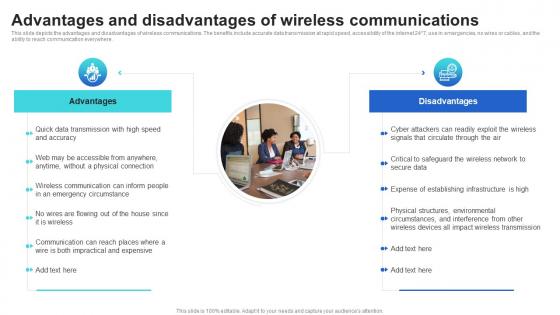
This slide depicts the advantages and disadvantages of wireless communications. The benefits include accurate data transmission at rapid speed, accessibility of the internet 24x7, use in emergencies, no wires or cables, and the ability to reach communication everywhere.
People who downloaded this PowerPoint presentation also viewed the following :
Advantages And Disadvantages Of Wireless Communications Mobile Communication Standards 1g To 5g with all 6 slides:
Use our Advantages And Disadvantages Of Wireless Communications Mobile Communication Standards 1g To 5g to effectively help you save your valuable time. They are readymade to fit into any presentation structure.





FAQs for Advantages And Disadvantages Of Wireless Communications Mobile Communication Standards
**INPUT**: What are the key differences between 4G and 5G wireless communication technologies? **OUTPUT**: Key differences include significantly faster speeds, ultra-low latency, enhanced device connectivity, improved network reliability, and advanced energy efficiency capabilities. These technologies enable organizations across healthcare, manufacturing, and financial services to streamline operations through real-time data processing, seamless IoT integration, and enhanced customer experiences, ultimately delivering competitive advantages in an increasingly connected business landscape. [Word count: 58 words]
Radio frequency interference disrupts wireless communication systems by causing signal degradation, increased error rates, and reduced data throughput through overlapping frequencies, electromagnetic noise, and competing transmissions. In crowded environments like hospitals, airports, and manufacturing facilities, organizations implement frequency planning, shielding techniques, and adaptive protocols to maintain reliable connectivity, ultimately ensuring operational continuity and seamless user experiences.
Modulation enhances wireless transmission quality by converting digital data into analog signals optimized for specific frequency bands, reducing interference, and maximizing bandwidth efficiency. Through advanced techniques like QAM and OFDM, telecommunications companies and broadcasting networks achieve clearer voice calls, faster data speeds, and more reliable connections, ultimately delivering superior user experiences in increasingly congested spectrum environments.
Environmental factors significantly impact wireless signal propagation through atmospheric absorption, terrain blocking, and weather-related interference that can cause signal attenuation, multipath fading, and coverage gaps. These challenges affect cellular networks, satellite communications, and IoT deployments across industries like telecommunications, agriculture, and transportation, with many organizations finding that strategic antenna placement, signal boosting technologies, and adaptive transmission systems help maintain reliable connectivity and minimize service disruptions.
Wireless communication security challenges include eavesdropping, data interception, unauthorized network access, signal jamming, and man-in-the-middle attacks. These vulnerabilities particularly impact sectors like banking, healthcare, and retail, where sensitive data transmission occurs frequently, with many organizations finding that implementing robust encryption, multi-factor authentication, and network monitoring ultimately delivers enhanced protection and competitive advantage.
MIMO techniques enhance wireless communication performance by using multiple antennas at both transmitter and receiver ends, enabling spatial multiplexing, diversity gains, and beamforming capabilities. These technologies streamline data transmission by increasing throughput, improving signal reliability, and reducing interference, with many telecommunications providers finding that MIMO ultimately delivers faster network speeds and enhanced coverage in increasingly demanding wireless environments.
Key advancements include 5G networks, Low Power Wide Area Networks (LPWAN), Wi-Fi 6, Bluetooth 5.0, and edge computing integration. These technologies enhance IoT deployment by delivering faster data transmission, extended device battery life, and improved network capacity, with manufacturing plants, smart cities, and healthcare facilities finding that seamless connectivity ultimately streamlines operations and reduces costs.
Li-Fi delivers significantly faster data transmission speeds and enhanced security compared to traditional Wi-Fi, using light waves instead of radio frequencies to eliminate electromagnetic interference. While Wi-Fi remains more versatile for widespread deployment, Li-Fi excels in hospitals, banks, and manufacturing facilities where security and speed are critical, ultimately offering organizations strategic advantages in data-sensitive environments.
Satellite communication in remote areas delivers global coverage, reliable connectivity, and rapid deployment capabilities, enabling essential services like telemedicine, education, and emergency response. While initial setup costs and latency present challenges, many remote communities and organizations find that satellite solutions ultimately provide cost-effective infrastructure alternatives, enhancing economic opportunities and bridging digital divides.
Network topologies significantly influence wireless communication efficiency through coverage optimization, bandwidth allocation, interference management, and routing protocols. Star topologies enhance centralized control in corporate WiFi networks, while mesh configurations improve reliability in smart city deployments and industrial IoT systems, ultimately delivering better signal quality, reduced latency, and enhanced scalability for organizations requiring robust connectivity.
Spectrum management is crucial for preventing interference, optimizing bandwidth allocation, and ensuring reliable communication across networks and devices. It enables telecommunications companies, government agencies, and enterprises to coordinate frequency usage efficiently, minimize signal conflicts, and maximize network capacity, ultimately delivering seamless connectivity and supporting the growing demand for wireless services in an increasingly connected landscape.
Software-defined networks enhance wireless communication by centralizing network control, enabling dynamic resource allocation, and automating traffic management through programmable interfaces. Through SDN controllers, telecommunications providers streamline network operations, reduce latency issues, and adapt bandwidth allocation in real-time, while minimizing infrastructure costs and ultimately delivering more reliable, scalable wireless services across diverse applications.
FCC regulations significantly influence wireless communication networks through spectrum allocation policies, infrastructure deployment guidelines, safety standards, and competition frameworks that drive innovation. These regulatory approaches enable faster network rollouts, enhanced security protocols, and broader accessibility across rural and urban markets, with telecommunications companies finding that compliance ultimately delivers competitive advantages and accelerated 5G implementation nationwide.
Artificial intelligence enhances wireless communication through machine learning algorithms, predictive analytics, network optimization, spectrum management, and adaptive beamforming technologies. These AI-driven systems enable telecommunications providers to automatically optimize network performance, predict maintenance needs, and deliver seamless connectivity, while significantly reducing operational costs and improving user experiences across increasingly complex network environments.
Mesh networking revolutionizes urban wireless communication by creating self-healing networks where devices automatically route data through multiple pathways, eliminating single points of failure. This distributed approach enables cities to deliver more resilient internet access, reduce infrastructure costs, and enhance emergency communications, with municipalities increasingly finding that mesh networks provide comprehensive coverage while minimizing traditional cellular dependencies.
-
“Easy to use. I always wanted to have a quick search for products and SlideTeam has helped me have it.”
-
Their professional templates are very impressive, even my manager was curious about the source. I am very grateful.