

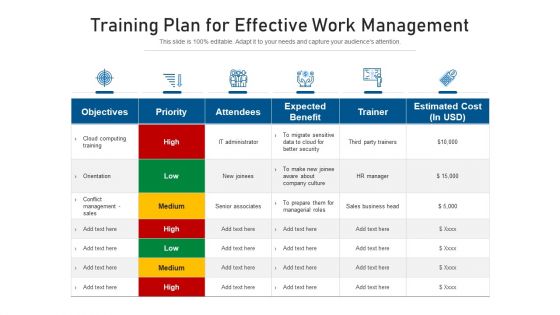
Training plan for effective work management




Try Before you Buy Download Free Sample Product
 Impress Your
 Audience
 100%
100% Editable
 Save Hours
 of Time


Our Training Plan For Effective Work Management are topically designed to provide an attractive backdrop to any subject. Use them to look like a presentation pro.
People who downloaded this PowerPoint presentation also viewed the following :
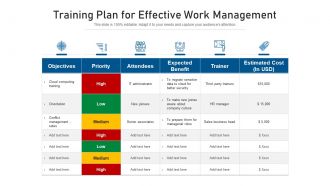
Training plan for effective work management with all 2 slides:
Use our Training Plan For Effective Work Management to effectively help you save your valuable time. They are readymade to fit into any presentation structure.

FAQs for Training plan for
Start with having them figure out what's actually breaking down in their current system - like a quick self-assessment thing. Then hit the basics: time management, how to prioritize without losing your mind, goal-setting that actually works. Delegation is huge too (most people suck at it honestly). Cover some project planning fundamentals and team communication stuff. The part everyone gets pumped about is the tech tools - but teach them to USE the software properly, not just click around aimlessly. Oh, and definitely include stress management. Boundaries matter because burnout will wreck everything else you're trying to build.
Honestly, you need both the numbers and the feelsy stuff to really know if it worked. Check if people are actually hitting deadlines better and finishing projects on time. But also - and this is huge - survey your team about whether they feel more confident juggling their workload. I'd watch for fewer panicked Slack messages too (you know the ones). Track maybe 3-4 things over 90 days after training. Don't just assume it helped because everyone attended. The before/after comparison is what'll actually tell you if you didn't waste everyone's time.
Honestly, tech tools are game-changers for managing work better. Project dashboards show you exactly what's happening instead of you flying blind. Automation handles all the tedious stuff nobody wants to do anyway. I love how collaboration platforms cut out those nightmare email threads - you know the ones where you're scrolling forever to find one detail. The trick is finding tools that click with how you actually think, not just grabbing whatever's popular right now. Workflow tools also train your brain to see patterns in how work moves around. Start small though - pick one thing and get good at it first.
So basically work management training gets everyone on the same page with how you handle projects. Your team learns frameworks for setting clear expectations and delegating without chaos. But honestly? The biggest win is just getting people to actually communicate instead of hiding in their little corners all day. Once you have regular check-ins and decent communication tools, you catch problems way earlier. Projects don't derail as much. I'd probably start with whatever your team struggles with most - like maybe everyone's terrible at deadlines or something.
Honestly, the worst part is getting totally overwhelmed by all the productivity apps and systems out there. Like, there's *so* many options that you just freeze up trying to find the "right" one. Plus your brain fights you hard at first - old habits die slowly, you know? Don't expect magic overnight either. I learned that the hard way when I tried organizing my entire life in one weekend (spoiler: it didn't work). Start stupidly small instead. Pick literally one thing and do it for three weeks straight. Once that feels automatic, then you can add more stuff. Trust me on this one.
Honestly, customized training is so much better because it actually fixes your real problems. Instead of sitting through some boring generic course, you work with trainers who figure out what's actually broken - like those project bottlenecks that drive everyone crazy or communication issues. They'll build scenarios using your actual workflows and tools. Way more useful than theoretical stuff, you know? Find trainers who'll design around your specific mess rather than shoving you into their cookie-cutter program. Start by listing what's driving you nuts right now, then look for people who get your industry and team size.
Honestly, just ditch the lecture format - it's death by PowerPoint. Get them working with real scenarios from your company instead of those boring generic case studies. Every 10 minutes or so, throw in polls or quick breakouts before people start scrolling their phones. Give them actual templates they can steal and use with their teams tomorrow. The role-playing stuff works great too - have them practice dealing with scope creep or when resources get pulled. Oh, and definitely make each person pick one thing they'll try in the next week. Otherwise they'll just forget everything by Friday.
First figure out what your company actually needs to hit this year - better efficiency, lower costs, happier customers, whatever. Design the training around those specific goals instead of some cookie-cutter program. So if you're trying to speed up deliveries, focus on scheduling and finding bottlenecks rather than random productivity stuff. Honestly, most companies skip this step and wonder why training doesn't stick. Track metrics that actually matter to your business priorities too. Every module should connect back to what you're trying to achieve - otherwise you're just wasting everyone's time.
Hey! So from what I've seen, most companies get around 15-25% productivity bumps in the first few months after work management training. People finally learn to prioritize properly instead of just spinning their wheels on busy work. The collaboration stuff gets way better too - everyone's actually talking about deadlines and who needs what from who. Honestly, the biggest game-changer is teaching folks to focus on high-impact tasks rather than just checking boxes all day. My advice? Start with whatever teams are your biggest pain points right now. Those are the ones where you'll see the most dramatic results. Makes sense to go where the problems are worst first.
Mix it up with hands-on stuff - have them actually walk through real work processes and build project timelines. I love throwing in those tricky "what would you do if..." scenarios because honestly, that's where you see who really gets it. Pre/post assessments are fine I guess, but watching them apply this stuff back at their desks tells you way more. The real test? Check in after 30 and 60 days to see if they're still using what you taught them or if it all went out the window when things got crazy.
So there's basically three big things happening right now with work training. Micro-learning is huge - you know, those short modules you can knock out in like 15 minutes instead of sitting through endless seminars. Also, everyone's cramming AI tools into their programs because honestly, you kinda have to at this point. The other shift is personalized learning that actually fits your job instead of generic stuff. Oh, and I forgot - flexibility is everything now. People want training they can do around their actual schedule, not some rigid curriculum that pretends we all work the same way.
Oh totally, you've gotta match how people actually learn. Visual people need charts and dashboards - they want to *see* the workflow connections. For auditory learners, do discussions and walk through scenarios out loud. Kinesthetic learners are honestly the hardest with this topic, but they need to actually click through systems and mess around with the tools themselves. Mix all three approaches though. PowerPoint alone will put half your people to sleep. Throw in demos, breakout groups, and hands-on practice time. That way everyone gets something that clicks for them.
Mix hands-on stuff with digital demos - that's what actually works. Show them Asana or Trello so they can click around themselves. Case study worksheets are honestly my favorite because people get into the problem-solving aspect. For workflow mapping, sticky notes beat fancy tech every time (trust me on this). Video tutorials are clutch too since everyone wants something to reference later. Just don't go crazy with too many tools at once. Pick maybe 2-3 max or you'll lose them. Build up from there once you see what clicks with your group.
Okay so first thing - schedule those manager check-ins before people even walk out of training. Monthly works at the start, then scale back to quarterly. Also get a buddy system going because honestly? People learn way better from each other than some formal help desk. Quick reference guides are clutch too - nobody wants to dig through a 50-page manual when they're stuck. Oh and definitely pick someone to be the "ask me anything" person, whether that's your trainer or someone internal. The peer mentoring thing is huge though, I can't stress that enough.
So work management training is actually great for building leadership skills - you'll learn how to prioritize and delegate without micromanaging everyone. The communication part is huge too, like setting clear expectations so people aren't constantly asking "wait, what did you want again?" Honestly, juggling multiple deadlines will teach you patience faster than anything else I know. You also get conflict resolution skills and learn how to give feedback that doesn't make people hate you. Oh, and all that planning stuff? It really does make you a better strategic thinker. Just start small with one project and work your way up.
-
Topic best represented with attractive design.
-
Editable templates with innovative design and color combination.
-
Excellent work done on template design and graphics.