

Key steps for creating effective employee training program plan





Try Before you Buy Download Free Sample Product
 Impress Your
 Audience
 100%
100% Editable
 Save Hours
 of Time


Our Key Steps For Creating Effective Employee Training Program Plan are explicit and effective. They combine clarity and concise expression.
People who downloaded this PowerPoint presentation also viewed the following :
Content of this Powerpoint Presentation
Description:
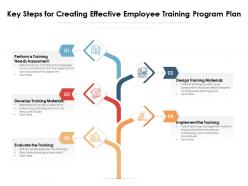
The image presented is a structured infographic outlining the "Key Steps for Creating Effective Employee Training Program Plan." It is a blueprint intended to aid organizations in developing a systematic approach toward employee training and development. The image is color-coded and contains five primary sections, each with a sequential number, icon, and description of the steps involved in the creation of a training program.
1. Perform a Training Needs Assessment:
The infographic's first step emphasizes the importance of defining the necessary activities employees need to perform to meet organizational objectives. This involves a thorough analysis to identify skills gaps and training needs.
2. Design Training Materials:
The second step emphasizes the creation of content and assessments that align with the employees' learning objectives, ensuring that training materials are both relevant and practical.
3. Develop Training Materials:
This step focuses on making materials for hands-on elements and mentions the use of "E-learning authoring tools such as Articulate Studio," which are platforms for creating online courses and educational programs.
4. Implement the Training:
The fourth section refers to the operational phase of training, recommending the use of learning management systems (LMS) to automate administrative tasks, scheduling, and communication regarding the training process.
5. Evaluate the Training:
Finally, the infographic suggests assessing the effectiveness of the training program by soliciting feedback from participants, measuring if the training goals were achieved, and determining whether the business objectives were supported by the training.
Use Cases:
These depicted steps are applicable across various industries as follows:
1. Technology:
Use: To ensure that technical staff keeps pace with rapid advancements in software and hardware.
Presenter: Training managers or IT department leads.
Audience: Software engineers, development teams, and IT support staff.
2. Healthcare:
Use: For compliance, patient care procedures, and updates on healthcare regulations.
Presenter: Clinical trainers or compliance officers.
Audience: Doctors, nurses, and hospital administrative staff.
3. Manufacturing:
Use: For operational safety training and skill enhancement in production methods.
Presenter: Safety officers or operations managers.
Audience: Production line workers, quality assurance teams, and maintenance personnel.
4. Education:
Use: For professional development of educators and administrative staff.
Presenter: Professional development coordinators or academic leaders.
Audience: Teachers, school counselors, and university staff.
5. Hospitality:
Use: For customer service excellence and operational training.
Presenter: HR trainers or hospitality managers.
Audience: Front desk employees, housekeeping, and service staff.
6. Retail:
Use: For sales training, customer service skills, and product knowledge enhancement.
Presenter: Corporate trainers or store managers.
Audience: Sales associates, cashiers, and store supervisors.
7. Finance:
Use: For regulatory compliance, new financial product updates, and customer service.
Presenter: Compliance trainers or financial product experts.
Audience: Bank tellers, financial advisors, and customer service representatives.
Key steps for creating effective employee training program plan with all 2 slides:
Give your audience a fulfilling experience. They will find our Key Steps For Creating Effective Employee Training Program Plan elevating.

FAQs for Key steps for creating effective employee
So first thing - figure out what skills your team actually lacks, then build from there. You'll want clear objectives and content that hits different learning styles. Hands-on practice is huge, honestly can't stress that enough. Oh and do a pre-assessment! Sounds boring but it really shows you where everyone's starting from. Mix up your delivery - online, in-person, whatever works. Regular feedback keeps people engaged. The whole thing needs to connect to their real job though, otherwise they'll just zone out. Post-training eval helps you see if it actually worked.
Honestly, start with a skills gap analysis for each department - compare what people can do versus what they actually need to do. Survey managers AND employees because they'll spot totally different issues. Performance reviews are pure gold for this kind of thing. Also check productivity numbers, error rates, customer complaints - you'd be surprised what patterns show up. Don't just wing it based on assumptions though. Once you've got real data, rank everything by business impact and build training plans around each department's actual needs instead of generic stuff.
Honestly, you gotta look at both the hard numbers and the touchy-feely stuff. Completion rates and test scores are obvious ones. But also check if people are actually performing better on the job after training - that's what really matters, right? Employee satisfaction surveys tell you a lot too. Oh, and don't just measure right after training ends. Check back in like 3-6 months to see if they retained anything. My biggest tip? Pick maybe 3-4 metrics max that actually tie to your goals. Otherwise you'll drown in data and still not know if the training worked.
Honestly, tech can totally transform your training programs. Learning management systems are clutch for tracking who's doing what and customizing content for different people. Video training is great because everyone can go at their own speed - no more sitting through boring group sessions if you already know the stuff. Mobile apps are probably the biggest game-changer since your team can literally train anywhere. VR simulations are getting really impressive for hands-on skills too, though they're still kinda pricey. The analytics are super helpful - you'll see exactly who needs extra help. I'd start with whatever tool fixes your biggest headache first, then expand from there.
Honestly, you can't skip employee feedback if you want training that actually works. Before you build anything, ask what skills they're missing. During the program, check if it makes sense - I've watched so many trainings bomb because nobody spoke up about confusing content. After it's done? Get their honest thoughts. The thing is, you can create the prettiest program ever, but if people are saying "this is useless," you're just burning money. Set up regular ways for them to give input, then actually use what they tell you. Don't just collect feedback and ignore it - that's worse than not asking at all.
Honestly, most companies mess this up because they skip the obvious first step - actually figuring out what they're trying to accomplish. Map your training directly to those business goals. Want better customer satisfaction? Focus on communication skills and product knowledge instead of some random leadership stuff. I'd definitely check in with department heads regularly so you're not just doing training because... well, because you're supposed to. Here's the thing though - measure what actually impacts your bottom line, not just who showed up. Will this training actually change anything that matters?
Dude, you should totally do the soft skills training thing. Communication and emotional intelligence are what make employees actually worth keeping around - way more than just technical stuff. Your managers will thank you because they won't be stuck mediating petty office drama all the time (been there, it sucks). Start with basic communication and conflict resolution. The engagement scores go up, people work together better, and honestly? Customer satisfaction improves too. Oh, and turnover drops which saves you money in the long run. You'll probably notice a difference pretty fast once people stop being weird with each other.
Survey your team first to see what they actually prefer. Mix up the formats - visual people need charts and videos, auditory learners want discussions or podcasts. Hands-on folks (honestly my favorite to train) need role-playing and simulations. Don't forget the note-takers who love written materials. Here's the thing though - don't box people into one style. Each training should hit 2-3 different approaches. Like, cover a topic with a quick video, then do a group exercise, plus give them something to reference later. Way more effective than just PowerPoint death.
Ditch the PowerPoint marathon - seriously, that's the fastest way to lose everyone. Get people actually doing stuff instead: breakouts, role-playing, real scenarios they deal with daily. Ask them upfront what they're struggling with, then build around that. I've seen too many trainings that felt totally disconnected from actual work. Gamification can work if your team's into it, but don't force it. The magic happens when people see how this stuff helps them right now, not in some theoretical future. Oh, and keep checking in - what's working? What isn't?
Honestly, at least once a year but some stuff needs way more attention. Tech training? Maybe every 6 months because everything's constantly changing. Compliance too - regulations are always shifting. Leadership and soft skills can probably wait a full year though. I'd set quarterly reminders to actually look at your content and see what's getting stale. Oh, and definitely ask people for feedback after sessions - they'll tell you when something feels outdated or irrelevant. Really depends on your industry too. Some move faster than others, you know?
Honestly, you've got some pretty good budget-friendly options here. Loom's great for recording quick training videos - people can rewatch the confusing parts. Coursera for Business has decent bulk rates if you want something more polished. But here's the thing: peer mentoring costs almost nothing and sometimes works better than fancy courses anyway. Webinars are solid too since you're hitting multiple people at once. Oh, and don't sleep on recorded Zoom sessions - super easy and free if you've already got the platform. I'd pick one thing first and see how your team responds before going all-in.
Just pair new people with your experienced folks right from day one - way easier than building some whole separate thing. Have the mentor actually shadow them during real work, not just sit around talking theory. Coffee chats are nice but you need actual structure and goals or it's basically useless. Train your mentors first though (seriously, being good at your job doesn't automatically make you a good teacher). Do regular check-ins to keep things on track. I'd honestly start with like 5-10 people as a test run before rolling it out everywhere - trust me on this one.
Honestly, budget's always the first headache. Getting people to actually show up and care? That's another beast entirely. Everyone's calendars are already insane, so good luck finding time slots that work. Plus people genuinely hate change - even when it's obviously beneficial, they'll find ways to resist it. Tech integration can get messy too, especially if your systems are from like 2015. Most companies are absolutely horrible at measuring if training actually does anything useful afterward. Leadership sometimes needs convincing if they can't see quick results. Start with a small test group though - their wins will sell the program way better than any presentation you could make.
Oh man, this is so true from experience! What crushes it in the US can totally bomb elsewhere. Like, that direct fast-paced style Americans love? Japanese teams think you're being rude and skipping the whole consensus thing. Some cultures are all about storytelling and group talks, others want you to just tell them what to do step-by-step. I honestly messed this up badly during our global launch last year - whoops. Time zones are a nightmare too. Plus language barriers and whatever local rules they've got. Survey your teams first about how they actually like to learn. Trust me, don't wing it like I did.
Honestly, three main things to watch out for. First, consent and fairness - don't let your training materials reinforce crappy stereotypes, and actually get permission before collecting people's data. Also, remember everyone learns differently, so don't force participation in weird role-playing stuff that makes people uncomfortable. I made that mistake once! Keep everything tied to actual job skills instead of pushing company culture that crosses lines. Oh, and respect boundaries - some people just aren't into certain activities and that's totally valid. Create a space where people can actually learn without feeling judged or excluded.
No Reviews