


Types Of Customer Segmentation And Profiling Guide For Customer Journey Mapping Through Market Mkt Ss




Try Before you Buy Download Free Sample Product
 Impress Your
 Audience
 100%
100% Editable
 Save Hours
 of Time


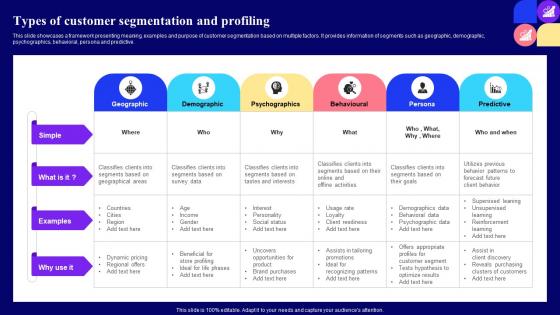
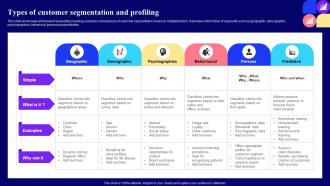
This slide showcases a framework presenting meaning, examples and purpose of customer segmentation based on multiple factors. It provides information of segments such as geographic, demographic, psychographics, behavioral, persona and predictive.
People who downloaded this PowerPoint presentation also viewed the following :
Types Of Customer Segmentation And Profiling Guide For Customer Journey Mapping Through Market Mkt Ss with all 6 slides:
Use our Types Of Customer Segmentation And Profiling Guide For Customer Journey Mapping Through Market Mkt Ss to effectively help you save your valuable time. They are readymade to fit into any presentation structure.





FAQs for Types Of Customer Segmentation And Profiling Guide For Customer Journey Mapping Through
Primary customer segmentation methods include demographic analysis, behavioral tracking, psychographic profiling, geographic targeting, and value-based categorization. These approaches enable marketers to create tailored campaigns by analyzing purchase patterns, lifestyle preferences, and regional characteristics, with many retail and financial services companies finding that strategic segmentation delivers higher conversion rates and improved customer lifetime value.
Businesses effectively identify customer segments through demographic analysis, behavioral data tracking, purchasing pattern evaluation, psychographic profiling, and geographic segmentation studies. Through advanced analytics tools, companies streamline market research, enhance targeted marketing campaigns, and optimize product development strategies, while retail and financial services organizations find that precise segmentation ultimately delivers improved customer experiences and increased revenue conversion rates.
Data analytics enhances customer segmentation by analyzing purchase patterns, demographic data, behavioral insights, transaction histories, and engagement metrics to identify distinct customer groups. Through advanced analytics tools, organizations can create more precise segments, predict customer preferences, and personalize marketing approaches, ultimately delivering targeted campaigns and improved customer experiences while maximizing revenue potential.
Demographic segmentation enables marketers to customize messaging, channels, and product positioning by analyzing age, income, education, and lifestyle patterns within target audiences. Through targeted campaigns, companies can deliver personalized content that resonates with specific groups, ultimately increasing conversion rates and customer engagement while optimizing marketing spend across diverse demographic profiles.
Behavioral segmentation challenges include data collection complexity, changing consumer patterns, resource-intensive analysis, integration difficulties across platforms, and maintaining segment accuracy over time. Organizations overcome these through advanced analytics tools, real-time data processing, and automated tracking systems, with many retailers and financial services finding that strategic technology investments ultimately streamline segmentation processes while delivering more personalized customer experiences.
Psychographic segmentation analyzes consumer attitudes, values, lifestyle preferences, and behavioral motivations, while demographic approaches focus on basic statistical characteristics like age, income, gender, and location. This deeper psychological insight enables companies to create more personalized marketing strategies, targeted product development, and compelling brand messaging that resonates emotionally with specific customer mindsets, ultimately delivering higher engagement rates and stronger brand loyalty than traditional demographic targeting alone.
Customer segmentation tools include CRM platforms like Salesforce and HubSpot, analytics software such as Google Analytics and Adobe Analytics, specialized solutions like Segment and Mixpanel, and statistical tools including R and Python. These platforms streamline segmentation by automating data collection, enabling advanced statistical modeling, and providing visualization capabilities, with many organizations finding that integrated analytics approaches deliver deeper customer insights and more targeted marketing strategies.
Small businesses can implement customer segmentation through free analytics tools like Google Analytics, social media insights, email platform data, and simple customer surveys. These approaches enable targeting specific demographics, purchase behaviors, and preferences without expensive software, with many small retailers finding that basic segmentation through existing channels significantly improves marketing effectiveness and customer engagement.
Customer segmentation significantly influences product development by enabling companies to create targeted solutions for specific user groups, prioritize features based on segment needs, and allocate resources more strategically. Through detailed segment analysis, organizations streamline innovation processes, reduce development costs, and accelerate time-to-market, with many finding that segment-driven products deliver higher adoption rates and customer satisfaction.
Companies ensure segmentation relevance through regular data analysis, continuous customer feedback collection, market trend monitoring, and periodic strategy reviews. By leveraging advanced analytics, conducting quarterly assessments, and integrating real-time behavioral data, organizations can adapt their approaches dynamically, with many retail and financial services companies finding that flexible segmentation frameworks ultimately deliver sustained competitive advantage and improved customer experiences.
Amazon, Netflix, Spotify, Starbucks, and Nike exemplify successful customer segmentation through personalized recommendations, targeted content delivery, and tailored marketing campaigns. These companies leverage advanced analytics and behavioral data to create highly specific customer segments, ultimately delivering enhanced user experiences, increased customer loyalty, and significantly improved conversion rates across their diverse customer bases.
Customer segmentation significantly influences pricing strategies by enabling businesses to tailor prices based on customer value perception, purchasing power, and price sensitivity across different segments. Through targeted segmentation, companies can implement premium pricing for high-value segments, competitive pricing for price-sensitive groups, and value-based pricing for loyalty-focused customers, ultimately maximizing revenue while maintaining market competitiveness.
Customer segmentation raises ethical considerations including data privacy protection, consent transparency, avoiding discriminatory profiling, ensuring algorithmic fairness, and preventing exclusionary practices. These principles help organizations build trust while delivering personalized experiences, with many companies finding that ethical segmentation approaches ultimately enhance customer relationships and brand reputation in an increasingly privacy-conscious marketplace.
AI and machine learning enhance customer segmentation by analyzing vast datasets, identifying complex behavioral patterns, and predicting future customer actions with unprecedented accuracy. These technologies enable businesses to create hyper-personalized segments in real-time, with retailers and financial services finding that automated segmentation delivers improved targeting, higher conversion rates, and ultimately stronger customer relationships.
Key metrics for measuring customer segment effectiveness include customer lifetime value, acquisition cost, retention rates, purchase frequency, and average order value. These metrics enable businesses to identify high-performing segments, optimize resource allocation across different customer groups, and refine targeting strategies, with many organizations finding that segments with higher lifetime value and lower acquisition costs deliver the strongest long-term profitability and growth.
-
Great combination of visuals and information. Glad I purchased your subscription.
-
SlideTeam makes creating presentations easy. Unlimited products, premium quality designs and affordable.