

Customer Segmentation Map Marketing Best Practice Tools And Templates




Try Before you Buy Download Free Sample Product
 Impress Your
Audience
 100%
Editable
 Save Hours
of Time


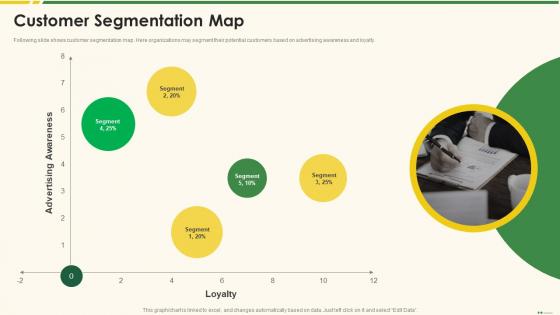
Following slide shows customer segmentation map. Here organizations may segment their potential customers based on advertising awareness and loyalty.
People who downloaded this PowerPoint presentation also viewed the following :
Customer Segmentation Map Marketing Best Practice Tools And Templates with all 6 slides:
Use our Customer Segmentation Map Marketing Best Practice Tools And Templates to effectively help you save your valuable time. They are readymade to fit into any presentation structure.






FAQs for Customer Segmentation Map Marketing Best Practice
Customer segmentation delivers enhanced marketing effectiveness, improved customer retention, optimized resource allocation, increased revenue per customer, and better product development alignment. Through targeted campaigns and personalized experiences, businesses streamline their marketing spend while maximizing conversion rates, with many retail and financial services companies finding that segmented approaches increase customer lifetime value significantly.
Data analytics enhances customer segmentation by analyzing behavioral patterns, purchase histories, demographic data, and engagement metrics to create precise customer groups. Through advanced analytics tools, businesses can identify micro-segments, predict customer lifetime value, and personalize marketing strategies more effectively, with retailers and financial services finding that data-driven segmentation increases conversion rates and customer satisfaction significantly.
Common customer segmentation methods include demographic analysis, behavioral tracking, geographic mapping, psychographic profiling, and value-based categorization. These approaches enable businesses to streamline marketing efforts, enhance customer experiences, and optimize resource allocation, with many retail and financial services organizations finding that strategic combinations deliver significantly higher conversion rates and competitive advantage.
Customer demographics influence segmentation strategies by providing foundational data for age-based targeting, income-level categorization, geographic preferences, education-focused messaging, and lifestyle alignment approaches. These demographic insights enable organizations to streamline marketing campaigns, enhance product positioning, and deliver personalized customer experiences, with many retail and financial services companies finding that demographic-driven segmentation ultimately delivers higher conversion rates and stronger customer loyalty.
Behavioral segmentation analyzes customer actions like purchase history, website interactions, and product usage patterns, while psychographic segmentation focuses on attitudes, values, lifestyle preferences, and personality traits. While behavioral data reveals what customers do through transaction records and engagement metrics, psychographic insights explain why they act by examining motivations and beliefs, with many retailers combining both approaches to create comprehensive customer profiles that drive more targeted marketing campaigns and ultimately deliver higher conversion rates.
Customer feedback provides critical insights that refine segmentation strategies by revealing actual customer preferences, pain points, purchasing behaviors, and satisfaction levels across different segments. Through surveys, reviews, and direct interactions, businesses can validate their segmentation assumptions, identify emerging customer needs, and adjust their targeting approaches, ultimately enhancing personalization and improving customer experiences while driving higher conversion rates.
Machine learning enhances customer segmentation by analyzing vast datasets, identifying hidden patterns, and creating dynamic segments that adapt to changing behaviors. Through predictive algorithms, businesses can develop highly targeted marketing strategies, personalize customer experiences, and optimize resource allocation, with retail and financial services companies finding significantly improved conversion rates and customer lifetime value.
Companies face challenges including data quality issues, integration across multiple systems, resource allocation for implementation, and maintaining segment relevance over time. These obstacles often arise in retail, financial services, and healthcare organizations, where fragmented customer data and evolving preferences create complexity, though strategic segmentation ultimately delivers enhanced targeting and competitive advantage.
Segmentation enables personalized marketing by dividing customers into distinct groups based on demographics, behavior, preferences, and purchase history, allowing targeted messaging for each segment. This strategic approach helps retailers customize email campaigns, banks tailor loan offers, and healthcare providers deliver relevant wellness programs, ultimately increasing engagement rates, conversion effectiveness, and customer satisfaction while reducing marketing costs.
Businesses should track conversion rates, customer lifetime value, engagement metrics, revenue per segment, and retention rates to evaluate segmentation effectiveness. These metrics enable organizations to identify high-performing segments, optimize marketing spend allocation, and refine targeting strategies, with many companies finding that well-measured segmentation delivers significantly improved ROI and enhanced customer experiences.
Customer segmentation significantly enhances customer retention rates by enabling personalized marketing strategies, targeted product recommendations, customized communication approaches, and tailored loyalty programs that address specific customer needs and preferences. Through strategic segmentation, companies deliver more relevant experiences, reduce churn by 15-25%, and increase customer lifetime value, with many retail and financial services organizations finding that segmented campaigns ultimately drive stronger emotional connections and long-term customer relationships.
Small businesses can effectively segment customers using free analytics tools like Google Analytics, social media insights, and basic survey platforms, while leveraging existing sales data and customer feedback. These cost-effective approaches enable targeted marketing through email campaigns, social media advertising, and personalized content, with many small retailers finding that simple demographic and behavioral segmentation significantly improves conversion rates and customer retention.
Amazon uses purchase history and browsing behavior for personalized recommendations, Netflix segments viewers by content preferences for targeted suggestions, and Starbucks leverages location and purchase data for customized offers through their app. These strategic segmentation approaches streamline marketing efforts, enhance customer experiences, and deliver significant revenue increases, with many retailers finding that personalized targeting boosts conversion rates by 10-15%.
Customer segmentation tools include CRM platforms like Salesforce and HubSpot, analytics software like Google Analytics and Adobe Analytics, specialized tools like Segment and Klaviyo, and statistical software like R and SPSS. These technologies streamline data collection, automate clustering analysis, and deliver actionable insights, with many retail and financial services organizations finding that integrated platforms enhance targeting precision while reducing manual analysis time.
Customer segmentation evolves through continuous data analysis, behavioral tracking, demographic shifts, psychographic changes, and real-time market monitoring. Organizations increasingly leverage advanced analytics and AI-driven insights to identify emerging patterns, with retail and financial services companies finding that dynamic segmentation approaches enable more personalized experiences, improved targeting accuracy, and stronger competitive positioning in rapidly changing markets.
-
Excellent work done on template design and graphics.
-
Nice and innovative design.